AI bias for small businesses: how flawed models affect operations
Machine learning models absorb human prejudice from training data, turning historical patterns into automated operational errors.

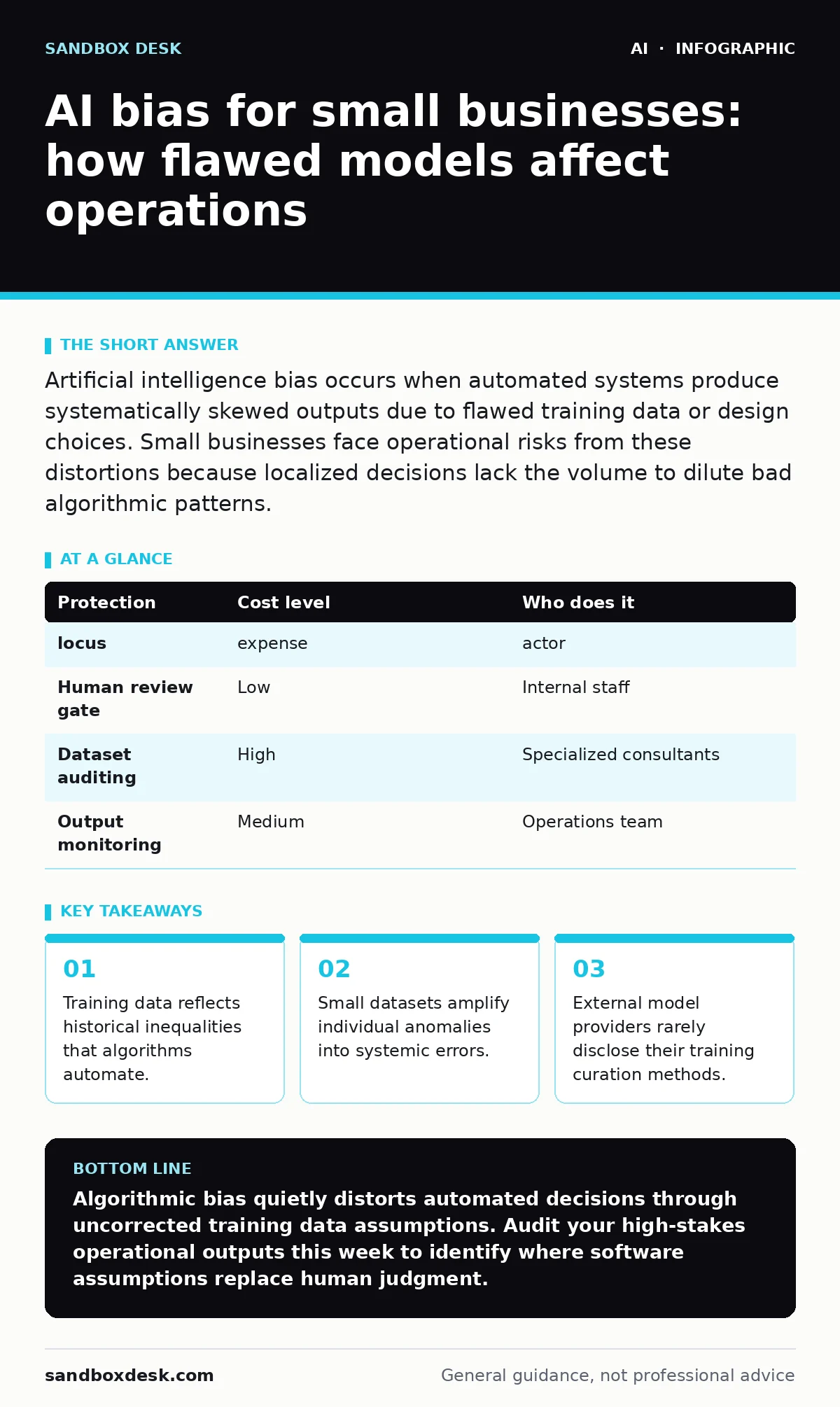
Artificial intelligence bias occurs when automated systems produce systematically skewed outputs due to flawed training data or design choices. Small businesses face operational risks from these distortions because localized decisions lack the volume to dilute bad algorithmic patterns.
Why algorithmic skew threatens small operations
Machine learning models absorb human prejudice from training data, turning historical patterns into automated operational errors. Small organizations assume software neutrality protects them from human prejudice. Statistical models lack intent, meaning they simply mirror the correlations present in their training inputs. When you deploy these tools without understanding their provenance, you inherit every uncorrected distortion embedded in the underlying mathematics.
How small datasets amplify systemic errors
Small sample sizes hide statistical anomalies that larger organizations easily absorb through sheer operational volume. Data skew happens when the information fed to an algorithm fails to represent the target population accurately. Large enterprises possess millions of internal records to retrain models locally. Your business likely relies on commercial software trained on generic public datasets that ignore your specific regional or niche market realities.
The mathematics behind neural networks rely on probability distributions that penalize minority categories. Rare customer profiles or atypical operational conditions get treated as noise and filtered out. You receive confident, automated decisions that systematically fail your edge cases because the underlying model optimized for the majority average. This dynamic makes fine-tuning necessary for adapting generic models to localized business contexts without inheriting blind spots.
Where hidden training assumptions create liability
Automated decision tools rely on proxy variables that recreate discriminatory outcomes without using protected attributes directly. Proxy discrimination occurs when an algorithm uses seemingly neutral criteria, such as vocabulary choice or shopping history, to reproduce demographic splits. Your business remains legally responsible for the final output regardless of whether third-party software generated the recommendation.
Regulatory frameworks hold organizations accountable for the decisions they execute, not just the intent behind their tool selection. Relying on commercial software does not transfer compliance liability away from your operations. Understanding these risks requires treating AI models as untrusted insiders within your organizational architecture.
Practical mitigation steps for limited resources
Mitigating algorithmic distortion requires deliberate intervention in your operational workflows rather than passive reliance on vendor promises.
- Audit every automated output that affects hiring, credit assessment, or customer pricing.
- Maintain human review gates for high-stakes decisions before final execution.
- Document all operational exceptions where the model's recommendation contradicts human judgment.
- Rotate test prompts regularly to detect shifting output patterns over time.
Human oversight remains the primary defense against systemic algorithmic failure. Software cannot evaluate its own fairness because it lacks an independent standard of equity. You must supply that standard by questioning automated recommendations that diverge from established operational fairness.
Managing software supply chain opacity
Commercial artificial intelligence tools arrive as black boxes with zero visibility into their training provenance. Model opacity prevents developers from inspecting the exact correlations driving a specific automated decision. Vendors protect their intellectual property by withholding training datasets, leaving you unable to verify whether the underlying data reflects your customer base.
| Protection | Cost level | Who does it |
|---|---|---|
| locus | expense | actor |
| Human review gate | Low | Internal staff |
| Dataset auditing | High | Specialized consultants |
| Output monitoring | Medium | Operations team |
Evaluating external models requires treating them with the same scrutiny applied to human contractors with unknown credentials. You must implement continuous monitoring to catch discriminatory drifts before they impact your brand reputation or trigger regulatory penalties.
See also: How Tabletop Exercises Work: Step-by-Step Mechanism and Limits · Security Culture Survey: How to Measure Behavior and Fix It
What to ask your technology vendor
Procuring software tools requires targeted interrogation of vendor claims regarding algorithmic fairness and data provenance.
- What specific demographic groups were represented in the primary training dataset?
- How do you test your models for disparate impact across regional markets?
- Can we adjust the decision thresholds to prioritize false negatives over false positives?
- What mechanisms exist to contest or explain automated rejections?
Vendors often market their tools as objective arbiters of efficiency while disclaiming liability for skewed outcomes in their user agreements. Push past marketing language to demand technical specifics about how the model handles minority classes and edge cases.
Key takeaways
- Training data reflects historical inequalities that algorithms automate.
- Small datasets amplify individual anomalies into systemic errors.
- External model providers rarely disclose their training curation methods.
Algorithmic bias quietly distorts automated decisions through uncorrected training data assumptions. Audit your high-stakes operational outputs this week to identify where software assumptions replace human judgment.
Frequently asked questions
Can small businesses sue AI vendors for biased outputs?
Vendor contracts typically include broad liability disclaimers that shift legal responsibility for automated decisions onto the end user.
Do open-source models suffer from less bias than proprietary systems?
Open-source models often exhibit similar or greater algorithmic skew because they rely on scraped internet data without commercial curation budgets.
How often should an operational model be audited for fairness?
Audits should occur whenever training data updates or at least quarterly to catch drift in automated decision patterns.
Does removing demographic data from training inputs prevent bias?
Removing protected attributes fails to eliminate bias because machine learning models simply learn substitute proxies that recreate demographic splits.
How this guide was produced: written by the Sandbox Desk editorial team with AI assistance, checked against the public references listed below, and reviewed when the facts change. See our editorial policy or report an error.