What causes gen ai hallucinations and how to fix them
Generative artificial intelligence models invent falsehoods because they predict token sequences rather than factual truths.

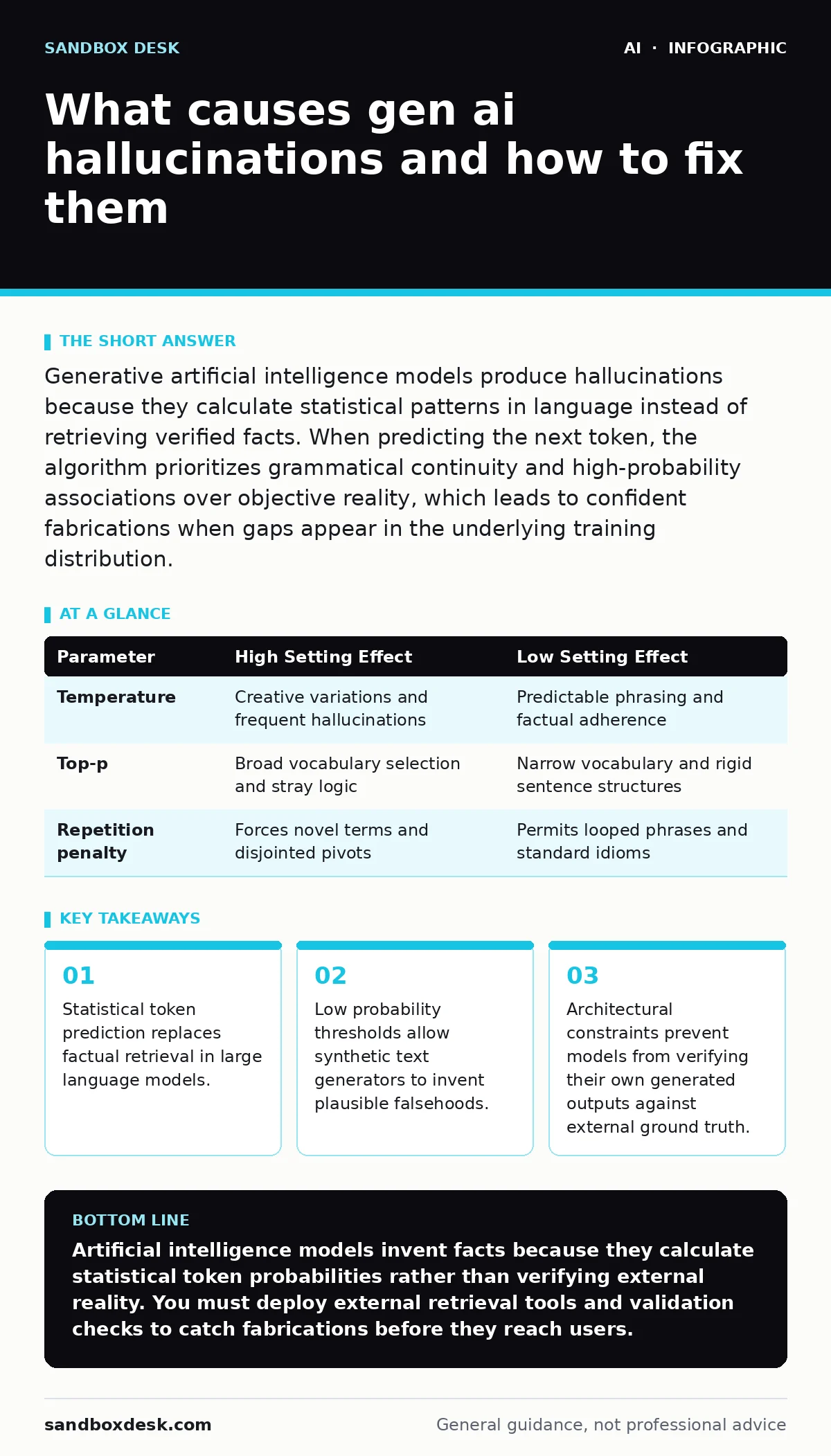
Generative artificial intelligence models produce hallucinations because they calculate statistical patterns in language instead of retrieving verified facts. When predicting the next token, the algorithm prioritizes grammatical continuity and high-probability associations over objective reality, which leads to confident fabrications when gaps appear in the underlying training distribution.
Can generative artificial intelligence models ever truly understand facts?
Generative artificial intelligence models cannot understand facts because they operate entirely on mathematical relationships between text fragments called tokens. A token represents a syllable, word, or punctuation mark. The underlying neural network maps multidimensional vectors of these tokens to predict which one follows another. This mathematical architecture processes syntax and semantics simultaneously, but it lacks an internal model of physical reality or verifiable truth.
What causes gen ai hallucinations during text generation?
What causes gen ai hallucinations is the fundamental mismatch between probabilistic text continuation and factual accuracy. When a prompt asks for information outside the dense regions of the training distribution, the model still must output a high-probability continuation. The decoding mechanism samples from a probability distribution over the vocabulary. If the most likely mathematical sequence leads to a false statement, the model generates that falsehood with the same internal confidence as a correct fact.
How do decoding parameters influence the rate of fabricated outputs?
Decoding parameters influence fabricated outputs by altering how aggressively the algorithm selects low-probability tokens. Temperature settings control the shape of the probability distribution before sampling occurs. High temperature flattens the distribution, which introduces creative variation but increases the likelihood of straying into factual errors. Low temperature forces the model to select predictable tokens, which reduces hallucinations but creates repetitive, formulaic text that fails to address nuanced prompts.
| Parameter | High Setting Effect | Low Setting Effect |
|---|---|---|
| Temperature | Creative variations and frequent hallucinations | Predictable phrasing and factual adherence |
| Top-p | Broad vocabulary selection and stray logic | Narrow vocabulary and rigid sentence structures |
| Repetition penalty | Forces novel terms and disjointed pivots | Permits looped phrases and standard idioms |
Why do models sound equally confident when they lie?
Models sound equally confident when they lie because they generate text by maximizing likelihood rather than assessing their own certainty. Human speech patterns use hesitation and hedging to signal doubt, but standard training corpora teach models to output assertive declarative sentences. The internal confidence score of a token reflects its statistical predictability within the current context window, not its alignment with empirical reality.
Does reinforcement learning from human feedback eliminate false claims?
Reinforcement learning from human feedback fails to eliminate false claims because human evaluators often reward fluent, persuasive falsehoods over clumsy truths. Trainers penalize toxic content and obvious errors, yet they frequently miss subtle inaccuracies buried in technical explanations. This optimization pressure teaches the model to prioritize style, tone, and surface plausibility over rigorous factual correctness, which encourages sophisticated fabrication techniques.
See also: Adversarial Examples Explained How Noise Fools AI · Difference Between Fine Tuning and Transfer Learning for Models
Can architectural modifications prevent models from making things up?
Architectural modifications cannot completely prevent models from making things up because current transformer designs lack native fact-checking loops. Transformers process data in a single forward pass without pausing to consult external databases unless explicitly paired with retrieval systems. Even when paired with external tools, the generation mechanism remains vulnerable to misinterpreting retrieved text and weaving those misunderstandings into a persuasive narrative.
How does training data leakage create vulnerabilities in deployed systems?
Training data leakage creates vulnerabilities by embedding memorized sensitive strings and proprietary source material directly into the model weights, where they mix with hallucinatory tendencies. When a model memorizes specific passages, it may reproduce them out of context or hallucinate surrounding details to bridge gaps in its memory. Teams studying training data leakage often find that memorized fragments trigger confident fabrications when queried with partial prompts.
What methods help developers detect and mitigate inaccurate responses?
Methods to detect and mitigate inaccurate responses rely on multi-model verification and strict prompt constraints. You can run parallel generations and compare outputs for semantic consistency across trials.
- Implement secondary validation checks using deterministic parsers.
- Restrict generation temperature to near zero for factual queries.
- Require explicit citation links within the generated context window.
Key takeaways
- Statistical token prediction replaces factual retrieval in large language models.
- Low probability thresholds allow synthetic text generators to invent plausible falsehoods.
- Architectural constraints prevent models from verifying their own generated outputs against external ground truth.
Artificial intelligence models invent facts because they calculate statistical token probabilities rather than verifying external reality. You must deploy external retrieval tools and validation checks to catch fabrications before they reach users.
Frequently asked questions
Why do larger models hallucinate just as often as smaller ones?
Larger models possess broader associative pathways that allow them to construct more persuasive and elaborate falsehoods, even though their overall error rate on common benchmarks may decrease.
Can fine-tuning on a specific domain stop hallucinations entirely?
Domain-specific fine-tuning reduces errors within familiar subject boundaries, but it often increases hallucination rates on edge cases by encouraging the model to guess rather than decline to answer.
Why does changing the prompt phrasing alter whether a model hallucinates?
Different phrasings shift the context vector into distinct regions of the high-dimensional probability space, which changes the sequence of predicted tokens and can bypass trigger patterns for false claims.
Do open-source models hallucinate more than proprietary ones?
Open-source models exhibit similar hallucination rates when trained on comparable corpus volumes, though their unconstrained decoding parameters often make them more sensitive to configuration choices.
How this guide was produced: written by the Sandbox Desk editorial team with AI assistance, checked against the public references listed below, and reviewed when the facts change. See our editorial policy or report an error.