Security Culture Survey: How to Measure Behavior and Fix It
Security culture surveys reveal that technical controls fail when human habits contradict policy, exposing gaps no firewall can patch.

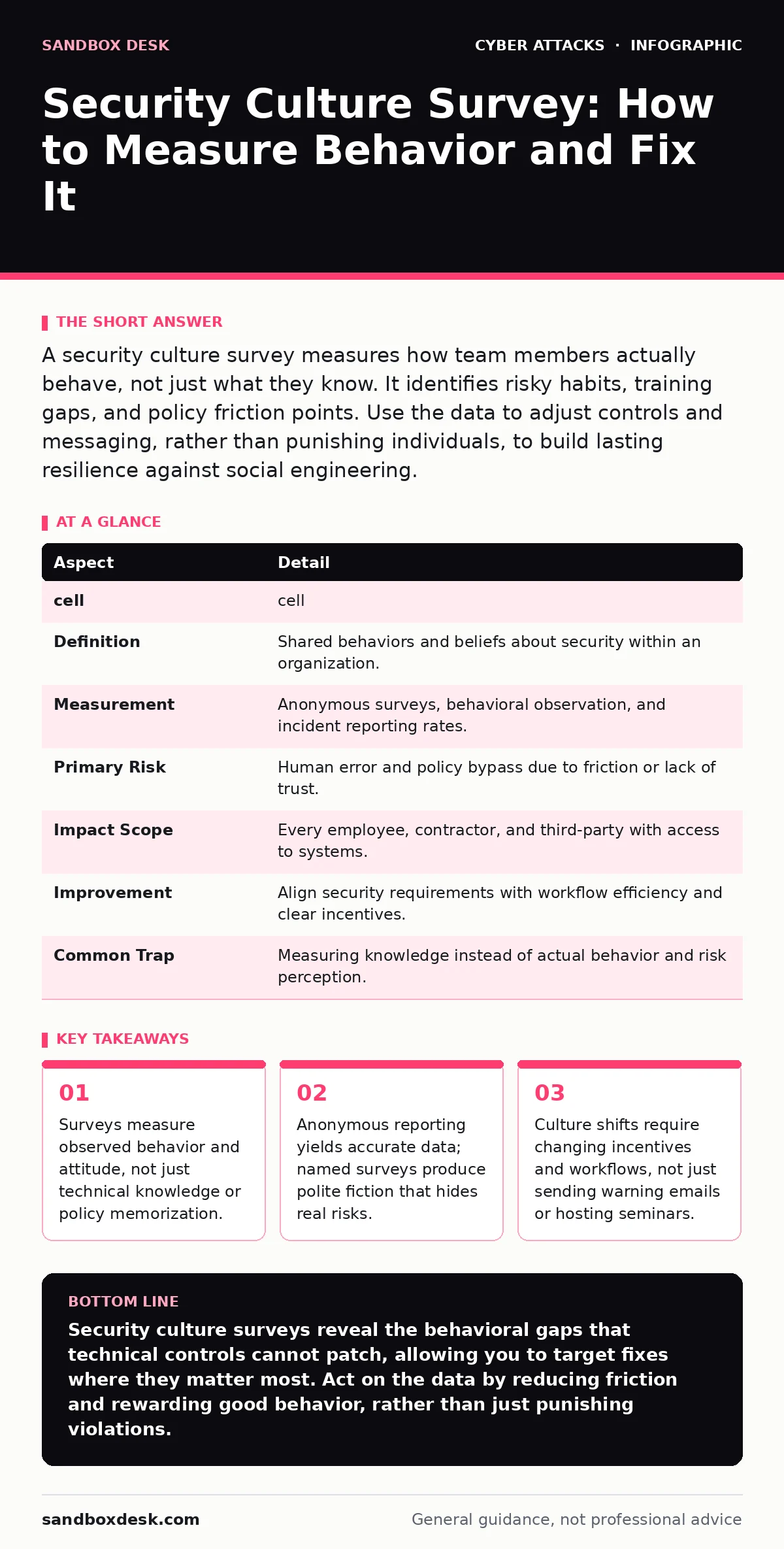
A security culture survey measures how team members actually behave, not just what they know. It identifies risky habits, training gaps, and policy friction points. Use the data to adjust controls and messaging, rather than punishing individuals, to build lasting resilience against social engineering.
The Psychology of Access
Imagine a library where every book is locked in a glass case. The locks are strong, but the librarians leave the keys on their desks because retrieving books takes too long. The security is technically sound, but the culture is open. Security culture works the same way in software organizations. It is the shared set of beliefs and behaviors that determine how people handle data, credentials, and access rights when no one is watching.
Technical controls like firewalls and encryption are static. They do not adapt to human impatience or confusion. Security culture is dynamic. It dictates whether a developer hard-codes an API key for convenience or uses a secrets manager. It determines whether a user reports a suspicious message or ignores it. When culture and controls align, the system is resilient. When they conflict, the human element becomes the weakest link.
At a glance
| Aspect | Detail |
|---|---|
| cell | cell |
| Definition | Shared behaviors and beliefs about security within an organization. |
| Measurement | Anonymous surveys, behavioral observation, and incident reporting rates. |
| Primary Risk | Human error and policy bypass due to friction or lack of trust. |
| Impact Scope | Every employee, contractor, and third-party with access to systems. |
| Improvement | Align security requirements with workflow efficiency and clear incentives. |
| Common Trap | Measuring knowledge instead of actual behavior and risk perception. |
Why Security Culture Survey Results Matter
People type "security culture survey" because they suspect their technical defenses are incomplete. A firewall cannot stop an employee from writing a password on a sticky note. An intrusion detection system cannot prevent a developer from committing credentials to a public repository. These actions stem from culture. A security culture survey quantifies these behavioral risks.
The survey reveals the gap between policy and practice. This is actionable intelligence. Without this data, you are guessing where the holes are. With it, you can target training and tool improvements where they matter most.
The survey also highlights trust issues. If employees do not report suspicious emails because they fear being blamed, your detection capabilities are blind. Whaling attacks succeed not because the technology failed, but because the culture punished the victim instead of rewarding the report. Understanding this dynamic allows you to shift from blame to learning.
What People Usually Get Wrong
Most organizations treat security culture as a training problem. They send newsletters, host webinars, and quiz staff on policy details. This approach fails because it assumes people ignore security because they do not know the rules. Often, they know the rules but choose to break them because the secure path is too difficult.
Another common error is measuring knowledge instead of behavior. A quiz tests memory. A culture survey tests habits. Asking "Do you report phishing?" yields a yes. Asking "Have you reported a suspicious email in the last month?" reveals the truth. Callback phishing works because victims hesitate to verify. A survey that only asks if they "know" to verify misses the friction in the verification process.
Finally, many teams ignore the cost of security friction. If logging in takes 3 minutes, users will find ways to bypass it. A security culture survey should ask about the pain points of security tools. If the answer is "too slow," fixing the tool is more effective than another warning email.
Designing the Assessment
A useful survey is anonymous and specific. Anonymity ensures honesty. Specificity ensures actionability. Do not ask "Do you care about security?" Ask "Do you share your screen with sensitive data during public meetings?"
Include questions about workflow friction. Ask how often users bypass security steps to get work done. Ask where they feel the most pressure to speed up. These questions reveal where your controls are blocking productivity. When security blocks productivity, users will remove the security.
Consider the context of vendor email compromise. The survey should also cover physical security, remote work habits, and code commit practices. The goal is to map the entire surface of human behavior.
See also: How Tabletop Exercises Work: Step-by-Step Mechanism and Limits · How Vulnerability Scanning Works: The Hidden Mechanics and Limits
Implementing Changes Based on Data
Data without action creates cynicism. If you survey the team and then do nothing, the next survey will yield less honest results. You must close the loop. Share the aggregate findings with the team. Explain what you are changing based on their feedback.
Prioritize fixes that reduce friction. If USB drop attacks are a concern because people plug in unknown drives out of curiosity, provide a safe sandbox for testing unknown media rather than just banning USBs.
Incentivize good behavior. Recognize teams that report vulnerabilities or near-misses. Make security a shared value, not a compliance burden. Attack vectors evolve, but the human desire for efficiency remains constant. Align security with efficiency, and the culture will follow.
Integrating with Technical Controls
Culture and technology must reinforce each other. Web filtering blocks malicious sites, but culture determines whether users report blocked pages that are actually safe. If users complain about false positives, investigate and adjust the filters. This builds trust in the system.
Intrusion detection systems alert on anomalies, but culture determines how quickly those alerts are investigated. A culture of urgency and clear ownership reduces response time. Bluetooth attacks exploit proximity, but a culture of device awareness reduces the risk of unauthorized pairing.
Vendor email compromise often succeeds because of rushed processes. A culture that encourages verification, even under pressure, stops these attacks. The survey data helps you identify where the pressure is highest and where verification is weakest.
Sustaining the Momentum
Security culture is not a one-time project. It is a continuous feedback loop. Repeat the survey annually or bi-annually. Track trends over time. Are reporting rates increasing? Is friction decreasing?
Integrate security into daily rituals. Discuss security implications in code reviews and sprint planning. Make it a natural part of the workflow. When security is embedded in the process, it becomes automatic.
Remember that intrusion detection systems and other tools provide data, but culture provides context. A spike in failed logins might be an attack, or it might be a confused user. A strong culture helps distinguish between the two and respond appropriately.
Key takeaways
- Surveys measure observed behavior and attitude, not just technical knowledge or policy memorization.
- Anonymous reporting yields accurate data; named surveys produce polite fiction that hides real risks.
- Culture shifts require changing incentives and workflows, not just sending warning emails or hosting seminars.
Security culture surveys reveal the behavioral gaps that technical controls cannot patch, allowing you to target fixes where they matter most. Act on the data by reducing friction and rewarding good behavior, rather than just punishing violations.
Frequently asked questions
How often should I run a security culture survey?
Run the survey annually to track trends, but consider shorter pulse surveys quarterly to measure the impact of specific changes or new policies.
Can I use a security culture survey to punish employees?
No. Using survey data for punishment destroys trust and ensures future responses are dishonest. Use the data to improve systems and processes, not to blame individuals.
What is the difference between a security awareness survey and a culture survey?
Awareness surveys test knowledge of policies and threats. Culture surveys test actual behaviors, attitudes, and the perceived friction of security controls in daily work.
How do I ensure honest responses in a security culture survey?
Guarantee anonymity, avoid identifying questions, and clearly state that the data will not be used for disciplinary action. Trust is the foundation of accurate data.
How this guide was produced: written by the Sandbox Desk editorial team with AI assistance, checked against the public references listed below, and reviewed when the facts change. See our editorial policy or report an error.