AI security testing checklist to systematically uncover prompt flaws
Systematic evaluation reveals structural flaws in machine learning pipelines before malicious actors exploit hidden prompt injections.

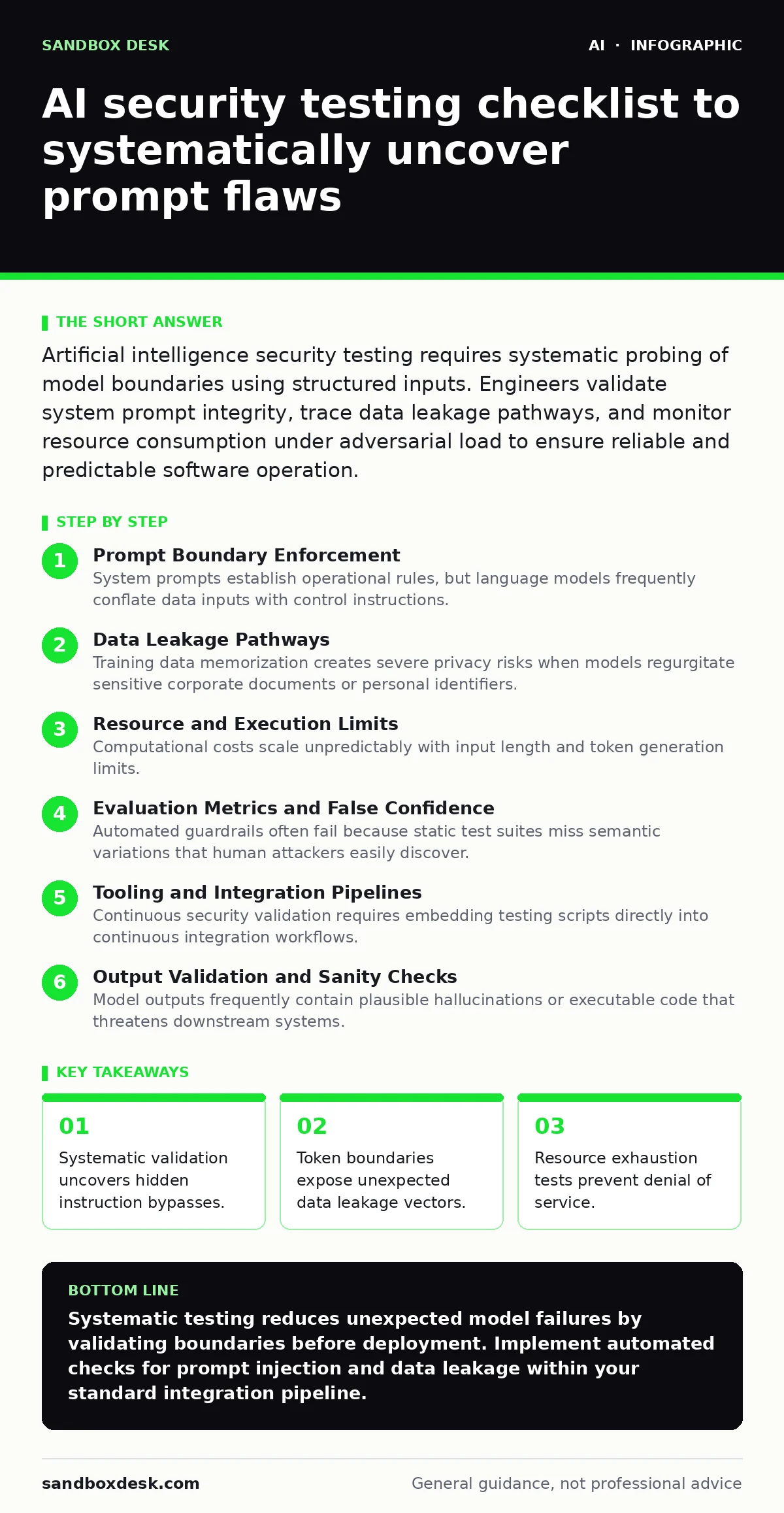
Artificial intelligence security testing requires systematic probing of model boundaries using structured inputs. Engineers validate system prompt integrity, trace data leakage pathways, and monitor resource consumption under adversarial load to ensure reliable and predictable software operation.
Practical testing frameworks serve engineers building applications on top of large language models. You apply these checks during integration testing cycles to catch failures before deployment. 3 core areas require systematic verification: prompt boundary enforcement, data handling pathways, and runtime resource limits.
Prompt Boundary Enforcement
System prompts establish operational rules, but language models frequently conflate data inputs with control instructions. Testing this boundary requires injecting contradictory directives wrapped in formatting markers. You must treat AI models as untrusted insiders when designing these adversarial inputs.
- System prompt extraction: verifies if users can force the model to reveal hidden initialization instructions.
- Delimiter collision testing: checks whether special formatting tokens bypass safety filters by confusing the parser.
- Persona adoption checks: ensures the model refuses malicious roleplay scenarios designed to bypass safety constraints.
- Multi-turn drift evaluation: measures how conversation length degrades adherence to original safety instructions.
Data Leakage Pathways
Training data memorization creates severe privacy risks when models regurgitate sensitive corporate documents or personal identifiers. Testing these pathways involves crafting specific prompts that trigger memorized associations. Preventing sensitive data leaks through AI chatbots demands rigorous validation of output filters and token suppression rules.
- PII reconstruction probing: tests if repeated queries reconstruct training records containing names or numbers.
- Upstream retrieval injection: checks whether external document stores bleed unauthorized files into context windows.
- Error message inspection: verifies that stack traces and internal API responses do not appear in user-facing outputs.
- Cross-tenant context bleeding: ensures distinct user sessions never share cached vector embeddings.
Resource and Execution Limits
Computational costs scale unpredictably with input length and token generation limits. Adversaries exploit this asymmetry to induce high latency and financial drain. Testing infrastructure resilience prevents unexpected resource exhaustion during high-concurrency events and protects downstream services from cascading failures.
- Context window saturation: measures system behavior when input tokens reach maximum capacity limits.
- Recursive token amplification: checks if repetitive generation loops consume excessive memory and processing time.
- API rate limit bypass: verifies that distributed request patterns successfully trigger throttling mechanisms.
- Timeout handling verification: ensures stalled inference threads release worker nodes cleanly.
Evaluation Metrics and False Confidence
Automated guardrails often fail because static test suites miss semantic variations that human attackers easily discover. Developers frequently rely on probabilistic scoring that misses subtle logic flaws. Compliance frameworks such as the EU AI Act mandate documented testing procedures, yet compliance does not equal operational security.
- Semantic variance testing: evaluates safety filter robustness against synonym substitution and character encoding tricks.
- Fallback behavior audit: checks how the application responds when the primary safety classifier times out.
- Determinism checks: measures output variance across identical requests to detect unstable safety boundaries.
Tooling and Integration Pipelines
Continuous security validation requires embedding testing scripts directly into continuous integration workflows. Manual checks alone cannot keep pace with rapid model weight updates and prompt modifications. Developers must align their testing methodologies with established baselines like the OWASP Top 10 for LLM applications.
- Regression test suite execution: verifies that model updates do not reintroduce previously patched prompt vulnerabilities.
- Static configuration scanning: checks API keys, temperature settings, and endpoint permissions for exposed credentials.
- Dependency audit integration: scans wrapper libraries and tokenizers for known software vulnerabilities.
See also: Prompt injection in AI desktop apps and how to prevent it · Malware Targeting AI Infrastructure: Threats and Defense
Output Validation and Sanity Checks
Model outputs frequently contain plausible hallucinations or executable code that threatens downstream systems. Filtering generated responses before execution prevents secondary code injection attacks. Teams must validate every downstream action triggered by model decisions and reject malformed payloads.
- Code execution sandboxing: ensures any generated scripts run strictly within isolated container environments.
- Schema enforcement verification: checks that structured outputs strictly conform to expected JSON or database schemas.
- Malicious link filtering: scans generated text for phishing domains and unverified hyperlinks before rendering.
Key takeaways
- Systematic validation uncovers hidden instruction bypasses.
- Token boundaries expose unexpected data leakage vectors.
- Resource exhaustion tests prevent denial of service.
Systematic testing reduces unexpected model failures by validating boundaries before deployment. Implement automated checks for prompt injection and data leakage within your standard integration pipeline.
Frequently asked questions
How often should security testing run on production AI models?
Security testing must run whenever system prompts, underlying model weights, or connected data sources change. Continuous integration pipelines should execute baseline checks on every code commit.
Can automated scanners catch every type of prompt injection?
Automated scanners catch known patterns and simple bypasses, but novel semantic variations require manual exploratory probing. Security testing reduces risk without guaranteeing complete prevention.
What is the biggest mistake developers make during AI security audits?
Developers often test only happy-path inputs while ignoring how models handle contradictory instructions or encoded adversarial tokens.
Do local models require the same security testing as cloud-hosted APIs?
Local models require identical boundary testing because architectural flaws and training data vulnerabilities persist regardless of hosting location.
How this guide was produced: written by the Sandbox Desk editorial team with AI assistance, checked against the public references listed below, and reviewed when the facts change. See our editorial policy or report an error.