How Tabletop Exercises Work: Step-by-Step Mechanism and Limits
Tabletop exercises expose decision-making gaps in security processes by simulating attack scenarios without requiring technical execution or live system changes.

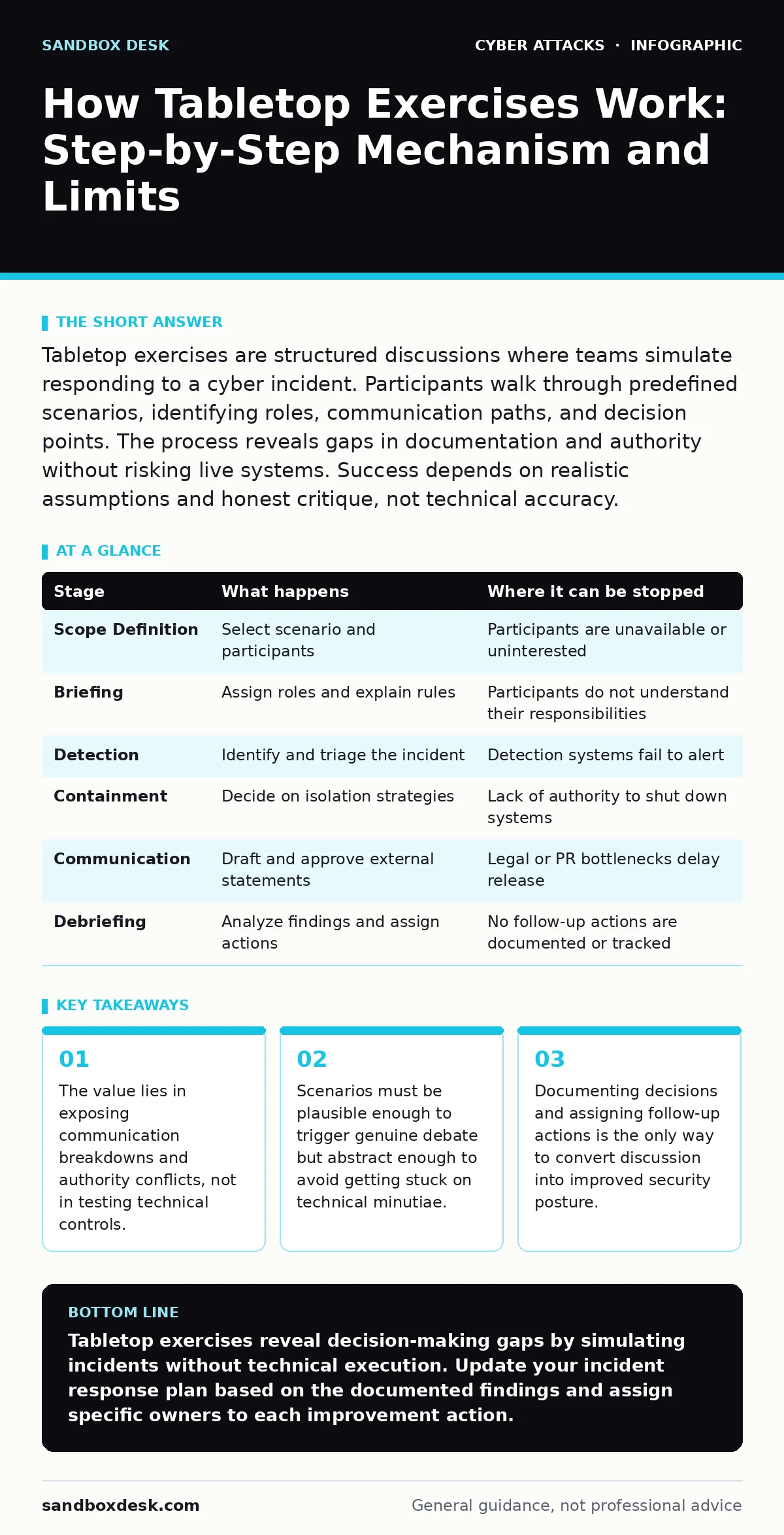
Tabletop exercises are structured discussions where teams simulate responding to a cyber incident. Participants walk through predefined scenarios, identifying roles, communication paths, and decision points. The process reveals gaps in documentation and authority without risking live systems. Success depends on realistic assumptions and honest critique, not technical accuracy.
Defining the Exercise Scope and Participants
A tabletop exercise begins with defining what the team intends to test. You select a specific incident type, such as a ransomware deployment or a data exfiltration event. The goal is not to test every possible attack vector but to stress-test the organizational response to one specific threat. You identify the participants who will make decisions during an actual incident. This group typically includes security operations staff, legal counsel, public relations, and executive leadership.
Excluding any of these groups creates a blind spot in the simulation. You define the scope to ensure the exercise remains focused. A broad scope leads to superficial discussions. A narrow scope allows deep exploration of decision trees and communication protocols. You determine the duration of the session. Two to four hours is standard for a single scenario. Longer sessions cause participant fatigue and reduce the quality of decisions.
Selecting the Scenario and Injecting Context
You choose a scenario that is realistic but hypothetical. Imagine a scenario where an employee receives a malicious attachment that installs keylogging software. The scenario description provides enough detail to trigger a response but leaves room for interpretation. You create "injects," which are new pieces of information released at specific intervals. An inject might reveal that the malware has encrypted files on a backup server. Another inject might state that a major customer has noticed unusual activity.
These injects force participants to adapt their strategy. The scenario should challenge assumptions about normal operations. If the scenario assumes all systems are isolated, it ignores the reality of network interdependencies. You design the scenario to test both technical responses and business continuity decisions. The scenario must be difficult enough to cause disagreement among participants. Consensus indicates the scenario is too easy or the participants are not engaging critically.
Stage 1: Briefing and Role Assignment
The facilitator introduces the scenario and assigns roles to each participant. You clarify who has authority to make specific decisions. This step prevents confusion when the exercise intensifies. Participants review the current incident response plan to understand their documented responsibilities. The facilitator explains the rules of engagement. These rules define what actions are allowed and what information is available.
You establish that the exercise is a learning opportunity, not a performance evaluation. Participants must feel safe to admit they do not know the answer. If participants fear blame, they will hide their gaps in knowledge. The facilitator sets the timeline for the exercise. This timeline dictates the pace of injects and decisions. You ensure all participants have the necessary materials, such as contact lists and escalation procedures.
Stage 2: Initial Detection and Triage
The exercise begins with the first inject: the initial detection of the incident. Participants discuss how they identify the threat and who gets notified. You examine the detection mechanisms in place. Does the security operations center recognize the alert as a true positive? How quickly does the information reach the incident commander? This stage tests the initial communication channels. You identify who decides to declare an incident.
This decision point is often delayed due to uncertainty or fear of making a mistake. Participants debate the severity of the incident. They determine whether to escalate to executive leadership. You document the time taken to reach a decision. Delays here increase the potential impact of the incident. The facilitator notes any confusion about roles or responsibilities. These notes become the basis for improving the incident response plan.
Stage 3: Containment and Eradication Decisions
The facilitator releases injects that complicate the situation. Suppose the malware spreads to the email server. Participants must decide how to contain the spread without disrupting business operations. You explore the trade-offs between speed and accuracy. Shutting down the email server stops the spread but halts business communication. Participants debate the acceptable level of disruption. This stage tests the technical containment strategies.
You examine whether the team has the tools to isolate affected systems. The facilitator challenges participants to consider collateral damage. Does the containment action affect third-party vendors? Participants must decide whether to involve external experts. This decision point reveals gaps in vendor contracts and support agreements. You document the decisions made and the rationale behind them.
Stage 4: Communication and Legal Considerations
The exercise shifts to external communication. Participants decide what to tell customers, regulators, and the media. You examine the legal implications of the disclosure. This stage tests the coordination between security, legal, and public relations. Participants draft statements and determine the timing of releases. You identify conflicts between transparency and liability.
The facilitator introduces injects that change the legal landscape. For example, new regulations may require immediate notification. Participants must adjust their communication strategy accordingly. This stage reveals gaps in pre-approved templates and approval workflows. You document the time taken to approve external communications. Delays in communication can worsen reputational damage.
Documenting Findings and Assigning Actions
The exercise concludes with a debriefing session. Participants discuss what went well and what failed. You focus on process gaps, not individual performance. The facilitator guides the discussion to ensure all voices are heard. You identify specific actions to improve the incident response plan. These actions must be assigned to owners with deadlines. Without assigned actions, the exercise provides no value.
You document the insights gained during the exercise. This documentation serves as a baseline for future improvements. You review the decisions made during the exercise. You identify any assumptions that proved incorrect. These assumptions often represent hidden risks in the organization. You update the incident response plan to reflect the new insights.
Analyzing Limits and Hidden Costs
Tabletop exercises have inherent limits. They test decision-making, not technical execution. A team may decide correctly in the exercise but fail to execute the steps in reality. You must validate technical controls through separate technical tests. Tabletop exercises rely on participant honesty. If participants hide their lack of knowledge, the exercise reveals nothing. You create a culture of psychological safety to encourage honest feedback.
The exercise is only as good as the scenario. A poorly designed scenario leads to irrelevant discussions. You invest time in designing realistic scenarios. The cost of preparation is significant. Facilitators must understand both technical and business aspects. Participants must prepare by reviewing their roles. The return on investment comes from improved coordination and reduced response times.
| Stage | What happens | Where it can be stopped |
|---|---|---|
| Scope Definition | Select scenario and participants | Participants are unavailable or uninterested |
| Briefing | Assign roles and explain rules | Participants do not understand their responsibilities |
| Detection | Identify and triage the incident | Detection systems fail to alert |
| Containment | Decide on isolation strategies | Lack of authority to shut down systems |
| Communication | Draft and approve external statements | Legal or PR bottlenecks delay release |
| Debriefing | Analyze findings and assign actions | No follow-up actions are documented or tracked |
See also: Is Command the Same as Control in C2 Infrastructure? · How to Create Disaster Recovery Plan: The 7 Step Rollout
Integrating with Broader Security Strategy
Tabletop exercises complement other security measures. They do not replace technical controls like zero trust security or web filtering. They test how the organization responds when those controls fail. You integrate exercise findings into the broader security strategy. This integration ensures that process improvements align with technical upgrades.
You schedule regular exercises to maintain proficiency. Frequency depends on the risk profile of the organization. High-risk environments require more frequent exercises. You vary the scenarios to test different aspects of the response. This variation prevents participants from memorizing responses. You encourage cross-functional participation to break down silos. This approach builds a more resilient organization.
Key takeaways
- The value lies in exposing communication breakdowns and authority conflicts, not in testing technical controls.
- Scenarios must be plausible enough to trigger genuine debate but abstract enough to avoid getting stuck on technical minutiae.
- Documenting decisions and assigning follow-up actions is the only way to convert discussion into improved security posture.
Tabletop exercises reveal decision-making gaps by simulating incidents without technical execution. Update your incident response plan based on the documented findings and assign specific owners to each improvement action.
Frequently asked questions
How often should we conduct tabletop exercises?
Conduct exercises at least once a year. High-risk environments may require quarterly sessions to maintain proficiency and adapt to changing threats.
Who should facilitate the exercise?
An independent facilitator is best. They can remain neutral and challenge assumptions without bias. An internal security manager can facilitate if they have no decision-making authority in the incident.
What if participants argue during the exercise?
Argument is valuable. It reveals conflicting priorities and unclear authority. The facilitator should guide the debate to a resolution and document the final decision and its rationale.
How do we measure success?
Success is measured by the number of actionable insights identified and the completion of follow-up actions. Not by the absence of problems during the exercise.
How this guide was produced: written by the Sandbox Desk editorial team with AI assistance, checked against the public references listed below, and reviewed when the facts change. See our editorial policy or report an error.