Adversarial Examples Explained How Noise Fools AI
Microscopic changes to digital images and audio can trick machine learning models into misclassifying inputs while remaining invisible to humans.

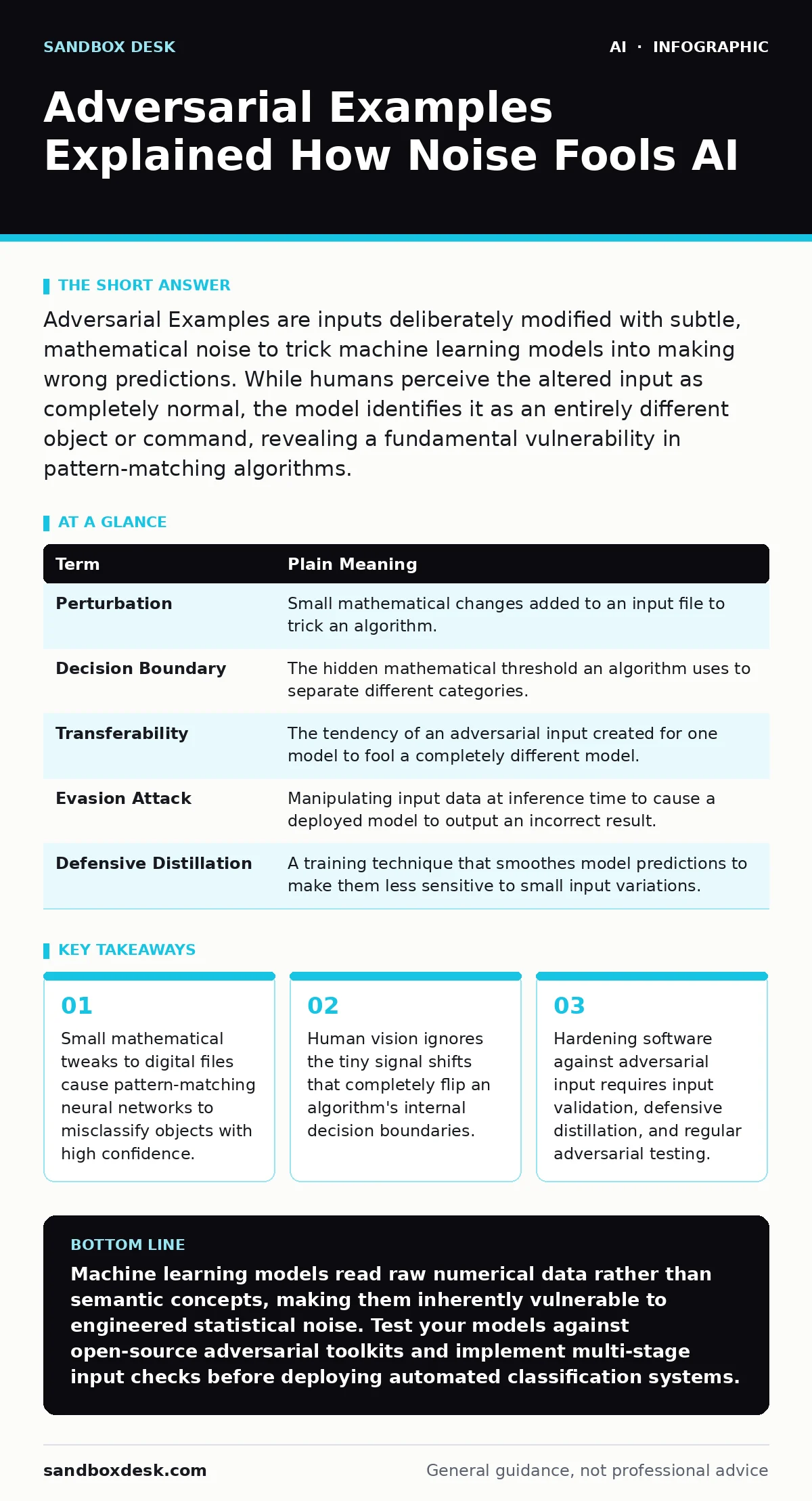
Adversarial Examples are inputs deliberately modified with subtle, mathematical noise to trick machine learning models into making wrong predictions. While humans perceive the altered input as completely normal, the model identifies it as an entirely different object or command, revealing a fundamental vulnerability in pattern-matching algorithms.
What Are Adversarial Examples in Machine Learning?
Adversarial examples are digital files modified with microscopic, engineered noise that tricks pattern recognition systems into making catastrophic errors. A human looking at an altered image sees a standard photograph, yet a neural network—an artificial intelligence system structured to mirror biological neurons—identifies the photograph as something entirely unrelated.
Neural networks calculate mathematical probabilities across millions of numerical pixel values rather than understanding visual concepts. Attackers calculate the exact vector changes needed to push an image across the mathematical threshold into another category. Small shifts in pixel data exploit the gaps between human perception and statistical classification.
The Stop Sign Analogy: How Microscopic Noise Tricks Vision Systems
Imagine a standard red octagonal stop sign standing at a quiet suburban intersection. A human driver recognizes the shape, color, and lettering instantly from any angle, even if the metal plate carries a few small smudges of grey dirt. The human brain prioritizes high-level geometric structure and semantic context over tiny surface details.
Automated camera systems process that same stop sign as a matrix of numbers representing color intensity. Suppose an attacker places 4 precise, small square stickers onto the face of the sign. To a human motorist, the object remains obviously a stop sign with minor blemishes. To an automated computer vision model, those 4 tiny patches alter the pixel values along critical decision boundaries, causing the computer to register a speed limit sign instead.
Key Terminology for Machine Learning Security
Machine learning security relies on precise terms to describe how models fail under targeted manipulation. The table below outlines the core concepts every defender must recognize.
| Term | Plain Meaning |
|---|---|
| Perturbation | Small mathematical changes added to an input file to trick an algorithm. |
| Decision Boundary | The hidden mathematical threshold an algorithm uses to separate different categories. |
| Transferability | The tendency of an adversarial input created for one model to fool a completely different model. |
| Evasion Attack | Manipulating input data at inference time to cause a deployed model to output an incorrect result. |
| Defensive Distillation | A training technique that smoothes model predictions to make them less sensitive to small input variations. |
How Hidden Noise Bypasses Model Confidence
Algorithms evaluate inputs by mapping data points in multi-dimensional space, drawing clear lines between categories like cars, animals, and signs. An adversarial perturbation shifts a data point just enough to cross a boundary line without moving far enough for human eyes to spot the difference. The machine does not see a physical object; the machine sees a coordinate grid.
A non-obvious consequence of this architecture is that models become wildly confident in their incorrect conclusions. Because the noise is calculated to maximize the target category's probability score, the classifier outputs its wrong answer with near-total certainty. This dynamic creates serious risks for automated monitoring systems covered in our guide to AI-assisted threat detection.
[Normal Input] + [Engineered Noise] = [Adversarial Input]
(Stop Sign) (Tiny Stickers) (Speed Limit Sign)
v v v
Human sees: Human ignores: Human sees: Stop Sign
Stop Sign Micro-changes Model sees: Speed Limit
Defenders often assume that keeping model architecture secret provides security. Transferability breaks this assumption: an attacker can generate adversarial examples against an open source proxy model, and those exact same inputs will frequently fool a proprietary, closed system. Systems running large language models face similar vulnerabilities through text-based inputs, as detailed in our analysis of prompt injection in AI desktop apps.
The Hidden Costs and Failures of Standard Defenses
Traditional cybersecurity controls fail against adversarial examples because the malicious payload contains no bad code, invalid syntax, or unexpected file formats. The target file is a perfectly valid image, audio recording, or document that adheres to every structural standard. Firewalls and antivirus tools pass these files without alarm because the exploit exists entirely inside the statistical weights of the receiving machine learning model.
Attempts to sanitize inputs often degrade system performance for legitimate users without stopping targeted attacks. Adding high-pass filters or reducing image resolution reduces overall classification accuracy while sophisticated attacks adapt around the defense. Organizations evaluating broader infrastructure risks should review our guide on AI supply chain risks to understand how corrupted software pipelines amplify these classification failures.
See also: Difference Between Fine Tuning and Transfer Learning for Models · 7 AI Model Monitoring Mistakes That Break Production Systems
3 Steps to Audit Your Systems Against Adversarial Noise
Testing machine learning deployments against adversarial manipulation requires systemic checking before production rollout. Follow these 3 steps to identify vulnerabilities in your data pipelines.
- Calculate input sensitivities using gradient analysis. Run baseline tests against your models using open-source adversarial generation toolkits to measure how few pixel changes force a misclassification.
- Apply adversarial training to training sets. Mix engineered adversarial examples into your original dataset during retraining so the model learns to ignore targeted statistical noise.
- Set strict confidence thresholds on multi-stage workflows. Configure software pipelines to flag inputs that trigger sharp, unexpected jumps in classification confidence for manual human review.
Key takeaways
- Small mathematical tweaks to digital files cause pattern-matching neural networks to misclassify objects with high confidence.
- Human vision ignores the tiny signal shifts that completely flip an algorithm's internal decision boundaries.
- Hardening software against adversarial input requires input validation, defensive distillation, and regular adversarial testing.
Machine learning models read raw numerical data rather than semantic concepts, making them inherently vulnerable to engineered statistical noise. Test your models against open-source adversarial toolkits and implement multi-stage input checks before deploying automated classification systems.
Frequently asked questions
What is the difference between an adversarial example and a normal software bug?
An adversarial example is an input crafted intentionally to exploit mathematical boundaries in a model, whereas a normal bug stems from mistakes in source code logic.
Can adversarial examples exist in text and audio, or only images?
Adversarial examples exist across all data formats, including subtle audio frequencies that hide voice commands and hidden text sequences that manipulate language algorithms.
Does retraining a model on adversarial examples fix the security problem permanently?
Retraining improves resilience against known noise patterns, but attackers can generate new perturbations targeting the updated model.
Are adversarial attacks common in basic web applications?
Web applications running basic traditional code are unaffected, but any feature relying on automated image recognition or natural language classification carries risk.
How this guide was produced: written by the Sandbox Desk editorial team with AI assistance, checked against the public references listed below, and reviewed when the facts change. See our editorial policy or report an error.