Treat AI Models as Untrusted Insiders: 8 Security Practices
Generative AI systems operate with internal state and persistent memory that bypass traditional network perimeters, requiring insider threat controls rather than perimeter defenses.

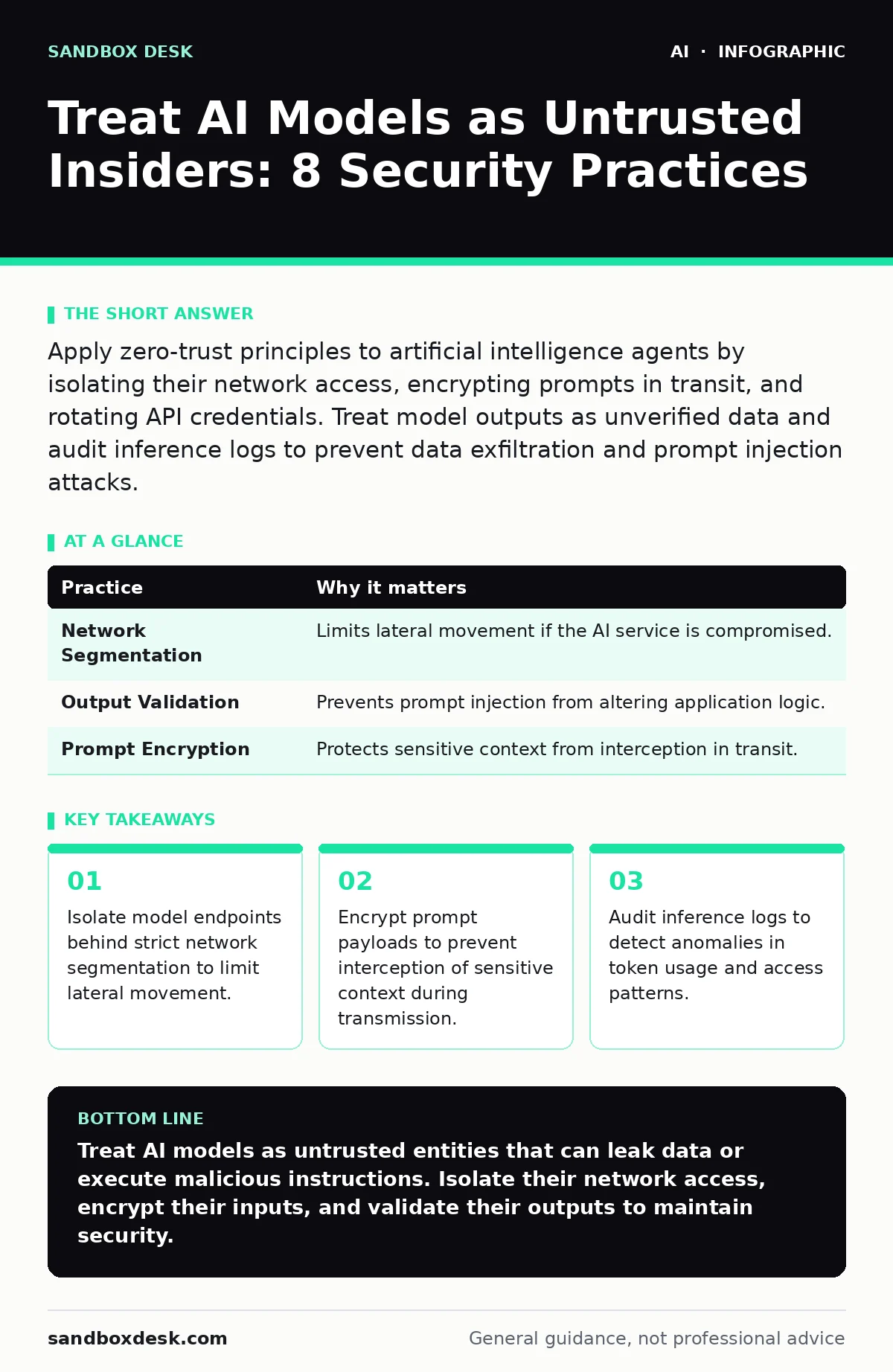
Apply zero-trust principles to artificial intelligence agents by isolating their network access, encrypting prompts in transit, and rotating API credentials. Treat model outputs as unverified data and audit inference logs to prevent data exfiltration and prompt injection attacks.
1. Isolate Model Endpoints in Dedicated Network Segments
Artificial intelligence services often require broad network access to retrieve context or write results. Placing these services in the same subnet as production databases creates a direct path for attackers. If an adversary compromises the model interface, they can pivot to internal systems. Segmentation restricts this movement. You must place AI inference engines in a distinct network zone with no direct route to sensitive data stores.
The model should only communicate through specific, audited APIs. This prevents the model from initiating connections to unexpected internal hosts. Suppose a developer embeds a malicious payload in a prompt that instructs the model to scrape internal documentation. Network segmentation ensures the model cannot reach those resources, even if the instruction is processed.
1.1. Restrict Outbound Traffic from AI Containers
Containerized AI services often inherit overly permissive network policies. You must define explicit allow lists for outbound connections. The model should only be permitted to contact its own storage backend and necessary external APIs. Block all other outbound traffic at the container orchestration level. This stops data exfiltration attempts that rely on the model sending stolen context to external servers.
| Practice | Why it matters |
|---|---|
| Network Segmentation | Limits lateral movement if the AI service is compromised. |
| Output Validation | Prevents prompt injection from altering application logic. |
| Prompt Encryption | Protects sensitive context from interception in transit. |
2. Encrypt Prompt Payloads in Transit
Prompts often contain sensitive context, including customer data or proprietary code. Sending this data in plaintext allows network observers to reconstruct confidential information. Encryption ensures that even if traffic is intercepted, the content remains unreadable. You must enforce mutual TLS between your application and the AI service. This verifies the identity of both the client and the server, preventing man-in-the-middle attacks.
Many developers assume that because the AI model is trusted, the transport layer can be relaxed. This is a critical error. The model does not need to see the raw credentials or private keys embedded in the context. Use secrets management tools to inject sensitive variables at inference time, rather than including them in the static prompt text. This reduces the amount of sensitive data in the transport stream.
3. Validate Model Outputs Against Strict Schemas
Model outputs are probabilistic and can be manipulated through prompt injection. An attacker might craft a prompt that causes the model to output executable code or malicious HTML. If your application trusts this output without validation, you create a remote code execution vulnerability. You must treat all model responses as untrusted input, similar to user-submitted form data.
Define strict schemas for expected outputs. If the model returns JSON, validate it against a predefined schema. If it returns text, check for forbidden patterns like script tags or shell commands. Reject any output that does not match the expected format. This stops injection attacks where the model is tricked into bypassing safety filters.
3.1. Sanitize Text Before Rendering
If you display model-generated text in a web interface, you must sanitize it. HTML and JavaScript can be injected into the response. Use a library that strips dangerous tags and attributes. Do not rely on the model to self-censor. The model may fail to recognize the danger, or an attacker may override its safety instructions. Sanitization is the final defense against cross-site scripting via AI.
4. Rotate API Credentials on a Fixed Schedule
API keys grant access to AI models and their associated data. If a key is leaked, an attacker can use it to query the model, potentially exfiltrating data or incurring costs. Long-lived keys increase the window of exposure. You must rotate API keys regularly. This limits the duration of access for any compromised credential. Use automated tools to manage rotation, ensuring that services are updated without manual intervention.
Consider using short-lived tokens generated by an identity provider. These tokens expire quickly, reducing the risk of reuse. The application requests a new token for each session or batch of requests. This approach aligns with zero-trust principles, where trust is never assumed and always verified. It also simplifies auditing, as each token can be tied to a specific user or service identity.
5. Audit Inference Logs for Anomalies
Logs record when and how the AI model is used. They are the primary source of visibility into insider threats. You must collect logs for every inference request, including the user identity, timestamp, and input length. Do not log the full prompt content if it contains sensitive data, to avoid creating a new data leak. Instead, log hashes or metadata.
Analyze these logs for unusual patterns. A sudden spike in token usage might indicate data exfiltration. Requests from unexpected IP addresses or at odd hours could signal compromised credentials. Set up alerts for these anomalies. This helps you detect abuse early, before significant damage occurs. The goal is to identify deviations from normal behavior, not to monitor every query in real-time.
See also: What Makes Generative AI Unique: The Architecture of Synthetic Output
6. Implement Rate Limiting on AI Endpoints
AI models are computationally expensive. An attacker can abuse a compromised account to make excessive requests, causing service degradation or high costs. Rate limiting controls the number of requests a user or service can make in a given time window. You must apply rate limits at the API gateway level. This protects the infrastructure from denial-of-service attacks and abuse.
Differentiate between user types. Internal services might need higher limits than external users. Adjust limits based on the complexity of the request. Simple queries can be allowed more frequently than complex reasoning tasks. This balances usability with security. If a limit is exceeded, return a clear error message. Do not reveal detailed system information in the error response, as this could aid an attacker.
7. Minimize Context Window Exposure
The context window holds the conversation history and instructions. It is often larger than necessary, containing sensitive data from previous turns. You must minimize the amount of data retained in the context. Delete conversation history after the session ends, unless retention is legally required. Use summarization techniques to condense history, removing sensitive details.
Imagine a scenario where a user asks for help with a coding problem, pasting proprietary source code. If this code remains in the context window for future sessions, it becomes accessible to other users or internal staff. Clearing the context ensures that sensitive data does not persist. This reduces the risk of accidental disclosure and complies with data minimization principles.
8. Use Synthetic Data for Training and Testing
Real production data often contains personally identifiable information or trade secrets. Using this data to train or test AI models creates significant privacy and security risks. You must use synthetic data that mimics the structure and distribution of real data without containing actual sensitive values. This allows you to validate model performance without exposing confidential information.
Synthetic data generation tools can create realistic datasets. You must verify that the synthetic data does not inadvertently recreate real records. This requires careful validation and privacy checks. Using synthetic data also helps in testing edge cases and rare scenarios that might not be present in limited production datasets. It supports robust model evaluation while maintaining strict data governance.
Key takeaways
- Isolate model endpoints behind strict network segmentation to limit lateral movement.
- Encrypt prompt payloads to prevent interception of sensitive context during transmission.
- Audit inference logs to detect anomalies in token usage and access patterns.
- Rotate API keys regularly to reduce the blast radius of credential compromise.
Treat AI models as untrusted entities that can leak data or execute malicious instructions. Isolate their network access, encrypt their inputs, and validate their outputs to maintain security.
Frequently asked questions
How do I prevent prompt injection in a chat application?
Validate all user inputs before sending them to the model. Use strict output schemas to ensure the model returns only expected data types. Sanitize all text before rendering it to the user.
Should I log the full prompts for debugging purposes?
No. Logging full prompts can create a data leak if the logs are accessed by unauthorized personnel. Log metadata like user ID, timestamp, and token count instead. Use hash values if you need to track specific requests.
Can I use public AI models for sensitive internal data?
Public models may retain training data and share context across users. Use private, on-premises models or dedicated instances for sensitive data. Ensure that the provider guarantees data isolation and offers encryption in transit and at rest.
What is the best way to manage API keys for AI services?
Use a secrets management system to store and rotate keys automatically. Avoid hardcoding keys in source code or configuration files. Implement role-based access control to limit who can view or use the keys.
How this guide was produced: written by the Sandbox Desk editorial team with AI assistance, checked against the public references listed below, and reviewed when the facts change. See our editorial policy or report an error.