AI Chatbot Data Leaks: Separating Fact from Fiction
Most developers believe private prompts remain secure, but statistical pattern matching exposes secrets during inference.

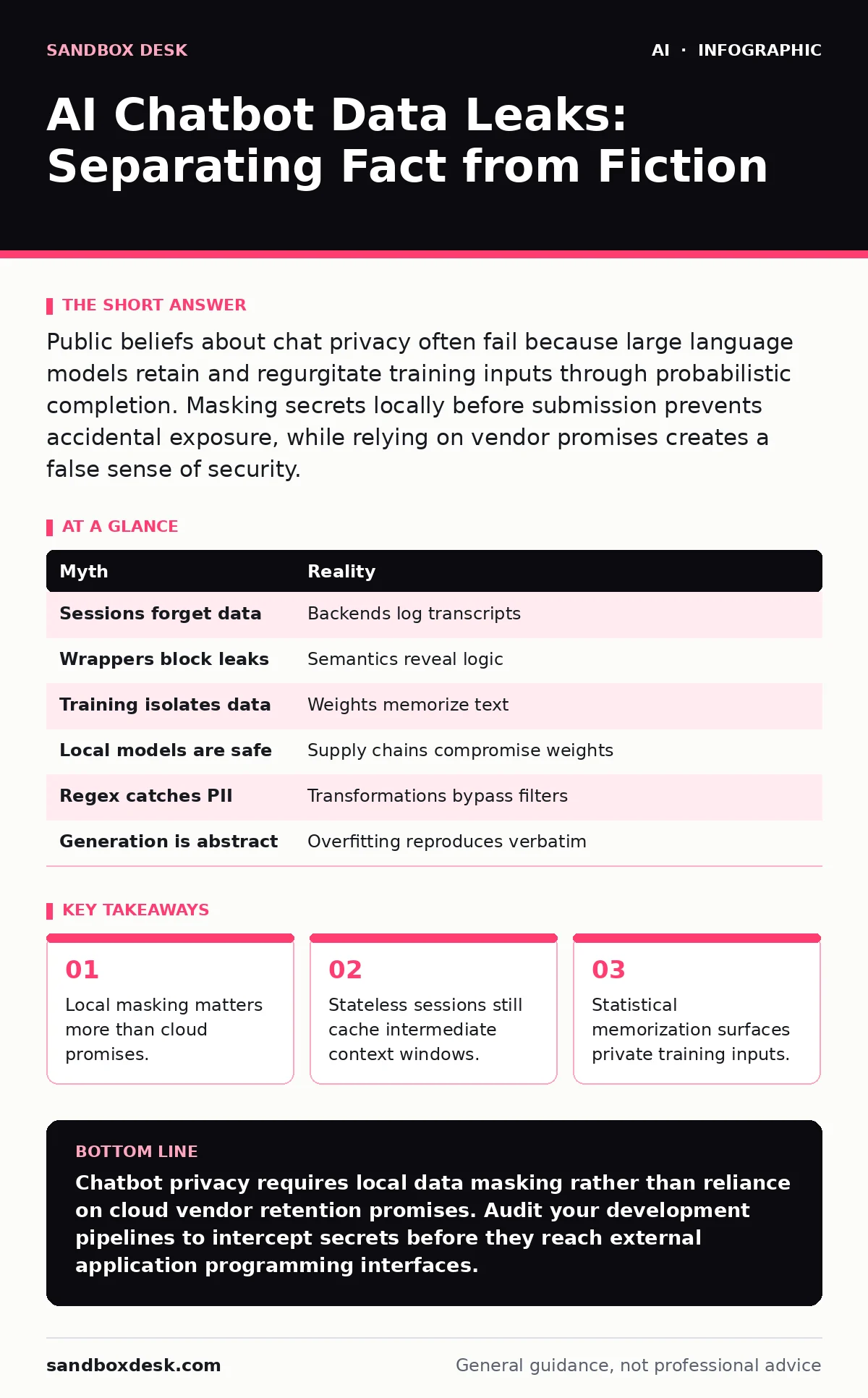
Public beliefs about chat privacy often fail because large language models retain and regurgitate training inputs through probabilistic completion. Masking secrets locally before submission prevents accidental exposure, while relying on vendor promises creates a false sense of security.
Myth: Chatbots forget your data when you close the tab
Reality: Session termination stops the active conversation interface, but backend logging systems preserve complete transcript histories for model improvement and diagnostic auditing purposes. Database persistence layers retain these transcripts indefinitely unless explicit retention policies delete them. Software teams frequently mistake user interface closure for data destruction, ignoring the persistent storage mechanisms operating behind standard web applications.
Cloud providers routinely archive prompt inputs to train subsequent model iterations and diagnose runtime failures. Telemetry collection operates outside standard visibility controls, meaning sensitive design documents remain accessible to internal platform administrators and automated data processing pipelines without explicit user consent.
Myth: Enterprise wrappers prevent all data leakage
Reality: Middleware proxies strip obvious identifiers while passing semantic context that reconstructs proprietary business logic. Semantic compression preserves structural patterns of source code and internal documentation even when specific names and numbers are scrubbed. Traffic inspection tools fail to recognize proprietary architectures disguised as generic programming problems.
Enterprise control wrappers focus heavily on catching explicit keywords like authorization tokens or customer names. Business logic vulnerabilities, however, depend on algorithmic relationships and architectural workflows rather than isolated string values. When developers paste entire functional modules into chat interfaces for refactoring, the underlying semantic intent leaks proprietary mechanics regardless of whether surface-level variables undergo masking.
Myth: Fine-tuning isolates models from public exposure
Reality: Custom model training embeds sensitive source material directly into internal weight matrices through gradient descent adjustments. Training processes designed for domain adaptation inadvertently memorize specific corporate documents alongside general linguistic patterns. Organizations adopting fine-tuning often create centralized repositories of proprietary knowledge that emerge unpredictably during standard inference queries.
Domain adaptation techniques regularly expose organizations to unexpected extraction vectors through carefully crafted prompts. Standard neural network architectures lack internal mechanisms to isolate private training records from public capabilities. Once proprietary documentation enters the training pipeline, extracting those secrets requires little more than steering the probability distribution toward the memorized text anchors during generation cycles.
Myth: Open-source local models guarantee complete privacy
Reality: Running weights on local hardware eliminates network transit risks, but upstream dependencies introduce severe AI supply chain risks through compromised repositories. Weight files downloaded from public registries can contain hidden triggers or backdoors injected during intermediate training stages. Hardware isolation offers zero protection against malicious code embedded inside the model architecture itself.
Local execution protects data in transit, but it leaves the underlying evaluation environment vulnerable to internal exfiltration channels. Custom plugins, vector databases, and retrieval-augmented generation pipelines connect local models to broader enterprise networks. These peripheral integrations frequently bypass internal security perimeters, creating unintended pathways for sensitive operational data to escape hardware boundaries during runtime execution.
Myth: PII scrubbing regex patterns catch every secret
Reality: Regular expressions rely on rigid syntactic structures that fail when developers format credentials using unconventional spacing or encoding methods. Developers often paste credentials wrapped in multi-line comments or JSON payloads that bypass standard pattern matching filters. Adversarial examples generated by minor text transformations easily trick automated sanitization layers while preserving the underlying functional secret.
Surface-level scrubbing assumes that sensitive data conforms to predictable formats like standard API key prefixes. Proprietary data leaks frequently involve internal IP addresses, proprietary database schemas, or algorithmic constants that lack distinct syntactic signatures. Sanitization tools miss these contextual secrets because they search for specific patterns rather than evaluating the broader semantic implications of the submitted text.
See also: AI Usage Policies at Work: Definition, Scope, and Control
Myth: Statistical generation never outputs exact training text
Reality: Overfitted models frequently reproduce exact multi-line blocks of source code and proprietary prose verbatim when prompted with specific contextual cues. High repetition rates in training corpora cause neural networks to memorize exact sequences rather than general abstractions. Prompt engineering techniques extract these memorized fragments by steering the probability distribution toward known training anchors.
Probabilistic completion mechanics ensure that models prioritize familiar linguistic patterns over abstract reasoning during high-confidence generations. Source code repositories containing repetitive boilerplate patterns are exceptionally vulnerable to verbatim extraction. Developers testing code completion features often trigger the generation of exact snippets from internal projects that shared structural similarities with public training datasets.
| Myth | Reality |
|---|---|
| Sessions forget data | Backends log transcripts |
| Wrappers block leaks | Semantics reveal logic |
| Training isolates data | Weights memorize text |
| Local models are safe | Supply chains compromise weights |
| Regex catches PII | Transformations bypass filters |
| Generation is abstract | Overfitting reproduces verbatim |
Key takeaways
- Local masking matters more than cloud promises.
- Stateless sessions still cache intermediate context windows.
- Statistical memorization surfaces private training inputs.
Chatbot privacy requires local data masking rather than reliance on cloud vendor retention promises. Audit your development pipelines to intercept secrets before they reach external application programming interfaces.
Frequently asked questions
How do chatbots memorize specific source code?
Large language models update internal weights based on exact token sequences found in training data, allowing them to reproduce memorized snippets when prompted with matching syntactic patterns.
Can enterprise privacy agreements stop data logging?
Contractual terms restrict human review, but automated logging systems still capture telemetry and transcripts for infrastructure maintenance and abuse monitoring.
What makes prompt sanitization fail so often?
Developers format secrets in countless variations, and rigid pattern matching filters cannot anticipate every encoding scheme or structural obfuscation method.
Are self-hosted models immune to data exfiltration?
Self-hosted deployments keep data off third-party servers, but compromised model weights or malicious dependencies can still exfiltrate inputs through outbound telemetry.
How this guide was produced: written by the Sandbox Desk editorial team with AI assistance, checked against the public references listed below, and reviewed when the facts change. See our editorial policy or report an error.