Difference Between Fine Tuning and Transfer Learning for Models
Fine tuning is a specific method within the broader transfer learning framework, changing how model weights adapt to new tasks without retraining from scratch.

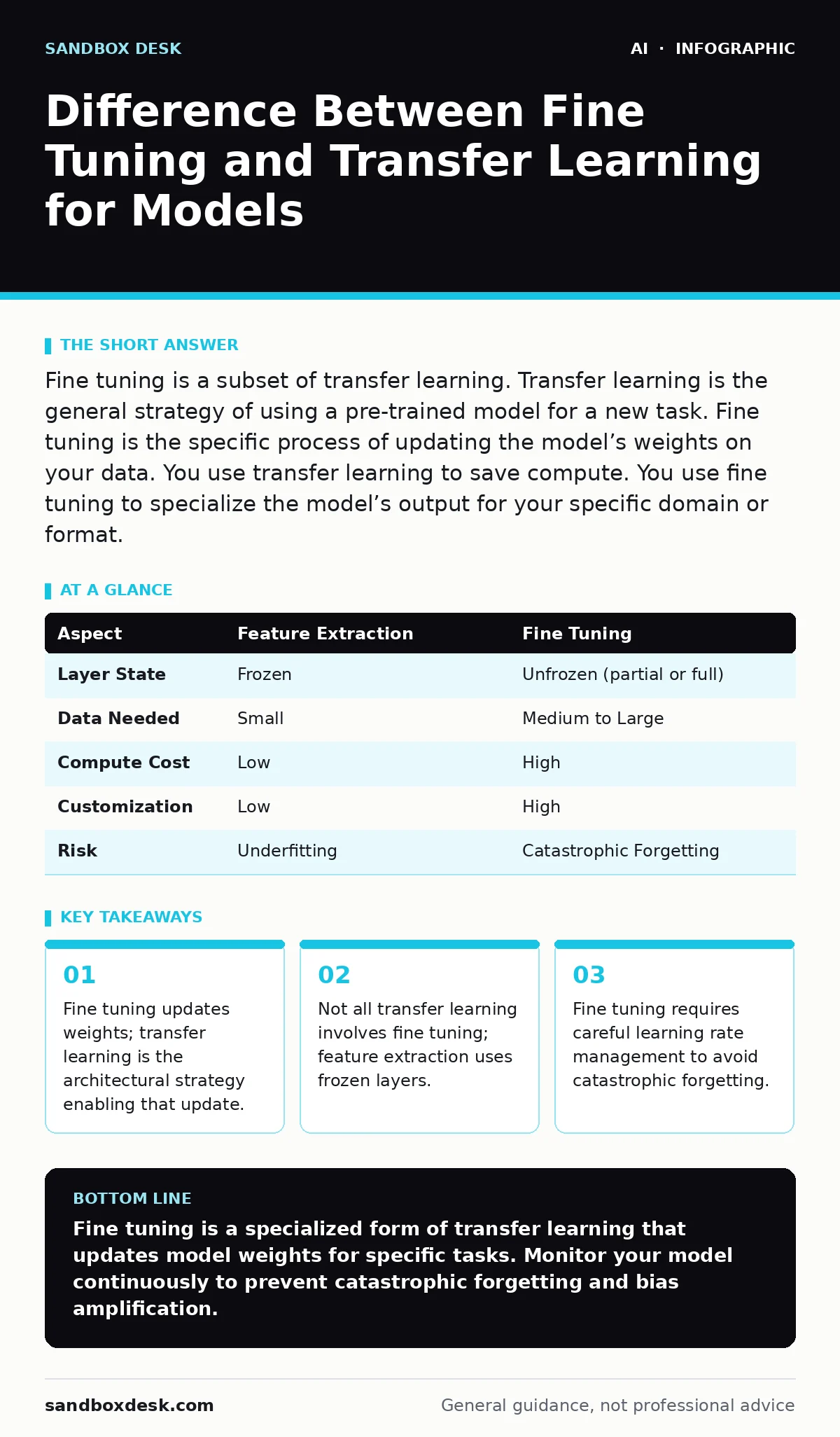
Fine tuning is a subset of transfer learning. Transfer learning is the general strategy of using a pre-trained model for a new task. Fine tuning is the specific process of updating the model’s weights on your data. You use transfer learning to save compute. You use fine tuning to specialize the model’s output for your specific domain or format.
What is the difference between fine tuning and transfer learning?
The difference between fine tuning and transfer learning is that fine tuning is a specific technique while transfer learning is the overarching strategy. Transfer learning allows you to take knowledge from one problem and apply it to another. Fine tuning is the mechanical act of adjusting the model’s internal parameters to fit that new problem. You cannot fine tune without transfer learning, but you can transfer learning without fine tuning. This distinction matters when you plan your compute budget and data requirements.
How does transfer learning work in practice?
Transfer learning works by reusing a model trained on a large, general dataset for a narrower, specific task. The model already understands basic patterns, such as syntax, image edges, or logical structures. You skip the initial training phase that requires massive compute and data. Instead, you start with a model that already knows the fundamentals. This approach reduces the amount of labeled data you need. It also shortens the time to deployment. The model retains its general capabilities while learning your specific requirements.
When do you use feature extraction instead of fine tuning?
You use feature extraction when your new dataset is small or when the source task is very different from the target task. In this method, you freeze the pre-trained layers. You treat the model as a static feature generator. You only train a new classifier head on top. This prevents the model from overfitting to your limited data. It also preserves the general knowledge learned during pre-training. Fine tuning risks destroying that general knowledge if your data is noisy or biased. Feature extraction keeps the base model stable.
What exactly happens during the fine tuning process?
Fine tuning involves unfreezing some or all of the pre-trained model layers. You then continue training on your specific dataset. The model adjusts its weights to minimize loss on your data. This process makes the model specialized for your domain. It learns your specific terminology, style, or visual patterns. The trade-off is compute cost and time. Fine tuning requires more resources than feature extraction. It also requires careful monitoring to ensure the model does not forget its general abilities.
| Aspect | Feature Extraction | Fine Tuning |
|---|---|---|
| Layer State | Frozen | Unfrozen (partial or full) |
| Data Needed | Small | Medium to Large |
| Compute Cost | Low | High |
| Customization | Low | High |
| Risk | Underfitting | Catastrophic Forgetting |
What is catastrophic forgetting and how do you prevent it?
Catastrophic forgetting occurs when the model loses its general knowledge while learning new tasks. The weights shift too far from their original positions. The model becomes too specialized and fails on general inputs. You prevent this by using a low learning rate. A low learning rate makes small, gradual adjustments. You can also use early stopping to halt training before performance degrades. Regularization techniques help maintain the original weight distribution. Monitoring validation loss on general data helps detect this drift early.
See also: How Large Language Models Work: Mechanics, Limits, and Reality · How Machine Learning Changes Cybersecurity Decision Making
How does parameter efficient fine tuning change the workflow?
Parameter efficient fine tuning (PEFT) methods allow you to specialize a model without updating all weights. Techniques like LoRA add small trainable matrices to the existing layers. The base model remains frozen. You only train these small adapter layers. This drastically reduces memory requirements. It also prevents catastrophic forgetting because the core weights never change. You can swap adapters easily to switch tasks. This method is ideal for organizations with limited GPU resources.
When should you avoid fine tuning entirely?
You should avoid fine tuning when your task is already well-solved by the base model. Prompt engineering or retrieval augmented generation might suffice. Fine tuning adds maintenance overhead. You must retrain the model whenever your data distribution shifts. You must monitor for drift and bias. If your data changes frequently, fine tuning becomes a burden. Static prompts or external knowledge bases are more flexible. They do not require retraining the model weights. Choose fine tuning only when the base model consistently fails on your specific format or domain.
How does this relate to securing AI agents and other frameworks?
Fine tuning changes the model’s behavior, which impacts security and compliance. A fine-tuned model may output unexpected tokens if the training data contains malicious patterns. You must treat AI models as untrusted insiders because they can leak training data. The EU AI Act requires transparency about training data and model capabilities. Fine tuning complicates audit trails. You must document what data was used and how the model changed. Refer to our guide on securing AI agents for specific mitigation strategies. Also consider machine learning in cybersecurity for defense applications.
What are the hidden costs of maintaining a fine-tuned model?
The hidden costs include data curation, compute for retraining, and monitoring. You must continuously collect and label new data. The model degrades as the real world changes. You must retrain periodically to maintain accuracy. Each retraining cycle consumes compute resources. You also need infrastructure to manage versions and rollbacks. A fine-tuned model is a living asset that requires constant attention. Budget for these ongoing operational costs, not just the initial training.
How do you evaluate if fine tuning was successful?
You evaluate success by comparing performance against a baseline. Use a held-out test set that represents your real-world data. Measure accuracy, precision, and recall. Also measure generalization by testing on data outside your training distribution. If the model fails on general inputs, it has overfitted. Check for latency changes. Fine tuning should not significantly slow down inference. Compare the fine-tuned model to prompt-based approaches. If the gains are marginal, the compute cost may not be justified.
Key takeaways
- Fine tuning updates weights; transfer learning is the architectural strategy enabling that update.
- Not all transfer learning involves fine tuning; feature extraction uses frozen layers.
- Fine tuning requires careful learning rate management to avoid catastrophic forgetting.
Fine tuning is a specialized form of transfer learning that updates model weights for specific tasks. Monitor your model continuously to prevent catastrophic forgetting and bias amplification.
Frequently asked questions
Can I fine tune a model without labeled data?
No, fine tuning requires labeled data to calculate loss and update weights. Unsupervised methods exist but are different from standard fine tuning.
Does fine tuning make the model larger?
No, fine tuning updates existing weights. The model size remains the same unless you use adapter methods like LoRA, which add small layers.
How much data do I need to fine tune?
It depends on the task complexity. A few hundred examples may suffice for simple classification. Complex tasks may require thousands of examples.
Can I fine tune a model on multiple tasks?
Yes, but you risk catastrophic forgetting. Use multi-task learning techniques or parameter efficient methods to balance performance across tasks.
How this guide was produced: written by the Sandbox Desk editorial team with AI assistance, checked against the public references listed below, and reviewed when the facts change. See our editorial policy or report an error.