Compensating Controls Explained: How to Secure Systems When Patches Fail
Compensating controls provide equivalent protection when direct security fixes are technically impossible or operationally disruptive.

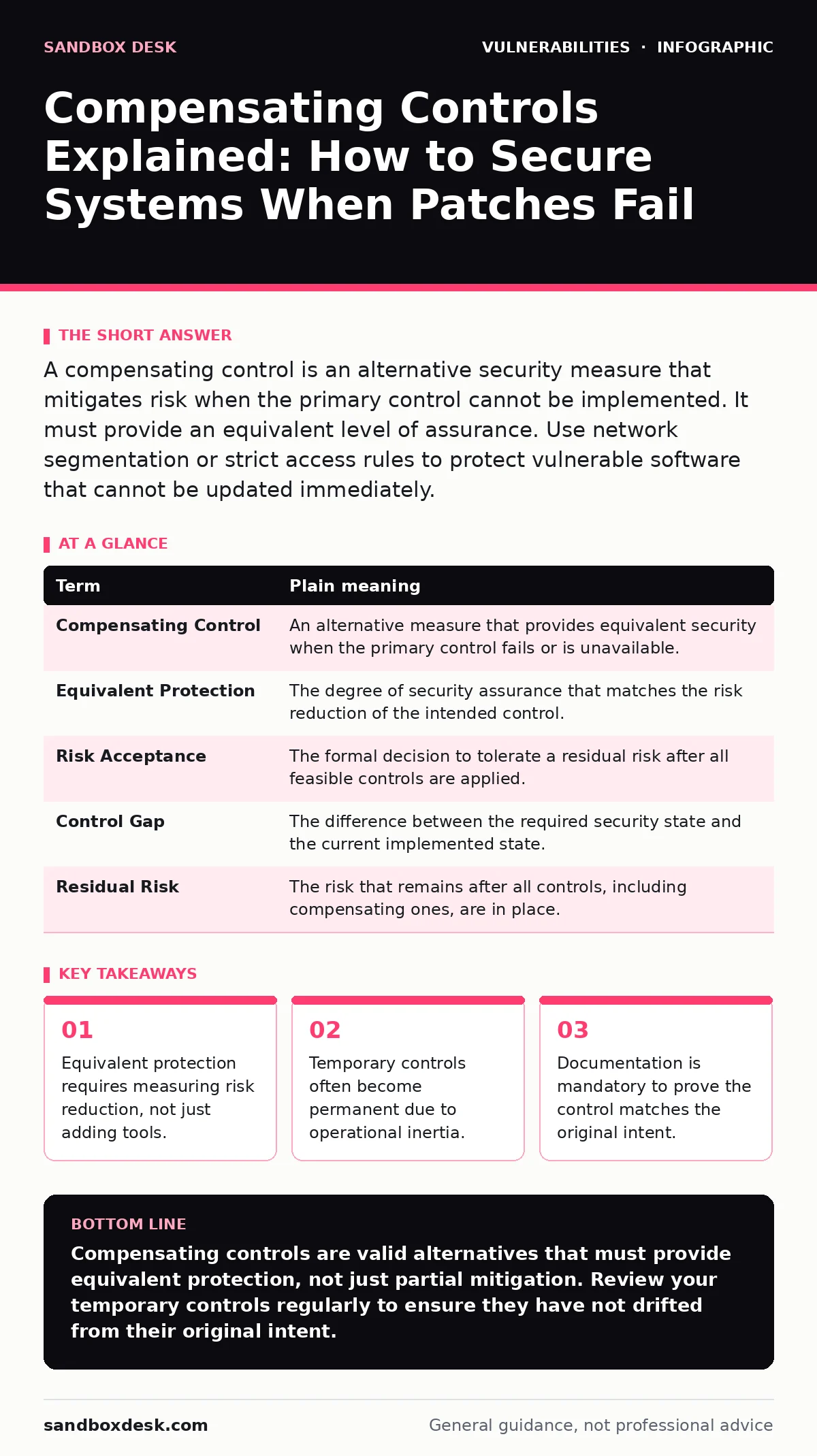
A compensating control is an alternative security measure that mitigates risk when the primary control cannot be implemented. It must provide an equivalent level of assurance. Use network segmentation or strict access rules to protect vulnerable software that cannot be updated immediately.
The Broken Lock Analogy
Imagine a high-security vault with a broken combination lock. The standard procedure is to replace the lock. Suppose the lock manufacturer is out of business and no compatible replacement exists. You cannot fix the primary control. You install a heavy steel bar across the door. You add a motion sensor inside. You station a guard outside. These alternatives are compensating controls. They do not fix the lock, but they prevent unauthorized entry. The risk remains, but the likelihood of success for an attacker drops significantly. The goal is equivalence, not perfection. The steel bar must be as hard to bypass as the original lock was to pick.
Defining the Mechanism
A compensating control addresses a specific gap in security posture. It applies when the recommended control is technically infeasible, operationally impossible, or legally prohibited. The key requirement is equivalence. The alternative must reduce the risk to a level comparable to what the original control would have achieved. You cannot substitute a weaker measure and call it compensation. If the original control prevented data exfiltration, the compensating control must also prevent data exfiltration. It does not need to work the same way, but it must achieve the same outcome.
| Term | Plain meaning |
|---|---|
| Compensating Control | An alternative measure that provides equivalent security when the primary control fails or is unavailable. |
| Equivalent Protection | The degree of security assurance that matches the risk reduction of the intended control. |
| Risk Acceptance | The formal decision to tolerate a residual risk after all feasible controls are applied. |
| Control Gap | The difference between the required security state and the current implemented state. |
| Residual Risk | The risk that remains after all controls, including compensating ones, are in place. |
The Hidden Cost of Equivalence
Equivalence is difficult to prove. You must demonstrate that the alternative control closes the same attack vector. Suppose you cannot patch a server due to legacy application compatibility. You isolate the server on a separate network segment. You restrict access to that segment via strict firewall rules. You monitor traffic for anomalies. This combination must be shown to be as effective as the patch. The hidden cost is complexity. Each compensating control adds maintenance overhead. You now manage network rules, monitoring alerts, and access lists. If one part fails, the whole compensation fails. The system becomes brittle.
When Standard Advice Fails
Standard security advice usually prioritizes patching. For example, guidance on change management for security patches emphasizes speed and consistency. However, some systems cannot be restarted. Some applications break with minor library updates. In these cases, patching is not an option. You must look elsewhere. Consider OpenSSL vulnerabilities in embedded devices. The device firmware cannot be updated easily. You cannot change the library. You must restrict what the device can do. You limit its network connectivity. You restrict its interaction with other systems. This is a compensating strategy. It accepts the vulnerability but limits the blast radius.
Practical Implementation Steps
Implementing compensating controls requires a structured approach. You cannot guess at equivalence. You must document the decision. You must validate the control. Follow these steps to ensure your alternatives hold up under scrutiny.
- Identify the specific vulnerability and the recommended control. Document why the recommended control is not feasible.
- Design an alternative control that addresses the same risk. Ensure it prevents the same attack scenario.
- Validate the control through testing or review. Confirm it provides equivalent protection. Document the validation results.
See also: How Vulnerability Scanning Works: The Hidden Mechanics and Limits · Security Culture Misread: Why Training Fails and Policy Succeeds
The Drift Problem
Compensating controls suffer from drift. The environment changes. The original justification for the control may no longer apply. The alternative control may become outdated. Suppose you isolated a server because of Apache Struts vulnerabilities. You restricted its internet access. Two years later, the server needs to call an external API. You open a port. You weaken the isolation. The compensating control is no longer equivalent. The risk increases. You must review these controls regularly. They are not set-and-forget. They require active management. This adds to the operational burden.
Documenting the Decision
Documentation is the most critical part of compensating controls. You must justify why the primary control was skipped. You must describe the alternative. You must prove equivalence. Auditors will look for this evidence. Without it, the control is just a guess. Reference known vulnerabilities to contextualize the risk. For instance, checking the National Vulnerability Database helps you understand the severity of the unpatched flaw. This context supports your decision to use a specific compensating measure. It shows you considered the threat level. It demonstrates due diligence.
Integrating with Development
Compensating controls should not be an afterthought. They should be part of the planning phase. During the secure software development lifecycle, consider failure modes. What happens if patching is delayed? What is the fallback? Design the system to support easy isolation. Use containerization or microservices to limit blast radius. This makes compensating controls easier to implement. It reduces the need for complex workarounds later. Proactive design reduces the reliance on reactive compensation. It builds resilience into the architecture.
Managing Long-Term Risk
Compensating controls increase technical debt. They add complexity. They require ongoing validation. You must track them. You must review them. You must remove them when the primary control becomes feasible. Do not let them accumulate. Each one is a potential point of failure. Monitor their effectiveness. If the risk changes, adjust the control. If the environment changes, re-evaluate the equivalence. This continuous process ensures that your security posture remains aligned with your risk tolerance. It prevents the gradual erosion of security guarantees.
Key takeaways
- Equivalent protection requires measuring risk reduction, not just adding tools.
- Temporary controls often become permanent due to operational inertia.
- Documentation is mandatory to prove the control matches the original intent.
Compensating controls are valid alternatives that must provide equivalent protection, not just partial mitigation. Review your temporary controls regularly to ensure they have not drifted from their original intent.
Frequently asked questions
Can compensating controls replace patching permanently?
They can, but only if they provide equivalent protection and are formally accepted as part of the risk posture. Permanent use increases maintenance overhead and complexity.
How do I prove equivalence to an auditor?
Document the risk assessment, the reason the primary control is infeasible, and the testing results showing the alternative control blocks the same attack vectors.
Are compensating controls allowed in compliance frameworks?
Most frameworks, including those tracking **CISA KEV due dates**, allow compensating controls if they mitigate the specific risk to an acceptable level and are properly documented.
What if the compensating control fails?
The underlying vulnerability remains exposed. You must have incident response plans ready and consider the compensating control as a temporary measure until a primary fix is available.
How this guide was produced: written by the Sandbox Desk editorial team with AI assistance, checked against the public references listed below, and reviewed when the facts change. See our editorial policy or report an error.