AI Coding Assistant Supply-Chain Risks Explained Simply
Code completion tools do not just write logic; they can introduce unverified packages, poisoned suggestions, and hidden upstream dependencies.

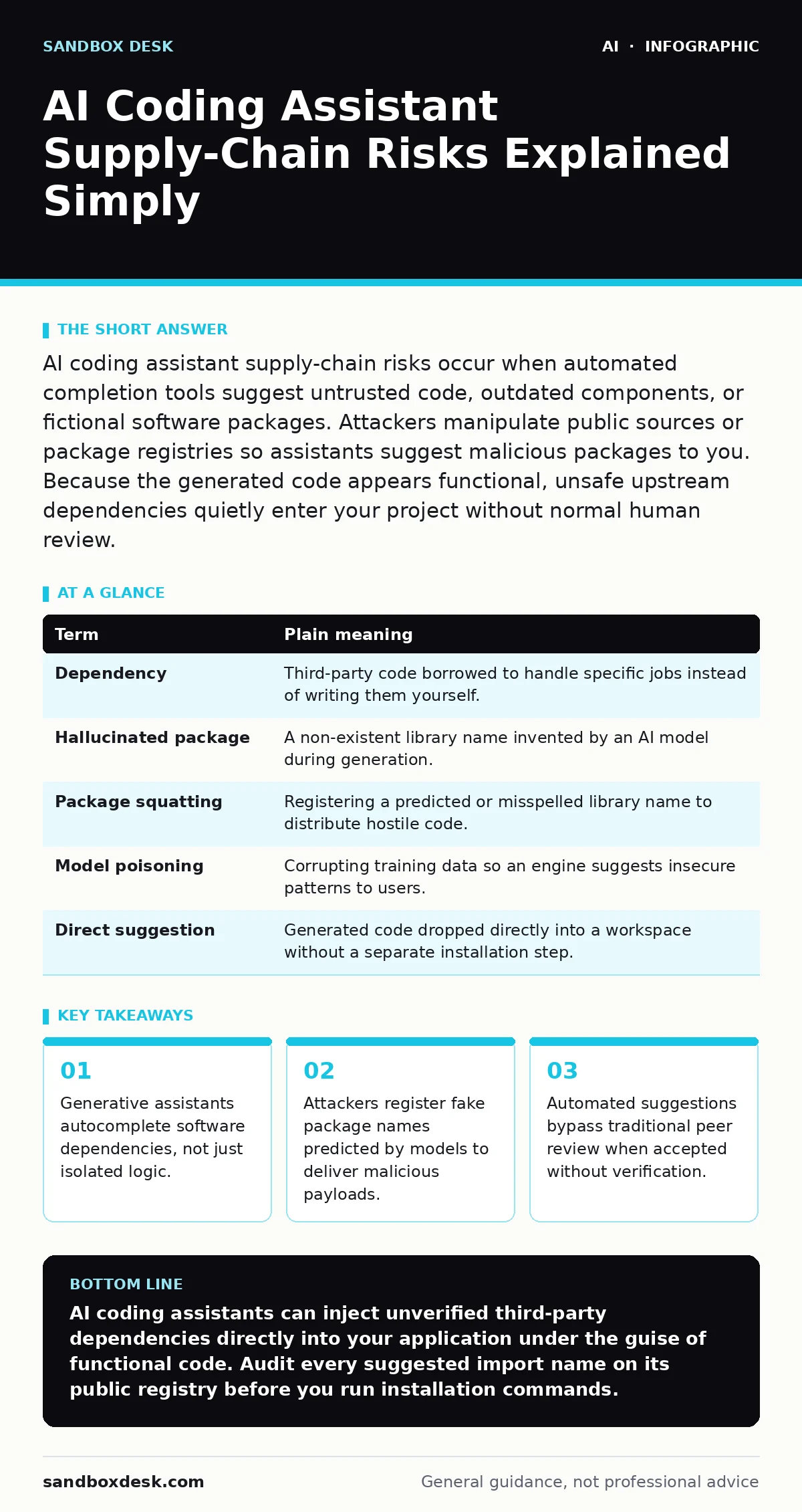
AI coding assistant supply-chain risks occur when automated completion tools suggest untrusted code, outdated components, or fictional software packages. Attackers manipulate public sources or package registries so assistants suggest malicious packages to you. Because the generated code appears functional, unsafe upstream dependencies quietly enter your project without normal human review.
The Catering Van in Your Kitchen
Automated coding tools act like an eager catering assistant working inside your private kitchen. You ask for a quick soup recipe, and instead of telling you to chop fresh vegetables, the helper reaches out to an external supplier van parked outside and pulls in pre-mixed cans. Most of the time, the cans save hours of preparation. The risk appears when the helper orders an ingredient label that sounds standard, but belongs to a rogue delivery truck waiting down the street.
Software construction relies on external components called dependencies. When an assistant writes code, it often generates lines that import libraries from public repositories. You might verify the arithmetic in the suggested function while completely overlooking the delivery van backing into your loading bay.
Core Vocabulary of AI Code Dependencies
| Term | Plain meaning |
|---|---|
| Dependency | Third-party code borrowed to handle specific jobs instead of writing them yourself. |
| Hallucinated package | A non-existent library name invented by an AI model during generation. |
| Package squatting | Registering a predicted or misspelled library name to distribute hostile code. |
| Model poisoning | Corrupting training data so an engine suggests insecure patterns to users. |
| Direct suggestion | Generated code dropped directly into a workspace without a separate installation step. |
Where Poison Enters the Delivery Route
Upstream supply chains break down across 3 distinct zones when you rely on machine-generated suggestions. First, public training sets contain unmaintained code, insecure examples, and deprecated APIs. Second, the underlying models can invent plausible package names, a weakness adversaries exploit by claiming those empty names on public registries before you look for them. Third, extensions linking your text editor to remote language engines can expose local project files, creating an issue covered in our guide on training data leakage.
[Public Repositories] -> [Poisoned Training Data] -> [AI Assistant] -> [Unvetted Suggestions in Editor]
Supply-chain attacks through machine helpers rarely involve altered system binaries on your laptop. Attackers target the suggestion mechanism itself, turning your trusted development tool into a distribution channel for unauthorized code.
The False Comfort of Working Syntax
Working code provides an illusion of safety. You run a generated block, the unit test passes, and the task looks complete. Beneath that passing test, the suggested snippet may pull in an unpinned dependency that executes a script during installation. Attackers know that functional code lowers your defenses, so they wrap hostile actions inside genuinely useful utility routines.
Standard review habits frequently miss these inclusions. A human reviewer examines internal logic closely but treats an import statement as harmless administrative plumbing. That imbalance creates a blind spot where compromised third-party code bypasses normal security checks.
The Cost of Autopiloting Complex Integrations
Connecting assistants directly to terminal execution tools or workspace extensions increases the hazard. When you run an assistant with authority to install its own recommendations, you remove human inspection from the chain, creating vulnerabilities examined in our analysis of insecure AI plugins and agents.
Model builders cannot manually audit every package an assistant predicts. If an assistant predicts an import that solves your problem, it selects the name purely on mathematical probability. If an adversary studies what models frequently output for a common task, the adversary can easily publish a weaponized package with that exact name.
See also: Malware Targeting AI Infrastructure: Threats and Defense · Treat AI Models as Untrusted Insiders: 8 Security Practices
Try This Routine Right Now
You can establish safe habits without abandoning your tools. Apply these 3 steps to the very next completion your assistant generates:
- Verify the package registry: Open the public repository for any suggested library and confirm it has a legitimate history, active maintainers, and real releases.
- Pin the exact release: Lock your configuration to a verified release hash rather than accepting floating version numbers.
- Execute an isolated build: Run the installation in an isolated sandbox without access to sensitive local keys or deployment credentials.
Organizations should formalize these inspection steps, a process detailed in our overview of AI usage policies at work.
Inspecting Suggested Code for Upstream Threats
- Inspect every new import statement against your team's approved package list.
- Check registry publication dates to ensure the library is not brand new.
- Review package installation scripts for unusual network calls.
- Run AI security testing against generated code blocks before merging.
Key takeaways
- Generative assistants autocomplete software dependencies, not just isolated logic.
- Attackers register fake package names predicted by models to deliver malicious payloads.
- Automated suggestions bypass traditional peer review when accepted without verification.
AI coding assistants can inject unverified third-party dependencies directly into your application under the guise of functional code. Audit every suggested import name on its public registry before you run installation commands.
Frequently asked questions
Can an AI coding assistant steal my proprietary code?
An assistant can expose proprietary logic if your workspace sends local files to third-party servers for completion processing. Review the data retention settings of your tool to prevent company secrets from entering shared training pipelines.
What is package hallucination in automated coding?
Package hallucination occurs when an AI model invents a plausible-sounding library name that does not actually exist. Attackers monitor these patterns, register the invented names on public package managers, and wait for unsuspecting users to download them.
Does static code analysis catch poisoned AI suggestions?
Static analysis catches known insecure syntax and flagged signatures, but it often misses brand-new malicious packages that carry out functional logic. You must combine static scanners with manual dependency verification and strict package registries.
Are local offline AI models safe from supply-chain risks?
Local offline models do not leak your code to cloud providers, but they still inherit the bad habits and poisoned dependencies present in their training data. An offline assistant can still recommend compromised or hallucinated public packages.
How this guide was produced: written by the Sandbox Desk editorial team with AI assistance, checked against the public references listed below, and reviewed when the facts change. See our editorial policy or report an error.