Security Culture Misread: Why Training Fails and Policy Succeeds
Security culture is not about compliance checkboxes but about the invisible social contracts that determine whether a developer bypasses a control under pressure.

Most teams mistake security culture for mandatory training or strict rules. True culture is the shared understanding of risk that guides behavior when no one is watching. It requires aligning incentives, reducing friction, and accepting that humans will optimize for speed unless the path of least resistance is also the secure path.
Misreading: Culture is a Training Program
Many organizations equate security culture with the completion rate of annual e-learning modules. Management views this as a solved problem. This is a measurement error.
Training provides awareness, but it does not create habit. A developer who knows what a SQL injection is will still write vulnerable code if the deadline is tight and the code review process is slow. Culture is the social pressure that exists when the trainer is not in the room. If the team culture rewards shipping features quickly over writing secure code, the training becomes background noise. The correct reading is that training is an input, but culture is the output of daily decisions. You build culture by making security the easy choice, not the right choice.
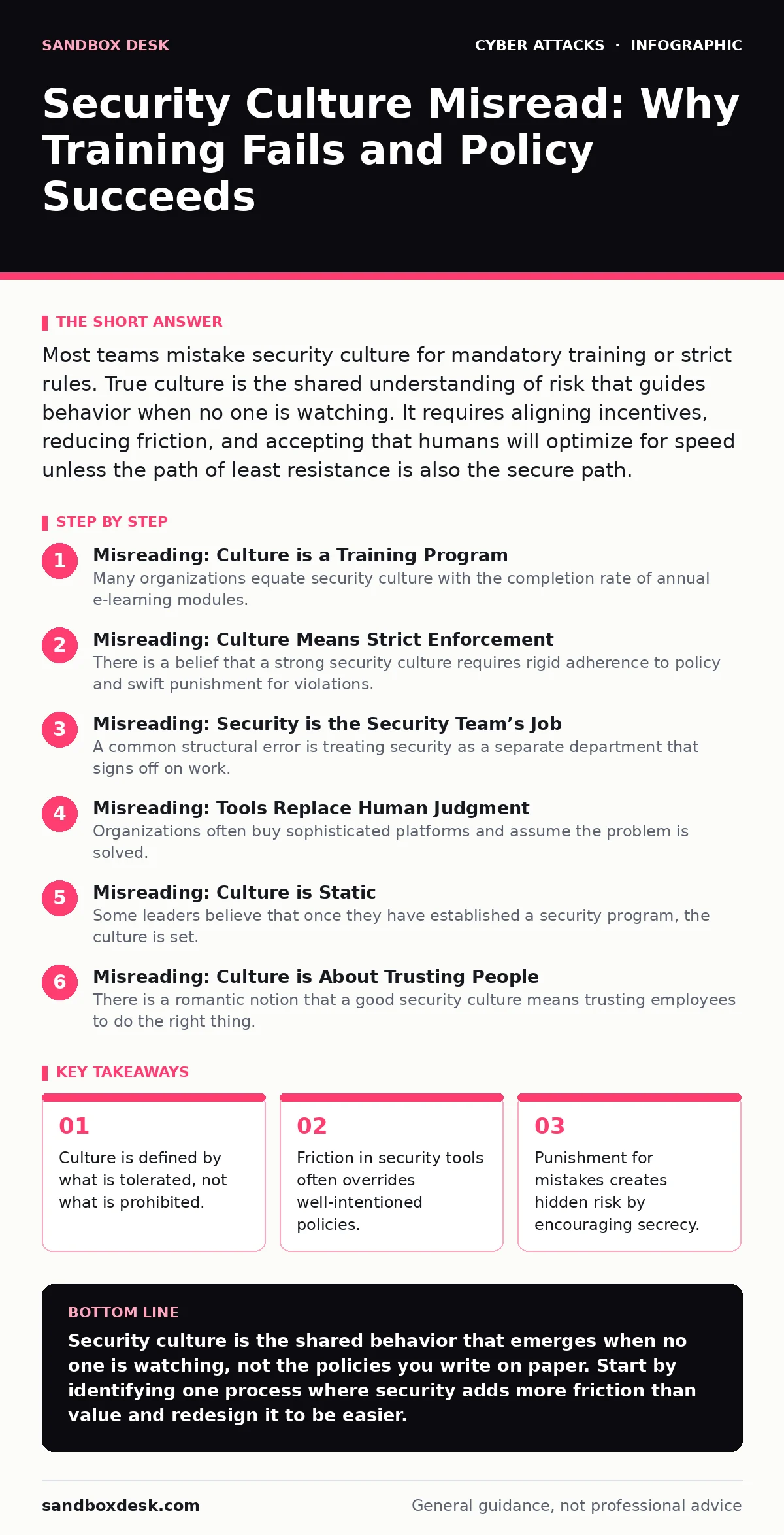
Misreading: Culture Means Strict Enforcement
There is a belief that a strong security culture requires rigid adherence to policy and swift punishment for violations. This approach assumes that fear of penalty will drive secure behavior. In practice, strict enforcement often drives bad behavior underground.
Suppose a developer discovers a critical bug in production. If the culture is punitive, they may hide the bug to avoid blame. This delays the fix and increases exposure. The correct reading is that culture is defined by what you tolerate, not what you forbid. If you punish honest mistakes, you lose visibility. You need a culture where reporting a mistake is seen as a contribution to system stability, not a career-limiting move. This does not mean ignoring negligence. It means distinguishing between a malicious act and a human error made in a complex system.
Misreading: Security is the Security Team’s Job
A common structural error is treating security as a separate department that signs off on work. The development team builds the product, and the security team reviews it at the end. This creates a bottleneck and fosters an "us versus them" dynamic.
This model fails because security cannot be inspected into a product after it is built. The correct reading is that security is a shared responsibility embedded in the engineering workflow. This aligns with zero trust security principles, where trust is never assumed and must be verified continuously. Every developer acts as a security engineer for their own code. The security team’s role shifts from gatekeeper to enabler, providing tools and frameworks that make secure coding easier. When security is seen as a specialized silo, developers view it as an obstacle. When it is integrated, it becomes part of the craft.
Misreading: Tools Replace Human Judgment
Organizations often buy sophisticated platforms and assume the problem is solved. You might implement intrusion detection systems that alert on every anomaly. You might deploy web filtering that blocks all non-business sites. These tools reduce risk, but they do not create culture.
If the tools generate too many false positives, teams will learn to ignore them. This is known as alert fatigue. The correct reading is that tools must support human judgment, not replace it. Culture determines how those alerts are handled. If the team knows how to investigate a Bluetooth attacks warning or distinguish a benign scan from a real threat, the tool adds value. If they do not, the tool is just noise. Security culture is the ability of the team to interpret the data these tools provide.
Misreading: Culture is Static
Some leaders believe that once they have established a security program, the culture is set. They create a handbook and expect it to remain relevant. This ignores the fact that technology and threats evolve.
The landscape of initial access vectors changes constantly. New frameworks, libraries, and deployment methods introduce new risks. A culture that was effective five years ago may be obsolete today. The correct reading is that culture must be adaptive. It requires continuous feedback loops. You must regularly review how the team responds to new threats like USB drop attacks or whaling attacks. If the response is slow or confused, the culture needs adjustment. Culture is a verb, not a noun. It is the ongoing process of aligning behavior with current risks.
See also: How Tabletop Exercises Work: Step-by-Step Mechanism and Limits · How Vulnerability Scanning Works: The Hidden Mechanics and Limits
Misreading: Culture is About Trusting People
There is a romantic notion that a good security culture means trusting employees to do the right thing. While trust is important, it is not a security control. Trusting people without verification is a liability.
The correct reading is that you must verify, not trust. This does not mean you distrust your staff. It means you recognize that accounts are compromised, credentials are leaked, and insider threats exist. A strong culture accepts that verification is a form of respect for the system’s integrity. It implements checks and balances that protect both the organization and the individual. For instance, requiring multi-factor authentication is not a lack of trust in the user; it is a recognition that passwords are weak. Culture here is the acceptance that these controls are necessary for collective safety.
Key takeaways
- Culture is defined by what is tolerated, not what is prohibited.
- Friction in security tools often overrides well-intentioned policies.
- Punishment for mistakes creates hidden risk by encouraging secrecy.
- Trust must be verified continuously, not assumed at the perimeter.
Security culture is the shared behavior that emerges when no one is watching, not the policies you write on paper. Start by identifying one process where security adds more friction than value and redesign it to be easier.
Frequently asked questions
How do I measure security culture without surveys?
Look at incident response times and the number of self-reported errors. High self-reporting and fast resolution indicate a healthy culture where transparency is valued over blame.
Can remote teams have a strong security culture?
Yes, but it requires more explicit communication. You must document decisions and standardize workflows so that security behaviors are consistent regardless of location or time zone.
What if developers resist security controls?
Resistance usually indicates friction. Investigate why the control is hard to use. Simplify the process or automate it. If the secure path is harder than the insecure path, you will lose the culture battle.
How does security culture affect hiring?
It defines the baseline expectations. You should ask candidates how they handle security failures in their past roles. Their answer will show whether they prioritize blame-shifting or problem-solving.
How this guide was produced: written by the Sandbox Desk editorial team with AI assistance, checked against the public references listed below, and reviewed when the facts change. See our editorial policy or report an error.