Apache Struts Vulnerability Prevention Checklist for Secure Deployments
Default configuration choices in Apache Struts often expose remote code execution paths that standard scanning tools miss without manual verification of interceptor stacks.

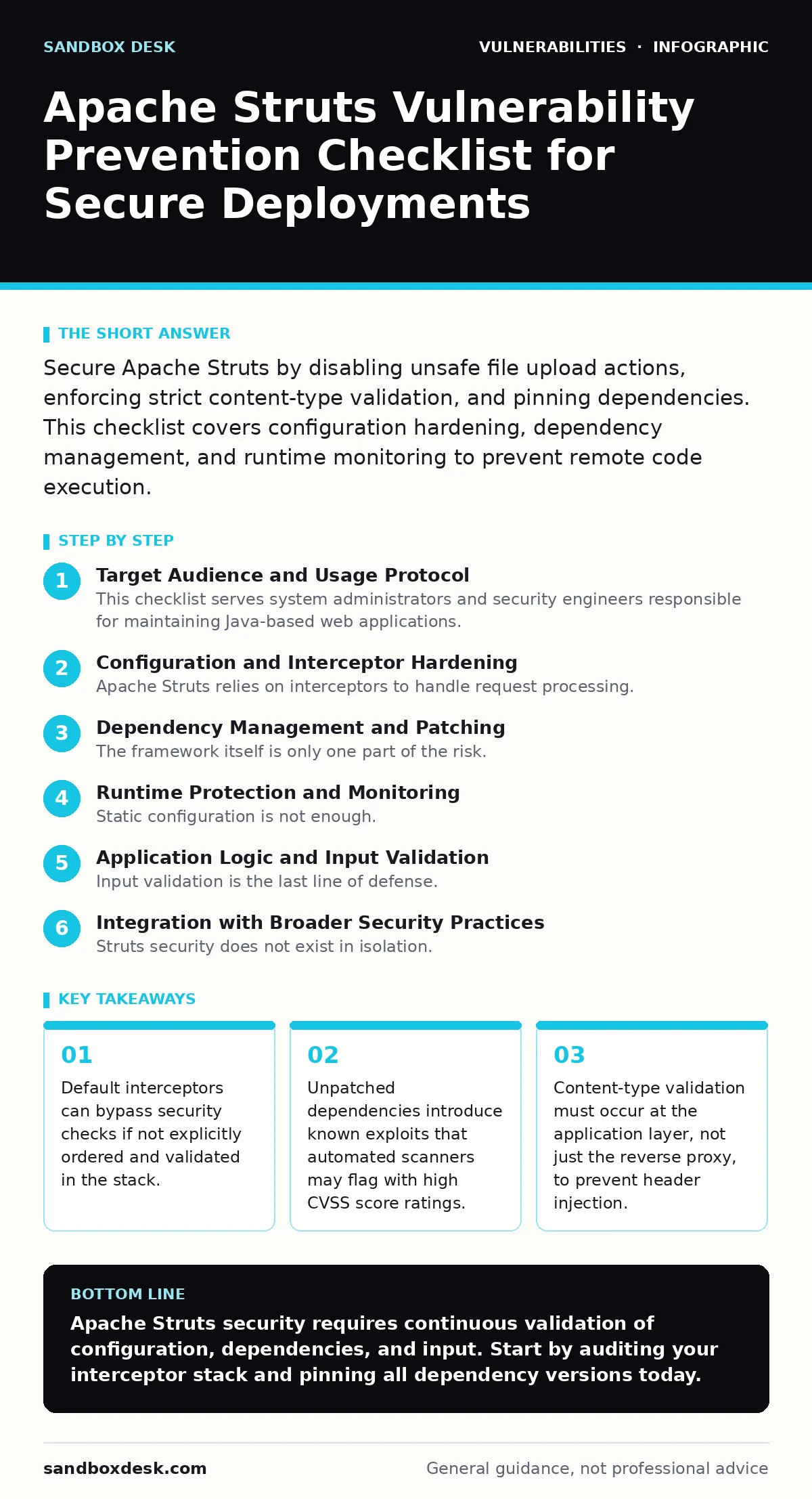
Secure Apache Struts by disabling unsafe file upload actions, enforcing strict content-type validation, and pinning dependencies. This checklist covers configuration hardening, dependency management, and runtime monitoring to prevent remote code execution.
Target Audience and Usage Protocol
This checklist serves system administrators and security engineers responsible for maintaining Java-based web applications. You use this list during initial deployment, after major version upgrades, and during routine security audits. The items are grouped by operational phase to match your workflow. Do not treat this as a one-time audit. You apply these controls continuously as new threats emerge. Imagine a deployment where a single misconfigured action allows an attacker to execute arbitrary commands on the server. This checklist prevents that scenario by enforcing strict validation and minimal exposure.
Configuration and Interceptor Hardening
Apache Struts relies on interceptors to handle request processing. Misconfigured intercepters are the primary vector for many historical breaches. You must ensure the security interceptor is placed correctly in the stack.
- Audit the defaultStack configuration: The default stack may include interceptors that allow unsafe operations if not explicitly restricted.
- Disable unused actions and packages: Exposed actions increase the attack surface and provide more entry points for exploitation.
- Enforce strict content-type validation: Relying on client-supplied headers allows attackers to bypass filters by spoofing MIME types.
- Disable file upload functionality where unnecessary: File upload components are frequently targeted for remote code execution via crafted payloads.
Dependency Management and Patching
The framework itself is only one part of the risk. Third-party libraries often contain the actual vulnerability. You must manage the entire dependency tree.
- Pin dependency versions to known secure releases: Floating versions can introduce unpatched libraries during routine updates.
- Monitor CISA KEV due dates: Known exploited vulnerabilities require immediate attention regardless of internal risk assessments.
- Implement automated dependency scanning: Manual checks are prone to error and fail to catch transitive dependencies.
- Review vulnerability remediation SLAs: Define clear timelines for patching critical issues to reduce exposure windows.
Suppose a minor library update introduces a backdoor. Without pinned versions and automated scanning, this change slips into production unnoticed. You must verify every change against a trusted source.
Runtime Protection and Monitoring
Static configuration is not enough. You need runtime controls to detect and block exploitation attempts.
- Enable detailed request logging: Capturing full request headers and bodies helps identify injection attempts post-incident.
- Deploy a web application firewall: A WAF can block known exploit patterns before they reach the application logic.
- Monitor for unusual outbound connections: Remote code execution often results in data exfiltration or command-and-control traffic.
- Validate input length and complexity: Excessive input sizes or special characters often indicate injection attempts.
Application Logic and Input Validation
Input validation is the last line of defense. You must validate all data entering the system.
- Implement server-side validation for all parameters: Client-side validation can be bypassed by determined attackers.
- Use allowlists for expected input formats: Denylists are incomplete and allow attackers to find bypasses.
- Encode output to prevent cross-site scripting: Proper encoding neutralizes malicious scripts injected into the response.
- Review WebSocket vulnerabilities if used: Real-time communication channels can be hijacked if not properly authenticated.
See also: Data Scraping Meaning: How Automated Extraction Works and What It Costs
Integration with Broader Security Practices
Struts security does not exist in isolation. It interacts with other technologies and frameworks.
- Compare controls with PHP application vulnerabilities: Different languages share common injection patterns that require similar mitigation strategies.
- Assess cross-site WebSocket hijacking risks: If your application uses WebSockets, ensure session tokens are not exposed to third-party sites.
- Evaluate NoSQL injection risks in data layers: If Struts interacts with NoSQL databases, ensure query parameters are properly sanitized.
- Align with hardening a WordPress site principles: While different platforms, the principles of minimal exposure and strict access control remain valid.
Continuous Review and Testing
Security is a process, not a product. You must continuously test your defenses.
- Conduct regular penetration testing: External testers identify logic flaws that automated scanners miss.
- Review access logs for anomalies: Unusual access patterns may indicate reconnaissance or exploitation attempts.
- Update threat intelligence feeds: New exploit techniques emerge regularly and require updated detection rules.
- Train developers on secure coding practices: Human error is the weakest link in any security chain.
Final Verification Steps
Before considering your deployment secure, perform a final review.
- Verify all checklist items are complete: Missing even one item can leave a critical gap.
- Document all configuration decisions: Future auditors need to understand the rationale behind your choices.
- Schedule the next review cycle: Security requirements change as the application evolves.
- Communicate findings to stakeholders: Transparency ensures everyone understands the risk posture.
Key takeaways
- Default interceptors can bypass security checks if not explicitly ordered and validated in the stack.
- Unpatched dependencies introduce known exploits that automated scanners may flag with high CVSS score ratings.
- Content-type validation must occur at the application layer, not just the reverse proxy, to prevent header injection.
Apache Struts security requires continuous validation of configuration, dependencies, and input. Start by auditing your interceptor stack and pinning all dependency versions today.
Frequently asked questions
How do I know if my Apache Struts version is vulnerable?
Check the official Apache Struts advisories and compare your version against the list of affected releases.
Can a web application firewall fully protect against Struts vulnerabilities?
No, a WAF provides an additional layer of defense but cannot replace secure coding and proper configuration.
What is the most common cause of Struts exploitation?
Misconfigured interceptors and unpatched dependencies are the most frequent causes of successful attacks.
How often should I review my Struts security configuration?
Review your configuration after every update and at least quarterly during routine audits.
How this guide was produced: written by the Sandbox Desk editorial team with AI assistance, checked against the public references listed below, and reviewed when the facts change. See our editorial policy or report an error.