Broken Object Level Authorization: Risks and Low-Cost Protections
Broken object level authorization allows attackers to access data by simply changing an ID number in a URL, bypassing most standard perimeter defenses.
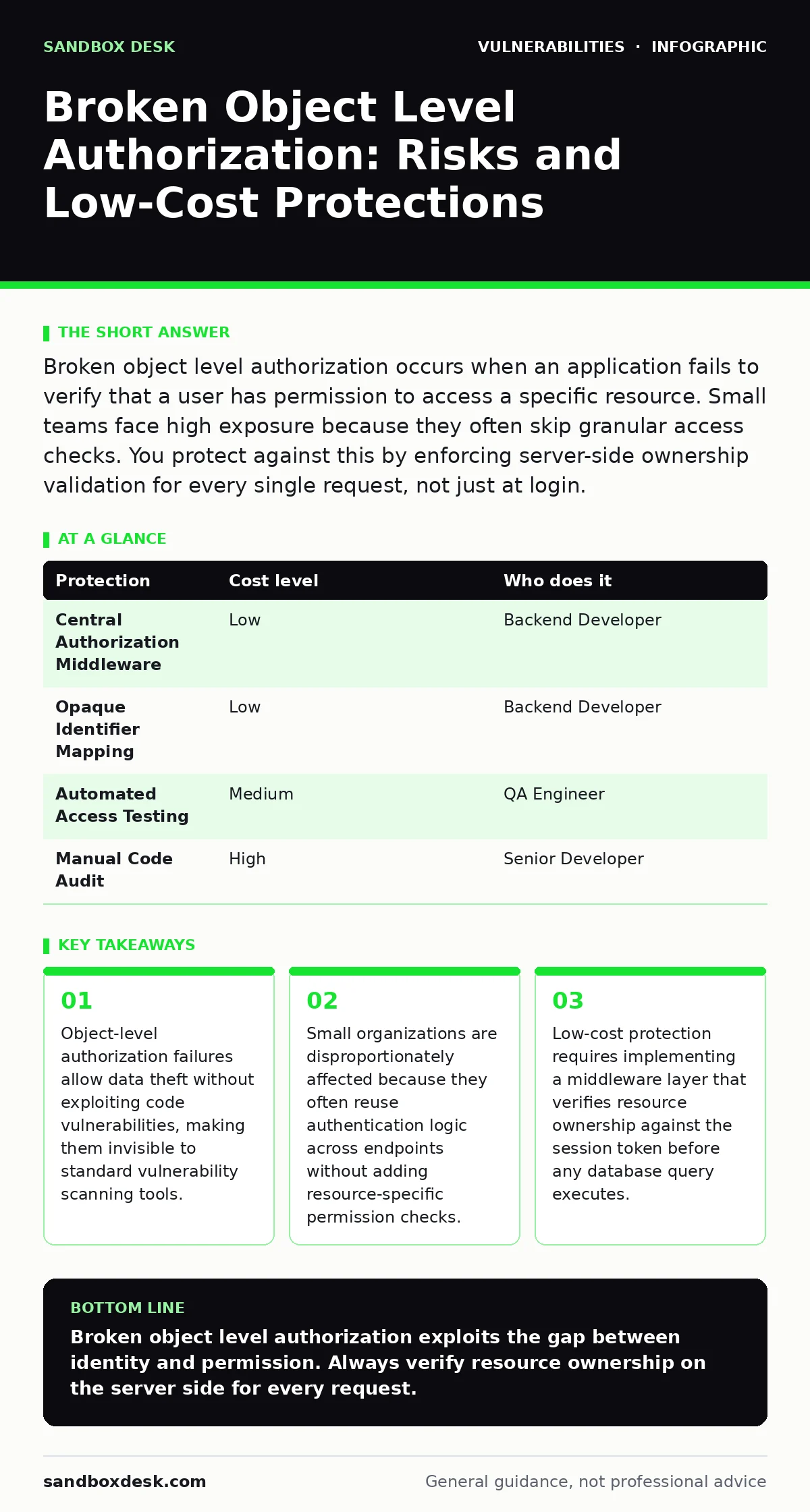
Broken object level authorization occurs when an application fails to verify that a user has permission to access a specific resource. Small teams face high exposure because they often skip granular access checks. You protect against this by enforcing server-side ownership validation for every single request, not just at login.
Why Small Organizations Face Elevated Exposure
Small organizations often prioritize feature delivery over security architecture. This creates a blind spot where authentication works, but authorization does not. Authentication confirms who the user is. Authorization confirms what the user can do. Many small teams assume that logging in is sufficient. They build endpoints that accept an ID parameter and return the corresponding data. They forget to verify that the logged-in user owns that ID. This gap exists because testing authorization requires checking every combination of user and resource. Testing authentication only requires checking if a password works. The effort difference is significant.
This exposure is not unique to small teams, but the impact is higher. Large enterprises often have dedicated security teams that catch these errors. Small teams rely on developers who may not know how to secure object-level access. They might rely on default credentials for internal tools, compounding the risk. When an attacker finds one valid session, they can pivot to any object they can guess the ID for. The attack surface grows with every new feature that exposes an ID.
The Mechanics of ID Manipulation Attacks
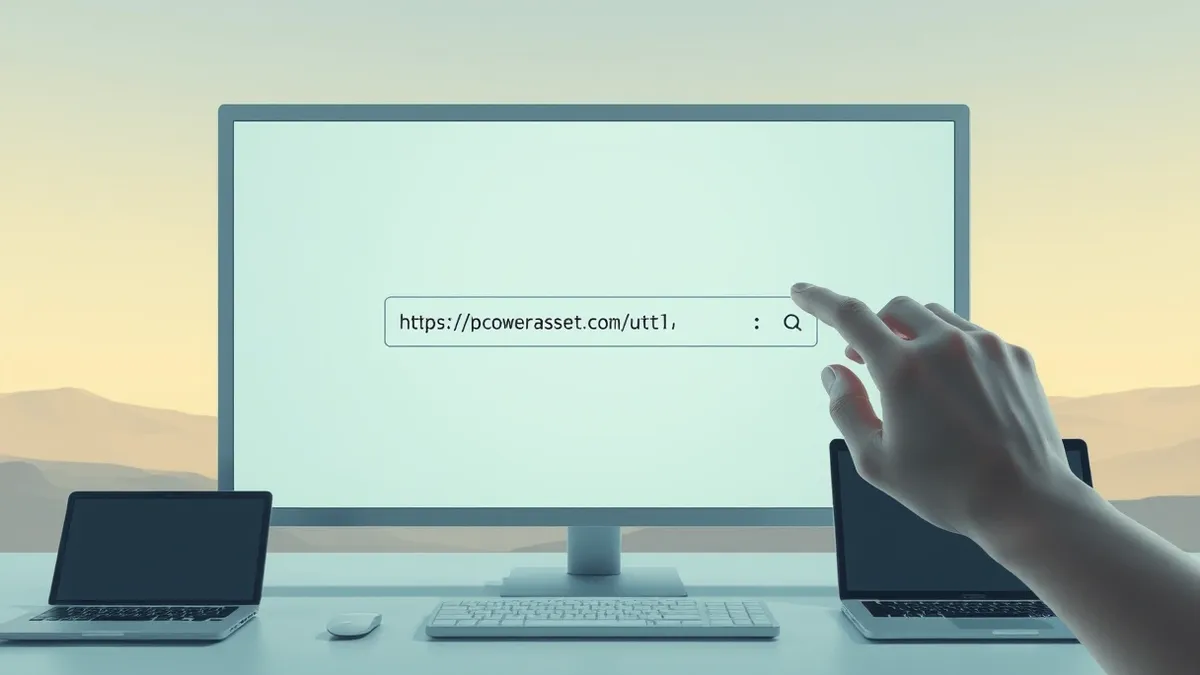
Broken object level authorization relies on predictable resource identifiers. If your system uses sequential integers for IDs, an attacker can guess them. They start at 1 and increment until they find valid data. If you use UUIDs, the attack is harder but not impossible. An attacker might obtain a few valid UUIDs through social engineering or data leaks. They then test those UUIDs with their own session. The server treats the UUID as just another input. It does not check if the session belongs to the owner of the UUID.
This vulnerability is distinct from API vulnerabilities that involve malformed inputs. The input here is valid. The ID exists. The session is valid. The logic is simply incomplete. The server trusts the client to specify the resource. It does not enforce the business rule that a user can only access their own resources. This makes the attack silent. There are no error messages. There are no failed login attempts. The server returns 200 OK for every successful data extraction. This silence makes detection difficult.
Hidden Costs of Inadequate Access Checks
The immediate cost of a breach is data loss. The hidden cost is the erosion of trust and the complexity of remediation. Once an attacker accesses one record, they assume they can access others. They automate the process. They scrape thousands of records before anyone notices. The damage is done before the incident is even detected. This is why vulnerability scanning often fails to catch BOLA. Scanners look for known weaknesses like SQL injection. They do not understand business logic. They cannot tell if a user should or should not see a specific record.
Remediation is expensive because it requires refactoring. You cannot just patch one function. You must ensure every endpoint that returns data checks ownership. This requires a consistent pattern across the entire application. If you missed it in one place, you likely missed it in others. The cost is not just in writing the code. It is in auditing the codebase to find every instance where an ID is used without a check. This audit is time-consuming and prone to human error.
Low-Cost Protections for Limited Budgets
You do need a large budget to protect against BOLA. The protection is largely architectural. The most effective measure is to implement a central authorization middleware. This middleware intercepts every request. It extracts the user ID from the session token. It compares this user ID to the owner ID of the requested resource. If they do not match, the request is rejected. This single point of control ensures consistency. You avoid the error of forgetting to add a check in a new endpoint.
Another low-cost measure is to use opaque identifiers. Instead of exposing sequential IDs in URLs, use a mapping table. The database uses internal IDs. The API uses random tokens. This prevents guessing. It does not stop an attacker who has a valid token. It stops casual scraping. It also hides the size of your database. An attacker cannot tell if you have 10 users or 10,000 users. This adds a layer of obscurity. Obscurity is not security, but it reduces the noise.
| Protection | Cost level | Who does it |
|---|---|---|
| Central Authorization Middleware | Low | Backend Developer |
| Opaque Identifier Mapping | Low | Backend Developer |
| Automated Access Testing | Medium | QA Engineer |
| Manual Code Audit | High | Senior Developer |
What to Ask an IT Provider
When you hire an IT provider, you need to verify their understanding of authorization. Many providers focus on network security. They install firewalls and update software. They may ignore application logic. You must ask specific questions. Do not accept vague answers about security best practices. You need to know how they handle object-level access.
- How do you enforce resource ownership in the application layer?
- Do you perform manual reviews of authorization logic for new features?
- What is your process for testing access controls with different user roles?
- How do you handle vulnerability remediation SLAs for logic flaws like BOLA?
- Do you use automated tools to detect missing authorization checks?
These questions reveal their depth. A provider that only mentions firewalls is not equipped to handle BOLA. You need a provider that understands the difference between authentication and authorization. You need a provider that builds security into the code, not just the network. This distinction is critical for small teams that cannot afford a dedicated security team.
Integrating with Existing Security Practices
BOLA protection works best when combined with other security measures. For example, if you are hardening a WordPress site, you should also check plugin permissions. Plugins often introduce new endpoints. These endpoints may not follow the main application’s authorization patterns. You must review them individually. Similarly, if you have PHP application vulnerabilities in your legacy code, you should prioritize fixing authorization checks. These vulnerabilities are common in older PHP frameworks that rely on global variables.
You should also review your weak password policies. Strong passwords reduce the risk of account takeover. If an attacker cannot steal a session, they cannot exploit BOLA. This is a defense-in-depth approach. No single measure is sufficient. You need layers. Authentication protects the user. Authorization protects the data. Both are necessary. Ignoring one leaves a gap that attackers will find.
Common Mistakes in Authorization Design
Developers often make mistakes in authorization design. One common mistake is client-side checks. You might disable buttons for users who should not access a resource. This is a usability feature, not a security feature. An attacker can bypass the button. They can send a direct request to the server. The server must enforce the rule. Another mistake is caching. You might cache responses to improve performance. If you cache a response for one user, another user might retrieve it. You must ensure that cached data is tagged with the user’s ID.
Another mistake is assuming that role-based access control is sufficient. Roles define broad permissions. They do not define object-level permissions. A user might have the role of "Editor". This allows them to edit articles. It does not allow them to edit other people’s articles. You must add an additional check for ownership. This check is separate from the role check. Both must pass. This adds complexity, but it is necessary. The complexity is the price of security.
Key takeaways
- Object-level authorization failures allow data theft without exploiting code vulnerabilities, making them invisible to standard vulnerability scanning tools.
- Small organizations are disproportionately affected because they often reuse authentication logic across endpoints without adding resource-specific permission checks.
- Low-cost protection requires implementing a middleware layer that verifies resource ownership against the session token before any database query executes.
Broken object level authorization exploits the gap between identity and permission. Always verify resource ownership on the server side for every request.
Frequently asked questions
Can vulnerability scanners detect broken object level authorization?
Standard vulnerability scanners rarely detect BOLA because it requires understanding business logic and user context, which automated tools lack. Manual testing is required.
Is using UUIDs enough to prevent ID manipulation?
No, UUIDs make guessing harder but do not stop an attacker who has a valid ID. You must still check if the user owns the resource.
How do I test for BOLA in my application?
Create two user accounts. Log in with one. Access a resource. Change the ID to a resource owned by the other user. If the server returns the data, you have a vulnerability.
Does HTTPS prevent broken object level authorization?
No, HTTPS encrypts data in transit. It does not enforce access controls. An attacker with a valid session can still manipulate IDs over an encrypted connection.
How this guide was produced: written by the Sandbox Desk editorial team with AI assistance, checked against the public references listed below, and reviewed when the facts change. See our editorial policy or report an error.