Data Leakage vs Data Exfiltration: Difference, Detection and Prevention
Most breaches begin as accidental leakage, not malicious exfiltration, because human error bypasses controls that only flag intentional theft.

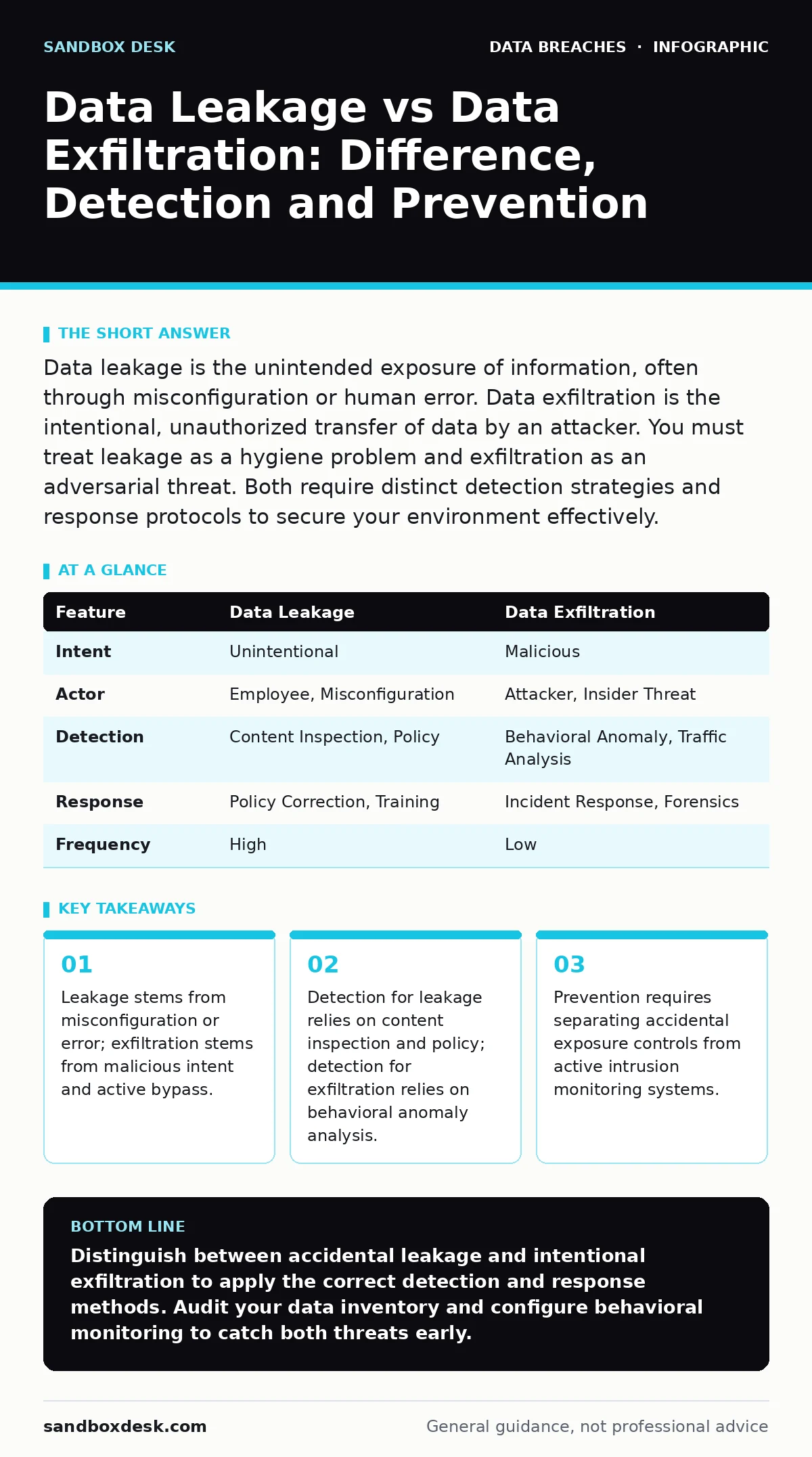
Data leakage is the unintended exposure of information, often through misconfiguration or human error. Data exfiltration is the intentional, unauthorized transfer of data by an attacker. You must treat leakage as a hygiene problem and exfiltration as an adversarial threat. Both require distinct detection strategies and response protocols to secure your environment effectively.
What is the difference between data leakage and data exfiltration?
Data leakage and data exfiltration differ primarily in intent and mechanism. Leakage is the unintentional exposure of sensitive information, often caused by misconfigured cloud storage, lost devices, or human error. Exfiltration is the deliberate, unauthorized removal of data by an attacker who has gained access to your systems. Understanding this distinction dictates your response strategy. Leakage requires policy correction and awareness training. Exfiltration requires incident response and forensic analysis. You cannot treat them as the same problem.
How does data leakage occur in modern systems?
Data leakage typically occurs through three common pathways: misconfiguration, human error, and third-party exposure. Cloud storage buckets set to public access are a frequent source. Developers accidentally committing secrets to public repositories create another vector. Employees sending sensitive files to personal email accounts represent a third risk. These events lack malicious intent but result in data exposure. You must audit configurations regularly to catch these errors. Review your data inventory and mapping to identify where sensitive data resides. This visibility is the first line of defense against accidental exposure.
What characterizes malicious data exfiltration?
Data exfiltration involves an attacker moving data out of your network boundaries. This process usually follows initial access and lateral movement. Attackers often use command and control channels to transfer stolen files. They may compress data to reduce detection risk. They might encode payloads to evade signature-based scanners. The goal is to extract value, such as intellectual property or customer records. Unlike leakage, exfiltration hides its tracks. Attackers delete logs and use legitimate protocols to blend in. You must monitor for unusual outbound traffic patterns.
Why do standard controls miss data exfiltration?
Standard security controls often fail to detect exfiltration because attackers mimic legitimate behavior. They use allowed protocols like HTTPS or DNS to tunnel data out. Volume-based alerts miss small, slow transfers known as low-and-slow exfiltration. Signature-based detection fails against custom malware or legitimate tools used for harm. The attacker leverages the same channels you use for business operations. You need behavioral analytics to spot deviations from normal baselines. Static rules cannot catch dynamic, adaptive threats. Focus on the context of the transfer, not just the content.
| Feature | Data Leakage | Data Exfiltration |
|---|---|---|
| Intent | Unintentional | Malicious |
| Actor | Employee, Misconfiguration | Attacker, Insider Threat |
| Detection | Content Inspection, Policy | Behavioral Anomaly, Traffic Analysis |
| Response | Policy Correction, Training | Incident Response, Forensics |
| Frequency | High | Low |
How do you detect silent data exfiltration?
Detecting silent exfiltration requires monitoring user and entity behavior. Look for large data transfers at unusual hours. Flag connections to unknown external IP addresses. Monitor for excessive use of cloud storage services by a single account. Check for DNS queries to newly registered domains. These indicators suggest command and control activity. You must establish a baseline of normal network activity. Deviations from this baseline are more valuable than static signatures. Use log retention policies that keep enough history to spot trends. Short retention windows hide slow extraction campaigns.
See also: Tax Identity Theft: How Stolen Data Becomes Fraudulent Returns · Shadow IT Data Exposure: Risks and Protection for Small Businesses
What stops data exfiltration at the network edge?
Network-level controls focus on limiting where data can go. Data Loss Prevention tools inspect outbound traffic for sensitive patterns. They block transfers of credit card numbers or source code. Firewalls restrict connections to known malicious destinations. Proxy servers enforce acceptable use policies. These controls add friction to the exfiltration process. They do not stop all attacks, but they raise the cost for the attacker. You must balance security with usability. Overly restrictive rules cause employees to find workarounds, creating new risks.
How does internal access control prevent exfiltration?
Internal access control limits what users can see and move. The principle of least privilege ensures users access only the data they need. Role-based access control assigns permissions based on job function. Multi-factor authentication prevents attackers from using stolen credentials to access data. If an attacker cannot reach the data, they cannot exfiltrate it. You must review access rights regularly. Stale permissions from former employees are a common entry point. Combine access control with email encryption to protect data in transit. This layered approach reduces the attack surface significantly.
What is the role of user behavior in leakage?
User behavior drives most data leakage incidents. Employees share data via personal cloud accounts to work from home. They print sensitive documents and leave them unattended. They misaddress emails to external recipients. These actions bypass technical controls. You must train users on data handling policies. Make security procedures easy to follow. Complex rules lead to non-compliance. Address the root cause of the behavior, not just the symptom. Provide secure alternatives for remote work. Reduce the friction of doing the right thing.
How do you respond to a confirmed exfiltration?
Responding to confirmed exfiltration requires a structured incident response plan. Isolate affected systems to stop further data loss. Preserve evidence for forensic analysis. Identify the scope of the breach. Notify affected parties as required by law. Review your data subject rights obligations during the notification process. Update security controls to prevent recurrence. Conduct a post-incident review to improve defenses. Speed and accuracy are critical in the initial hours. Delayed response increases damage and liability.
Why is data inventory critical for both threats?
You cannot protect what you cannot find. A comprehensive data inventory identifies where sensitive information lives. It classifies data by sensitivity and ownership. It maps data flows across systems and boundaries. This visibility enables targeted protection. It reduces the blast radius of both leakage and exfiltration. You can apply stricter controls to high-value assets. You can ignore noise from non-sensitive data. Maintain this inventory continuously. Systems change, and data moves. Stale inventories provide a false sense of security.
Key takeaways
- Leakage stems from misconfiguration or error; exfiltration stems from malicious intent and active bypass.
- Detection for leakage relies on content inspection and policy; detection for exfiltration relies on behavioral anomaly analysis.
- Prevention requires separating accidental exposure controls from active intrusion monitoring systems.
Distinguish between accidental leakage and intentional exfiltration to apply the correct detection and response methods. Audit your data inventory and configure behavioral monitoring to catch both threats early.
Frequently asked questions
Can data leakage lead to data exfiltration?
Yes, leakage exposes data that attackers can later target for exfiltration. Publicly accessible databases are often scraped for further attacks.
Is data exfiltration always external?
No, insider threats can exfiltrate data from within the network. They use their legitimate access to steal information without crossing perimeter defenses.
How do I prevent data scraping of leaked information?
You cannot fully prevent scraping of public data. Focus on preventing the initial leakage by securing cloud storage and restricting public access to sensitive APIs.
What is the first step in an exfiltration response?
Isolate the affected systems to stop the data transfer. Preserve logs and network captures for forensic analysis to determine the scope and method.
How this guide was produced: written by the Sandbox Desk editorial team with AI assistance, checked against the public references listed below, and reviewed when the facts change. See our editorial policy or report an error.