OpenSSL Vulnerabilities: How Crypto Bugs Spread and What to Fix
OpenSSL flaws often hide in memory handling code, allowing attackers to bypass encryption without breaking the cryptographic math itself.

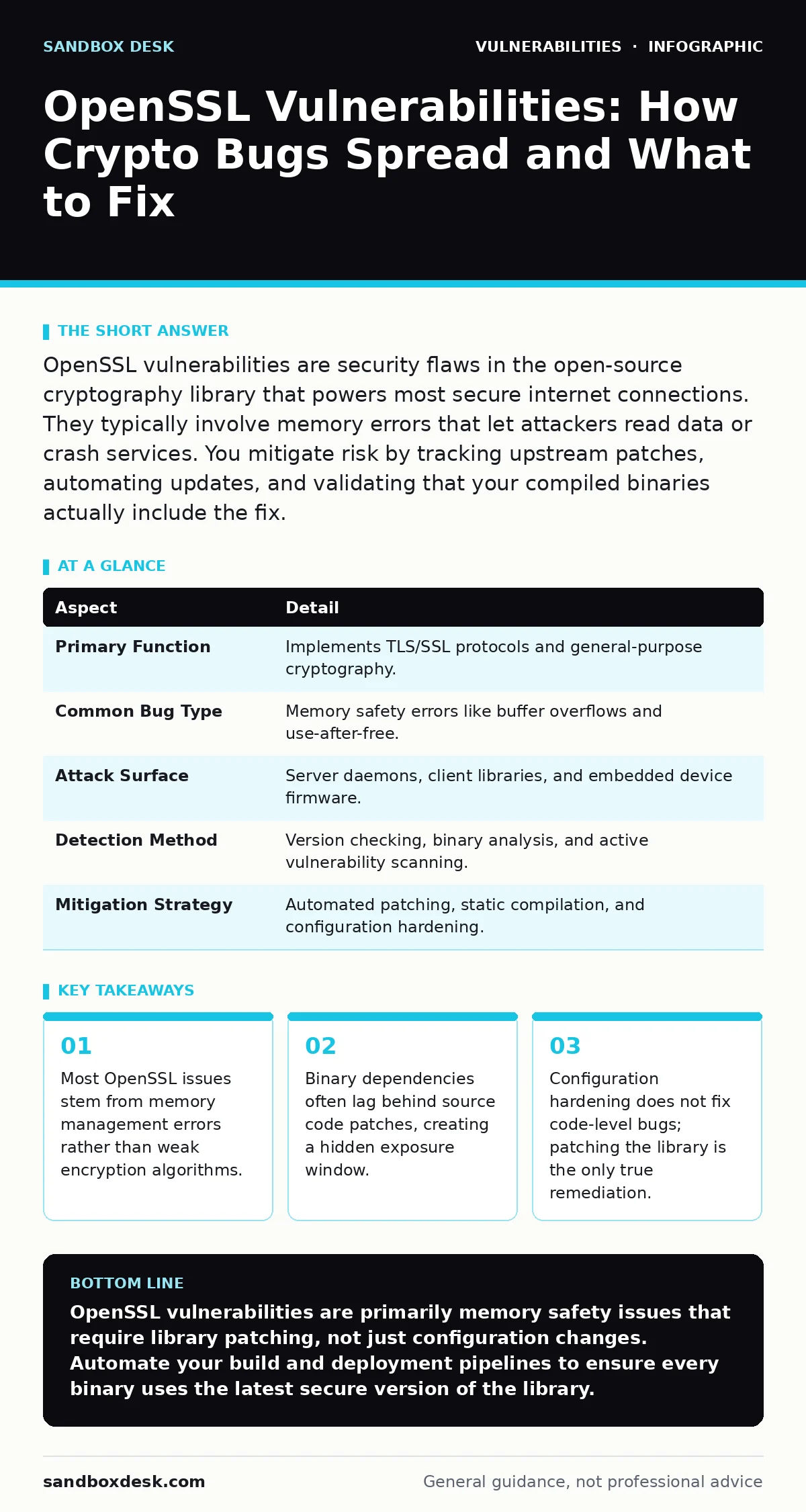
OpenSSL vulnerabilities are security flaws in the open-source cryptography library that powers most secure internet connections. They typically involve memory errors that let attackers read data or crash services. You mitigate risk by tracking upstream patches, automating updates, and validating that your compiled binaries actually include the fix.
Understanding the Scope of OpenSSL Risks
Imagine a bank vault with an unbreakable lock. The lock represents the cryptographic algorithms that protect your data. OpenSSL is the wall, the floor, and the guard that manages access to that vault. If the guard falls asleep or leaves the door ajar, thieves do not need to pick the lock. They simply walk in. This analogy explains why OpenSSL vulnerabilities are distinct from weaknesses in encryption standards. The mathematics of RSA or AES remain sound. The failure occurs in the software implementation that handles keys, certificates, and encrypted streams.
OpenSSL is a widely used open-source toolkit for the Transport Layer Security (TLS) and Secure Sockets Layer (SSL) protocols. It provides the cryptographic functions for secure communication over computer networks. Because it is free and open-source, it is embedded in millions of devices, servers, and applications. This ubiquity creates a single point of failure. A bug in the core library can affect every system that links against it. The risk is not theoretical. It is a structural reality of modern infrastructure.
| Aspect | Detail |
|---|---|
| Primary Function | Implements TLS/SSL protocols and general-purpose cryptography. |
| Common Bug Type | Memory safety errors like buffer overflows and use-after-free. |
| Attack Surface | Server daemons, client libraries, and embedded device firmware. |
| Detection Method | Version checking, binary analysis, and active vulnerability scanning. |
| Mitigation Strategy | Automated patching, static compilation, and configuration hardening. |
How Memory Errors Become Exploits
Most critical OpenSSL vulnerabilities arise from how the code manages memory. C and C++ do not automatically check array bounds or validate pointer usage. If a function expects a 10-byte input but receives 12 bytes, the extra data writes into adjacent memory. This is a buffer overflow. An attacker can craft a specific packet that triggers this overflow. They then overwrite function pointers or return addresses in the stack. When the function exits, the processor jumps to the attacker’s code instead of the intended next instruction.
This mechanism allows for remote code execution. The attacker gains control of the process running the library. If that process is a web server, the attacker now controls the server. If it is a database client, they may access sensitive data. The cryptographic layer is bypassed entirely. The attacker does not decrypt the traffic. They simply read the plaintext data as it passes through the compromised process memory. This is why understanding memory safety is more valuable than memorizing cipher suites.
Who Faces the Greatest Exposure
You face exposure if your software links against OpenSSL. This includes almost all Linux-based servers, many embedded devices, and desktop applications that use HTTPS. The risk varies by deployment model. System-wide installations where the OS package manager controls the library are easier to patch. Custom builds where developers compile their own version of OpenSSL are harder to track. These custom builds often lag behind security updates. Developers may ignore minor version bumps, not realizing they contain critical security fixes.
Embedded devices pose a unique challenge. They often run static binaries compiled years ago. The manufacturer may no longer support the device. You cannot patch the library without replacing the hardware. This is why supply chain security matters. You must know not just what you run, but what your dependencies run. A web application might be secure, but the underlying web server module might use an outdated OpenSSL version. The vulnerability lives in the dependency graph, not the application code.
Common Forms of Implementation Flaws
OpenSSL vulnerabilities generally fall into three categories. The first is memory corruption. This includes buffer overflows, use-after-free errors, and null pointer dereferences. These bugs allow attackers to crash the service or execute arbitrary code. The second category is logic errors. These occur when the code fails to validate inputs correctly.
An attacker might send a certificate with invalid fields. If the code does not check these fields, it might accept a forged identity. The third category is side-channel leaks. These are subtle timing differences in how the code processes keys. An attacker measures the time it takes to reject a wrong key. Over many attempts, they can deduce the correct key.
Logic errors are particularly insidious. They do not crash the system. They allow silent failures. An attacker might bypass a security check without triggering an alert. This is why thorough testing is difficult. You must test for what should not happen, not just what should. Fuzzing tools help here. They send random, malformed data to the library to find crashes. This proactive approach finds bugs before attackers do. However, fuzzing cannot find every logic error. Code review remains necessary.
The Hidden Cost of Binary Dependencies
Developers often think that updating the source code fixes the vulnerability. This is incorrect if you distribute pre-compiled binaries. You must recompile the library and all applications that link against it. Dynamic linking means the application uses the system library at runtime. If you update the system library, the application uses the new version. This is efficient but risky. If the new library has a bug, all applications break. Static linking embeds the library code into the application. This ensures consistency but makes patching hard. You must rebuild and redeploy the entire application to fix a library bug.
This trade-off creates a maintenance burden. You must track which version of OpenSSL is in each binary. You cannot rely on the operating system to tell you. You need inventory tools that analyze binary dependencies. This is often overlooked in vulnerability remediation SLAs. Teams focus on patching servers. They forget that container images and static binaries also need updates. A container might run an updated OS but contain an old static binary. The vulnerability remains.
What People Usually Get Wrong
Many teams believe that configuration hardening prevents exploitation. They disable weak ciphers and old protocols. This reduces the attack surface for protocol-level attacks. It does nothing for memory corruption bugs in the core library. An attacker can still exploit a buffer overflow using a valid TLS 1.3 handshake. Configuration is a defense in depth measure. It is not a substitute for patching.
Another common mistake is assuming that only servers are at risk. Clients are vulnerable too. A browser or mobile app using a flawed OpenSSL version can leak data or be manipulated. The attacker does not need to control the server. They need to control the network path or the client’s environment. Man-in-the-middle attacks become easier if the client library has a logic flaw. You must protect both ends of the connection.
Finally, teams often ignore the CVSS score nuances. A high score indicates severity. It does not indicate ease of exploitation. Some high-score bugs require specific conditions to trigger. Others are trivial to exploit. You must assess the actual impact on your architecture. Do not just patch based on scores. Patch based on exposure. If your service is internal and not internet-facing, the risk is lower. But it is not zero.
Reducing Risk Through Automation
You reduce risk by automating the update process. Manual patching is slow and error-prone. Use configuration management tools to enforce library versions. Define a baseline for approved OpenSSL versions. Block deployments that use older versions. This prevents drift. When a new vulnerability is disclosed, you can push updates to all systems simultaneously. This reduces the window of exposure.
For static binaries, you must rebuild. Automate this rebuild process. When a new OpenSSL version is released, trigger a rebuild of all affected applications. Test them thoroughly. Deploy them quickly. This requires a robust build system. It also requires discipline. You cannot have exceptions. Every binary must be rebuilt. This is tedious but necessary.
You should also limit the attack surface. Run services with minimal privileges. Use sandboxing techniques. If an attacker exploits a bug, they should not gain full system access. Use seccomp filters to restrict system calls. Use namespaces to isolate processes. These measures do not fix the bug. They limit the damage. This is a critical layer of defense.
Key takeaways
- Most OpenSSL issues stem from memory management errors rather than weak encryption algorithms.
- Binary dependencies often lag behind source code patches, creating a hidden exposure window.
- Configuration hardening does not fix code-level bugs; patching the library is the only true remediation.
OpenSSL vulnerabilities are primarily memory safety issues that require library patching, not just configuration changes. Automate your build and deployment pipelines to ensure every binary uses the latest secure version of the library.
Frequently asked questions
Does using a newer TLS version fix OpenSSL bugs?
No. Newer protocol versions still rely on the underlying library code. A memory bug in the library affects all protocol versions supported by that build.
How do I know if my application uses OpenSSL?
Check your dependency tree. On Linux, use tools like ldd or objdump to inspect linked libraries. In package managers, check the dependencies of your installed packages.
Is disabling SSLv3 and TLS 1.0 enough?
No. These steps prevent protocol-level attacks. They do not protect against code-level vulnerabilities like buffer overflows in the active protocol handlers.
Should I compile OpenSSL from source?
Only if you need specific features. Otherwise, use your distribution’s package manager. It provides tested, signed binaries and easier update paths.
How this guide was produced: written by the Sandbox Desk editorial team with AI assistance, checked against the public references listed below, and reviewed when the facts change. See our editorial policy or report an error.