National Vulnerability Database: Five Common Misreadings and Fixes
The NVD aggregates data but does not verify context, meaning a high score often reflects theoretical risk rather than actual exposure in your specific deployment.

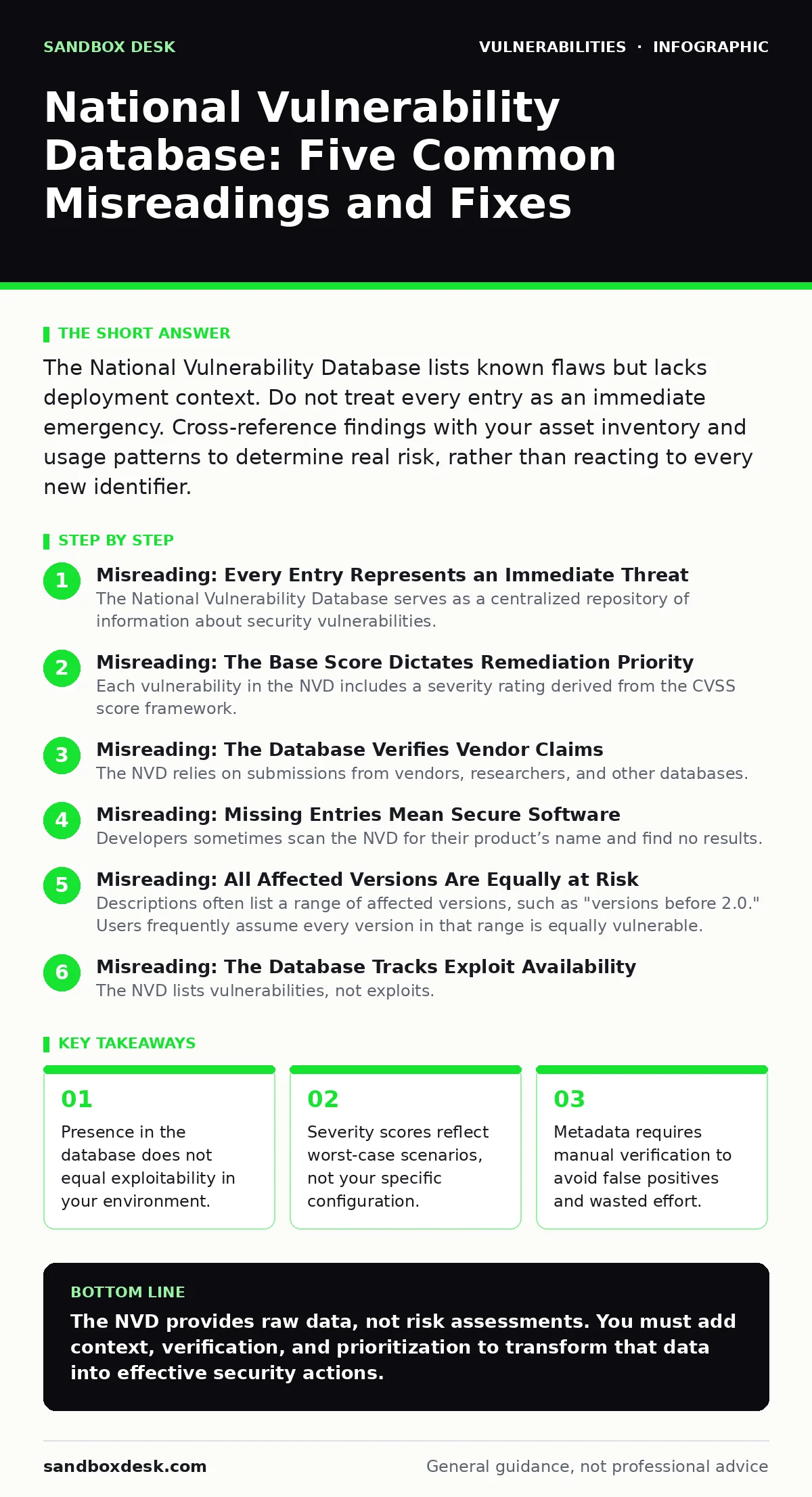
The National Vulnerability Database lists known flaws but lacks deployment context. Do not treat every entry as an immediate emergency. Cross-reference findings with your asset inventory and usage patterns to determine real risk, rather than reacting to every new identifier.
Misreading: Every Entry Represents an Immediate Threat
The National Vulnerability Database serves as a centralized repository of information about security vulnerabilities. It aggregates data from multiple sources, including vendors and independent researchers. Many users assume that any new entry requires immediate patching or mitigation. This assumption ignores the reality that many listed flaws are theoretical or apply to unused code paths.
Correct reading: Treat each entry as a potential risk that requires context. You must determine if the affected component exists in your environment. If the software is not installed, or if the vulnerable feature is disabled, the risk is effectively zero. Prioritize remediation based on exposure, not just presence in the list.
Misreading: The Base Score Dictates Remediation Priority
Each vulnerability in the NVD includes a severity rating derived from the CVSS score framework. This metric calculates potential impact using a standardized formula. Teams often sort their backlogs strictly by this number, assuming higher scores demand faster fixes. This approach fails because the base score assumes maximum conditions, such as no authentication required and full network exposure.
Correct reading: Use the base score as a starting point, not a final verdict. The score does not account for your specific security controls. A high-score flaw in an isolated internal system may pose less risk than a moderate-score flaw in a public-facing API. You must adjust the priority based on your actual architecture and threat model. Refer to our guide on the CVSS score for details on how environmental factors modify these ratings.
Misreading: The Database Verifies Vendor Claims
The NVD relies on submissions from vendors, researchers, and other databases. It acts as a mirror, not a filter. It does not independently validate the technical accuracy of every description. Sometimes, initial reports contain errors regarding the affected versions or the nature of the flaw. Relying on the initial description can lead to incorrect patching efforts or missed vulnerabilities.
Correct reading: Cross-reference NVD entries with official vendor communications. Check security bulletins for updates or corrections. Vendors often refine their initial disclosures after further analysis. If the NVD description conflicts with the vendor’s detailed advisory, trust the vendor’s technical documentation. This verification step prevents wasted engineering hours on non-existent issues.
Misreading: Missing Entries Mean Secure Software
Developers sometimes scan the NVD for their product’s name and find no results. They conclude their software is free from known vulnerabilities. This conclusion is flawed because the database is not exhaustive in real-time. There is a delay between discovery and publication. Additionally, proprietary or niche software may not have entries if no researcher has submitted them.
Correct reading: Absence of evidence is not evidence of absence. Use the NVD as one signal among many. Combine it with static analysis, dynamic testing, and dependency scanning. A clean NVD search does not replace rigorous code review. It simply means no public record of a flaw exists yet. Maintain a secure software development lifecycle to catch issues before they reach public databases.
Misreading: All Affected Versions Are Equally at Risk
Descriptions often list a range of affected versions, such as "versions before 2.0." Users frequently assume every version in that range is equally vulnerable. In reality, some versions may have default configurations that mitigate the issue. Others may require specific plugins or modules that are not installed by default. Treating all versions as equally risky leads to over-patching and operational disruption.
Correct reading: Investigate the specific conditions required for exploitation. Read the detailed description carefully. Look for mentions of required configurations, default settings, or optional components. If your deployment lacks these conditions, the risk is lower. Document these exceptions to avoid unnecessary downtime during future patch cycles. This precision saves resources and reduces friction between security and operations teams.
Misreading: The Database Tracks Exploit Availability
The NVD lists vulnerabilities, not exploits. It does not indicate whether working code exists to take advantage of the flaw. Some users assume that if a vulnerability is in the NVD, it is actively being exploited in the wild. This is often incorrect. Many entries represent theoretical risks that have never been weaponized. Conversely, some active exploits target flaws not yet in the database.
Correct reading: Differentiate between vulnerability disclosure and exploit activity. Use threat intelligence feeds or the CISA Known Exploited Vulnerabilities catalog to identify actively abused flaws. The NVD tells you what is broken; other sources tell you what is being used against you. Prioritize flaws that appear in both lists. This distinction helps you focus on threats that are currently impacting organizations, rather than those that are merely possible.
Misreading: Metadata Is Static and Complete
Vulnerability records change over time. Descriptions are updated, scores are recalculated, and references are added. Users often capture a snapshot of the data and treat it as permanent. This leads to outdated risk assessments. A flaw might be reclassified from critical to low after further research reveals mitigating factors. Relying on stale data causes unnecessary panic or missed remediation.
Correct reading: Implement a process for regular re-evaluation. Do not assume the initial data is final. Subscribe to feeds or set up automated checks for updates to critical records. When a record changes, review your risk assessment. This dynamic approach ensures your security posture reflects the latest understanding of each flaw. It aligns your defense with the evolving nature of vulnerability research.
Misreading: The Database Covers All Attack Vectors
The NVD focuses on software vulnerabilities. It does not cover physical security flaws, social engineering weaknesses, or procedural errors. Some teams believe that clearing the NVD backlog eliminates their security risk. This is a dangerous misconception. Attackers often bypass software flaws entirely by targeting human behavior or weak processes.
Correct reading: View the NVD as a tool for managing technical debt, not a holistic security solution. Combine vulnerability management with other security practices. For example, address weak password policies independently of software patching. Consider risks like NoSQL injection or API vulnerabilities that may require specific testing methodologies. A balanced security program addresses both code flaws and procedural gaps.
Key takeaways
- Presence in the database does not equal exploitability in your environment.
- Severity scores reflect worst-case scenarios, not your specific configuration.
- Metadata requires manual verification to avoid false positives and wasted effort.
The NVD provides raw data, not risk assessments. You must add context, verification, and prioritization to transform that data into effective security actions.
Frequently asked questions
How often is the National Vulnerability Database updated?
The database is updated continuously as new vulnerabilities are reported and existing records are revised. There is no fixed schedule, so frequent checks are necessary for critical systems.
Can I rely on the NVD for compliance auditing?
The NVD is a standard source for many compliance frameworks, but auditors will expect you to demonstrate how you contextualized the findings. Simply listing NVD entries is rarely sufficient for proving risk management.
What is the difference between the NVD and vendor advisories?
The NVD aggregates data from multiple vendors and sources into a single format. Vendor advisories provide specific details about their products. The NVD is useful for broad scanning, while vendor advisories are better for deep
How this guide was produced: written by the Sandbox Desk editorial team with AI assistance, checked against the public references listed below, and reviewed when the facts change. See our editorial policy or report an error.