WebSocket Vulnerabilities: Definition, Attack Vectors, and Mitigation
WebSocket vulnerabilities often bypass traditional web security controls because the persistent connection treats data as binary streams rather than discrete HTTP requests.

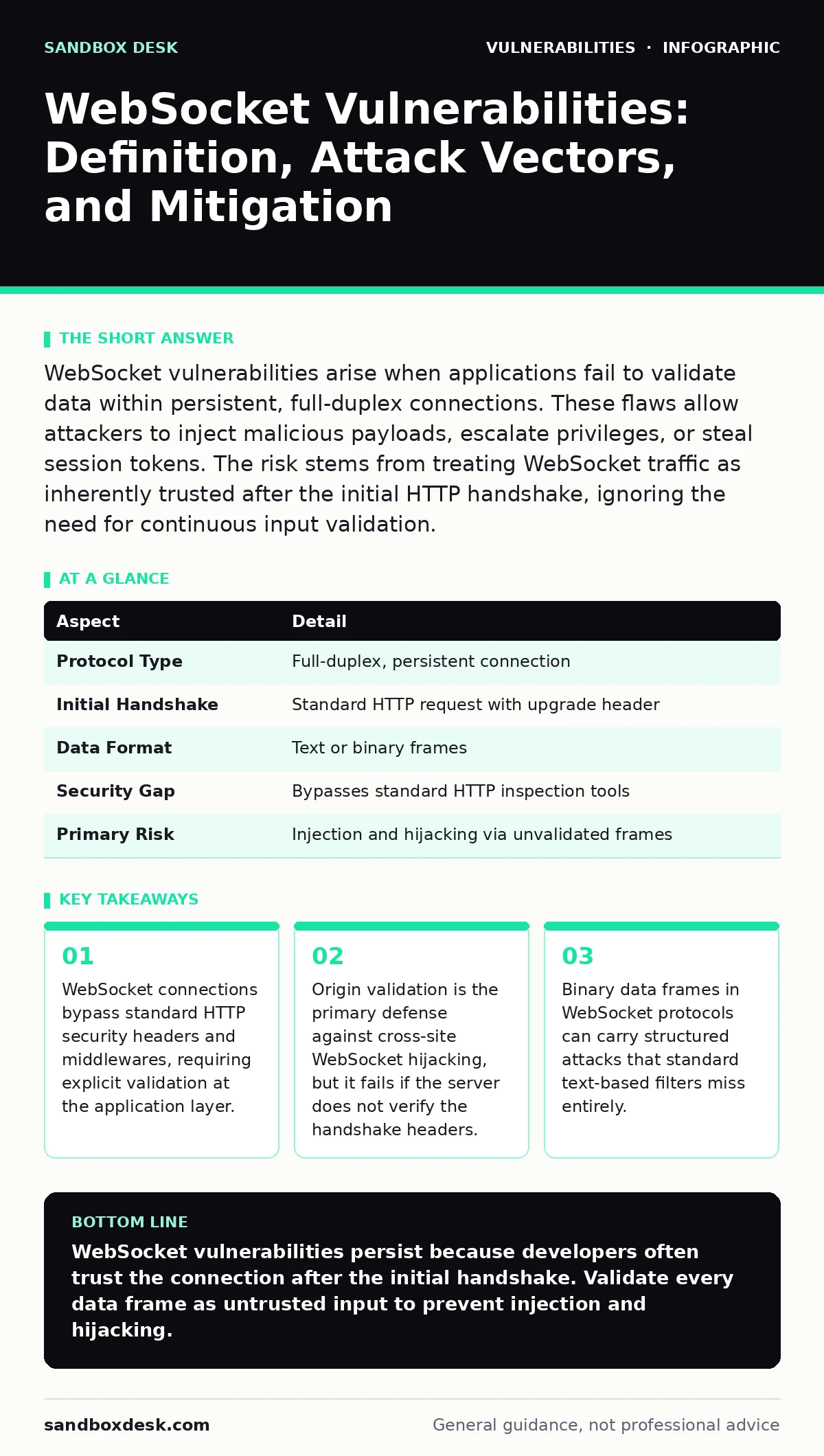
WebSocket vulnerabilities arise when applications fail to validate data within persistent, full-duplex connections. These flaws allow attackers to inject malicious payloads, escalate privileges, or steal session tokens. The risk stems from treating WebSocket traffic as inherently trusted after the initial HTTP handshake, ignoring the need for continuous input validation.
How WebSocket Connections Work
Imagine a traditional web request as sending a letter through the post office. You write the letter, seal it, and wait for a reply. The post office (the server) processes each letter individually. Now imagine walking into the post office, sitting down, and talking directly to the clerk for hours. This is how a WebSocket connection operates. It establishes a persistent, full-duplex communication channel between a client and a server. Once the connection is open, data flows freely in both directions without the overhead of repeated handshakes.
This efficiency creates a security gap. Traditional web security tools are designed to inspect discrete HTTP requests. They look for malicious patterns in URL parameters, headers, and body content. A WebSocket connection starts with an HTTP handshake, but it upgrades to a different protocol. Once upgraded, the traffic is no longer HTTP. It is a stream of frames. Most standard web application firewalls and reverse proxies do not inspect the content of these frames. They see the connection as established and trusted. The security responsibility shifts entirely to the application logic handling the stream.
| Aspect | Detail |
|---|---|
| Protocol Type | Full-duplex, persistent connection |
| Initial Handshake | Standard HTTP request with upgrade header |
| Data Format | Text or binary frames |
| Security Gap | Bypasses standard HTTP inspection tools |
| Primary Risk | Injection and hijacking via unvalidated frames |
What Are WebSocket Vulnerabilities
A WebSocket vulnerability is a flaw in how an application handles data within this persistent channel. These vulnerabilities occur when the server accepts input from the WebSocket stream without proper validation, sanitization, or authorization. Because the connection remains open, an attacker can send multiple malicious payloads over the same channel. The server may process these payloads as legitimate commands, leading to unauthorized actions or data exposure.
The core issue is a mismatch in security assumptions. Developers often assume that because the connection originated from a trusted domain, all subsequent data is safe. This assumption ignores the possibility of client-side compromise or network-level attacks. An attacker who controls the client environment can inject arbitrary data into the stream. If the server trusts this data implicitly, the application becomes vulnerable to injection attacks, privilege escalation, and information disclosure.
Common Forms of Attacks
Injection attacks remain the most prevalent form of WebSocket exploitation. An attacker sends a frame containing malicious code, such as JavaScript or SQL commands, within the data payload. If the server processes this data without sanitization, it may execute the code or pass it to a database. This is similar to cross-site scripting or SQL injection, but it occurs over a persistent channel. The impact can be immediate and sustained, as the attacker maintains control through the open connection.
Cross-site WebSocket hijacking is another significant threat. An attacker creates a malicious page that attempts to establish a WebSocket connection to a vulnerable service on behalf of a victim. If the server does not validate the origin of the connection, it accepts the request. The attacker can then read sensitive data sent by the server or send commands using the victim’s authenticated session. This bypasses same-origin policies that protect standard HTTP requests.
Brute-force and credential stuffing attacks also leverage WebSockets. Because the connection is persistent, an attacker can send rapid succession of login attempts without the overhead of reconnecting. This allows for high-volume attacks that might trigger rate-limiting defenses on standard HTTP endpoints but slip through WebSocket handlers. The server may not recognize the volume of requests from a single persistent connection as suspicious.
Who Is Affected
Any application that uses real-time communication is at risk. This includes chat applications, live dashboards, collaborative editing tools, and financial trading platforms. The impact depends on the sensitivity of the data and the level of access the WebSocket connection provides. Applications that handle user authentication, personal data, or financial transactions face the highest risk.
Developers who build custom WebSocket servers are particularly vulnerable. They must implement security controls manually. Using third-party libraries reduces risk, but only if the library is configured correctly. Misconfiguration is a common cause of exposure. For instance, failing to enforce origin checks or disabling compression can introduce vulnerabilities. Even well-maintained libraries can be compromised if the application logic passes untrusted data directly to the server.
What People Usually Get Wrong
Many developers believe that validating the initial HTTP handshake is sufficient. They check the origin and referer headers during the upgrade request and then assume the connection is secure. This is a critical error. The handshake only validates the start of the connection. It does not validate the data sent over the connection. An attacker can hijack a valid session or inject data after the handshake is complete. Continuous validation is required for every frame received.
Another common mistake is assuming that WebSockets are inherently secure because they use TLS. Transport Layer Security encrypts the data in transit, preventing eavesdropping. It does not protect against injection or hijacking. If the application accepts malicious input, TLS will encrypt that malicious input and deliver it securely to the server. Encryption protects confidentiality, not integrity or authorization.
See also: NoSQL Injection Myths: Why Your Database Is Not Safe From Code · How to Prevent API Vulnerabilities: A Priority-Based Approach
How to Reduce the Risk
Input validation is the primary defense. Treat every WebSocket frame as untrusted data. Validate the format, length, and content of each message. Reject frames that do not match expected schemas. Use allowlists for acceptable data types and values. Do not rely on blocklists, as attackers can easily bypass them. For binary data, ensure that the structure matches the application’s expectations.
Enforce strict origin validation. Check the Origin header during the handshake and reject connections from unauthorized domains. This prevents cross-site WebSocket hijacking. However, origin validation alone is not enough. Combine it with other controls, such as anti-CSRF tokens, to ensure that the request is intentional and authenticated.
Implement rate limiting and connection timeouts. Limit the number of messages a client can send within a specific time frame. This mitigates brute-force and denial-of-service attacks. Set idle timeouts to close connections that are inactive. This reduces the window of opportunity for attackers to exploit long-lived sessions.
Integration With Security Practices
WebSocket security does not exist in isolation. It must integrate with broader application security practices. This includes vulnerability remediation SLAs that prioritize fixing critical flaws in real-time components. Change management for security patches ensures that updates are tested and deployed without breaking functionality.
Compensating controls can mitigate risk when immediate fixes are not possible. For example, restricting WebSocket access to specific IP ranges or requiring additional authentication steps can reduce exposure. These controls do not eliminate the vulnerability, but they raise the barrier for attackers.
Developers should also consider the CVSS score when assessing the severity of WebSocket vulnerabilities. A high score indicates a significant risk that requires immediate attention. Understanding the potential impact helps prioritize remediation efforts.
RELATED: Apache Struts vulnerabilities; OpenSSL vulnerabilities; vulnerability scanning
Key takeaways
- WebSocket connections bypass standard HTTP security headers and middlewares, requiring explicit validation at the application layer.
- Origin validation is the primary defense against cross-site WebSocket hijacking, but it fails if the server does not verify the handshake headers.
- Binary data frames in WebSocket protocols can carry structured attacks that standard text-based filters miss entirely.
WebSocket vulnerabilities persist because developers often trust the connection after the initial handshake. Validate every data frame as untrusted input to prevent injection and hijacking.
Frequently asked questions
Do WebSockets bypass CORS?
WebSockets do not use the same CORS mechanism as HTTP requests. They rely on origin validation during the handshake. If the server does not check the origin, it can accept connections from any domain.
Can a firewall protect against WebSocket attacks?
Standard web application firewalls often cannot inspect WebSocket frames. They may block the initial handshake if misconfigured, but they typically allow the persistent connection to pass. Application-level validation is required.
Is TLS enough for WebSocket security?
TLS encrypts the data in transit, preventing eavesdropping. It does not protect against injection, hijacking, or logic flaws. The application must still validate and authorize the data it receives.
How do I detect a WebSocket hijack?
Monitor for unexpected origin headers during the handshake. Look for anomalous traffic patterns, such as a high volume of messages from a single connection. Implement logging and alerting for suspicious activities.
How this guide was produced: written by the Sandbox Desk editorial team with AI assistance, checked against the public references listed below, and reviewed when the facts change. See our editorial policy or report an error.