NoSQL Injection Myths: Why Your Database Is Not Safe From Code
NoSQL injection bypasses traditional input validation because the database engine interprets logical operators within the query structure itself.

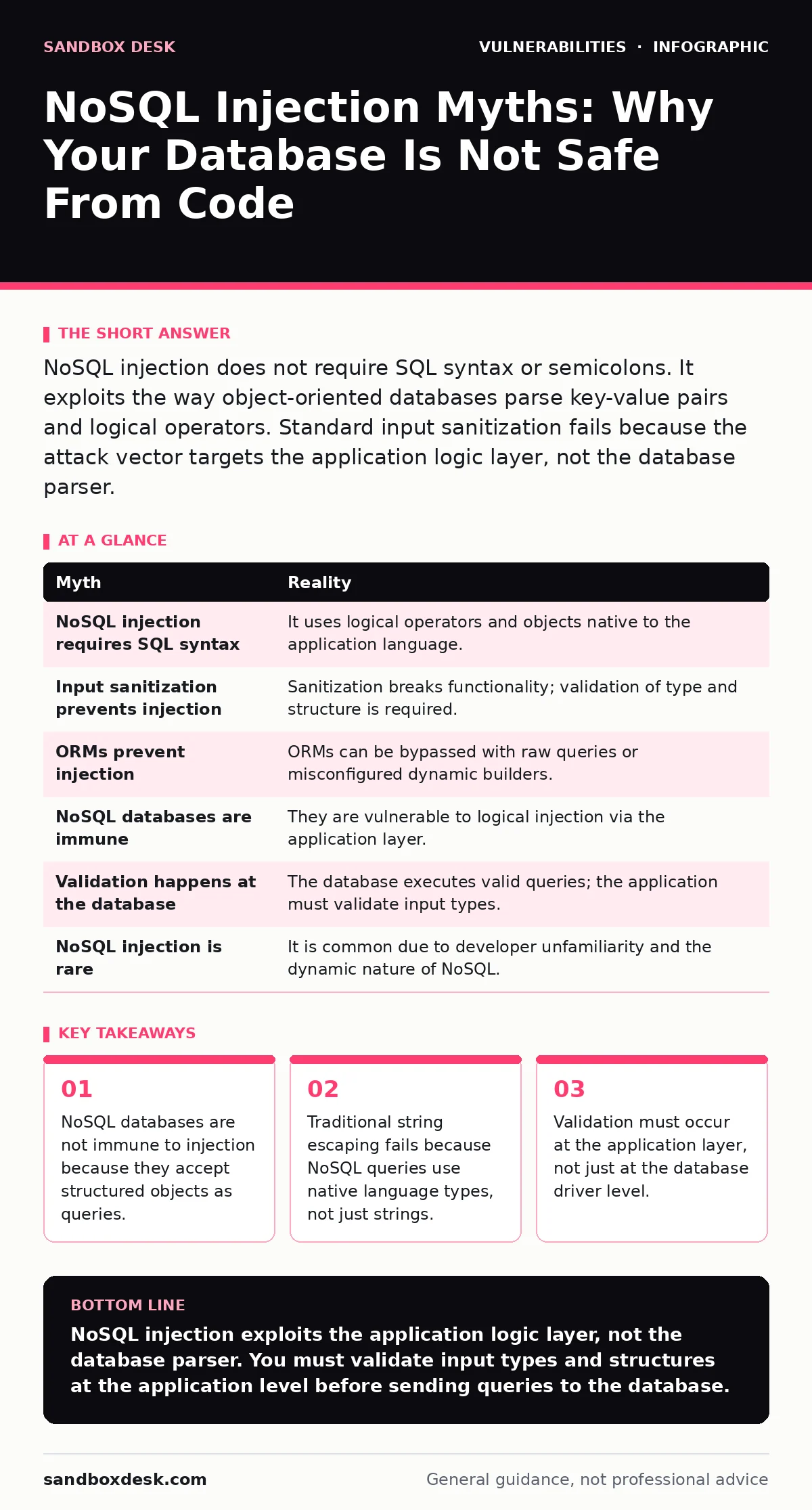
NoSQL injection does not require SQL syntax or semicolons. It exploits the way object-oriented databases parse key-value pairs and logical operators. Standard input sanitization fails because the attack vector targets the application logic layer, not the database parser.
Myth: NoSQL Injection Requires SQL Syntax
Reality: NoSQL injection does not use semicolons, single quotes, or standard SQL keywords like SELECT or DROP. The name is a misnomer that causes developers to look for patterns that do not exist. NoSQL databases store data in formats like documents, key-value pairs, or graphs. They do not rely on a rigid schema or a structured query language in the traditional sense. When an attacker injects code into a NoSQL application, they are manipulating the query object itself. This object is often written in the same language as the application, such as JavaScript or Python. The database engine executes the logic contained within that object. If the application passes user input directly into that object, the database treats the input as executable code. This is fundamentally different from SQL injection, where the database parser misinterprets string concatenation. Here, the application framework misinterprets user data as a command.
Myth: Input Sanitization Is Enough
Reality: Standard input sanitization strips special characters to prevent injection, but this approach fails against NoSQL. NoSQL queries often use operators like $gt (greater than), $lt (less than), or $ne (not equal). These operators are part of the query syntax, not special characters in a string. If an application constructs a query using these operators, it must accept them as valid input. Sanitization routines that remove dollar signs or curly braces will break legitimate application functionality. The problem is not the character itself, but the context in which it appears. You cannot sanitize a logical operator without understanding the data model. Blindly removing symbols creates a fragile application that breaks on valid data. Instead of sanitization, you must validate the type and structure of the input. Ensure that a field expecting a string does not receive an object or an array. This requires strict schema validation at the application layer.
Myth: Object-Relational Mapping Prevents Injection
Reality: Object-Relational Mapping (ORM) tools abstract the database layer, but they do not automatically prevent injection. Many developers believe that using an ORM eliminates the need to write raw queries. While ORMs provide a safer interface, they often allow for "raw" or "native" queries when performance or complexity demands it. If the application uses these raw query features, the ORM’s protection is bypassed.
Even when using high-level ORM methods, parameterized queries are not always the default. Some ORMs allow dynamic query construction where user input can influence the logic. If the developer passes user input directly into a dynamic query builder, the ORM will execute it. The safety of an ORM depends entirely on how the developer uses it. Relying on the tool without understanding its underlying mechanisms is a common error. You must verify that the ORM uses parameterized queries or strict type checking for all user inputs.
Myth: NoSQL Databases Are Not Vulnerable to Injection
Reality: The belief that NoSQL is inherently safer than relational databases is incorrect. NoSQL databases are often embedded within the application server or run as services that accept complex objects. This architecture exposes the database to the same logical flaws as any other system. The lack of a rigid schema means that the database accepts a wider variety of data types. This flexibility is a feature, not a security control.
An attacker can inject a complex object that the application did not intend to process. The database will execute the logic within that object if the application framework allows it. This is not a flaw in the database itself, but in how the application interacts with it. The database is doing exactly what it was told to do. The vulnerability exists in the application code that fails to distinguish between data and commands. This misconception leads to reduced security testing for NoSQL applications.
Myth: Validation Happens at the Database Layer
Reality: Validation must occur at the application layer, not at the database layer. The database engine is designed to process queries efficiently, not to validate business logic. It does not know if a user ID should be an integer or a string. It only knows how to compare values. If the application sends a query that compares a user ID to a logical operator, the database will execute it.
The database cannot distinguish between a legitimate query and an injected one if the syntax is correct. Therefore, the application must enforce strict type checking and schema validation before sending the query. This validation must be comprehensive and cover all possible input vectors. It must reject any input that does not match the expected type or format. This includes checking for unexpected objects, arrays, or functions in fields that should contain simple values.
See also: How to Prevent API Vulnerabilities: A Priority-Based Approach
Myth: NoSQL Injection Is Rare
Reality: NoSQL injection is a common vulnerability because it is easy to introduce and difficult to detect. Many developers are familiar with SQL injection but lack experience with NoSQL security. They assume that the absence of SQL syntax means the absence of injection. This leads to a lack of testing and monitoring for NoSQL-specific attacks. The rise of NoSQL databases in modern web applications has increased the attack surface.
These databases are often used in environments where rapid development is prioritized over security. The dynamic nature of NoSQL queries makes static analysis tools less effective. Dynamic testing and manual review are required to find these vulnerabilities. The prevalence of NoSQL injection is a direct result of this knowledge gap. Developers must update their security practices to include NoSQL-specific testing.
| Myth | Reality |
|---|---|
| NoSQL injection requires SQL syntax | It uses logical operators and objects native to the application language. |
| Input sanitization prevents injection | Sanitization breaks functionality; validation of type and structure is required. |
| ORMs prevent injection | ORMs can be bypassed with raw queries or misconfigured dynamic builders. |
| NoSQL databases are immune | They are vulnerable to logical injection via the application layer. |
| Validation happens at the database | The database executes valid queries; the application must validate input types. |
| NoSQL injection is rare | It is common due to developer unfamiliarity and the dynamic nature of NoSQL. |
Key takeaways
- NoSQL databases are not immune to injection because they accept structured objects as queries.
- Traditional string escaping fails because NoSQL queries use native language types, not just strings.
- Validation must occur at the application layer, not just at the database driver level.
NoSQL injection exploits the application logic layer, not the database parser. You must validate input types and structures at the application level before sending queries to the database.
Frequently asked questions
How do I test for NoSQL injection?
Use dynamic application security testing tools that support NoSQL databases. Inject logical operators and objects into input fields to see if the application behaves unexpectedly.
Can I use parameterized queries for NoSQL?
Yes, many NoSQL drivers and ORMs support parameterized queries. Ensure that you use these features for all user inputs to prevent injection.
Is MongoDB vulnerable to NoSQL injection?
Yes, MongoDB is one of the most common targets for NoSQL injection. Its document-based structure makes it susceptible to logical injection attacks.
How do I secure my NoSQL application?
Implement strict input validation, use parameterized queries, and follow the principles of least privilege access. Regularly review your code for dynamic query construction.
How this guide was produced: written by the Sandbox Desk editorial team with AI assistance, checked against the public references listed below, and reviewed when the facts change. See our editorial policy or report an error.