Cross-Site WebSocket Hijacking Prevention Checklist for Secure Apps
WebSocket connections inherit cookie credentials by default, allowing malicious scripts to hijack real-time sessions without explicit user authentication prompts.

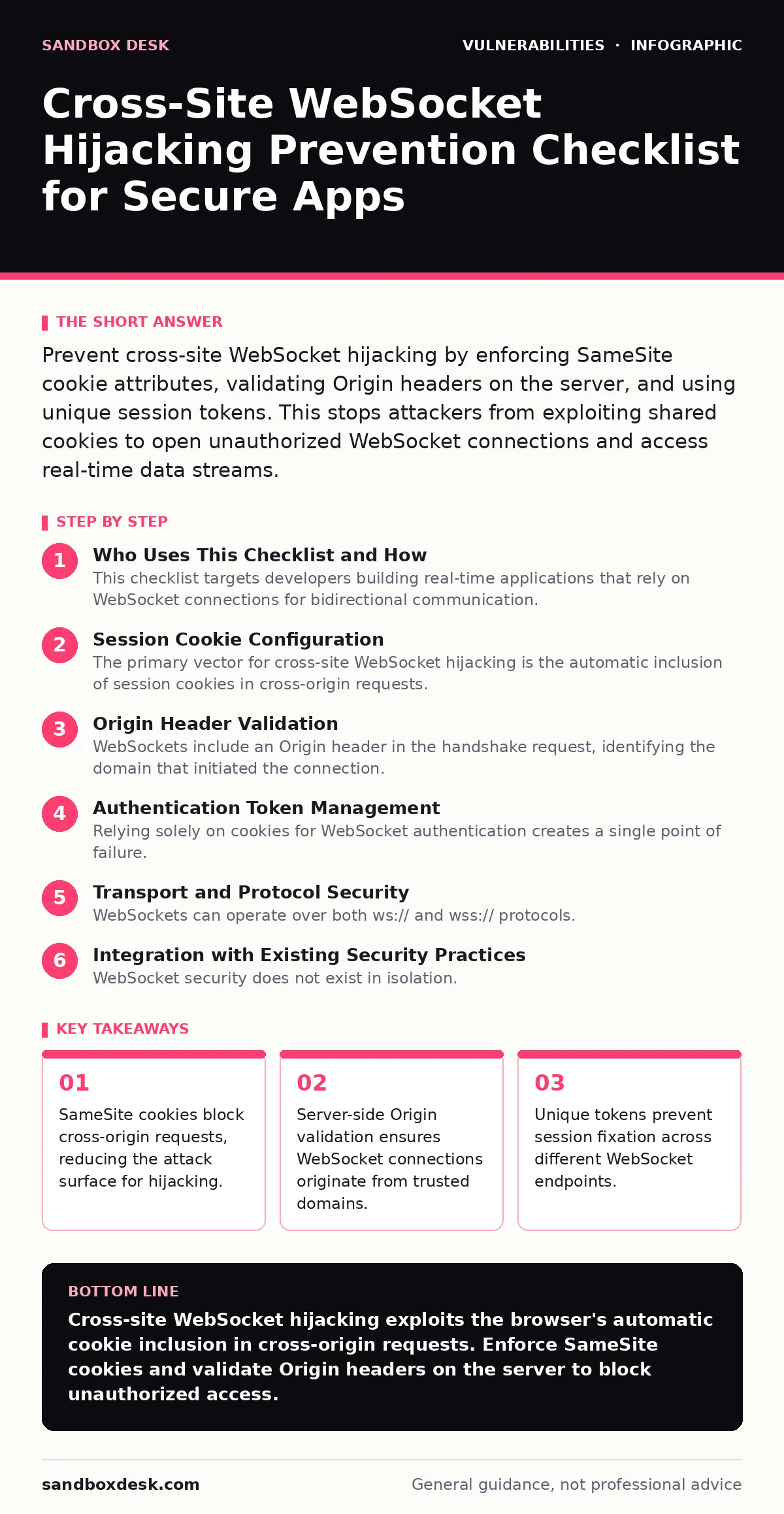
Prevent cross-site WebSocket hijacking by enforcing SameSite cookie attributes, validating Origin headers on the server, and using unique session tokens. This stops attackers from exploiting shared cookies to open unauthorized WebSocket connections and access real-time data streams.
Who Uses This Checklist and How
This checklist targets developers building real-time applications that rely on WebSocket connections for bidirectional communication. You use it during the design and review phases to ensure your session management does not leak privileges to external sites. Cross-site WebSocket hijacking occurs when a malicious site tricks your browser into opening a WebSocket connection to your application using your existing session cookies. The attacker gains access to your real-time data stream without needing your password.
Session Cookie Configuration
The primary vector for cross-site WebSocket hijacking is the automatic inclusion of session cookies in cross-origin requests. If your application relies on cookies for authentication, you must restrict how those cookies are sent. Browsers send cookies with WebSocket upgrade requests if the cookie is marked as accessible. This behavior mirrors standard HTTP requests, creating a blind spot for developers who assume WebSockets require separate authentication.
- Set SameSite attribute to Strict or Lax: This prevents the browser from sending cookies during cross-site requests, blocking the initial hijack attempt.
- Mark session cookies as HttpOnly: This stops client-side JavaScript from reading the cookie value, limiting the damage if a script injection occurs.
- Set Secure flag on all session cookies: This ensures cookies are only transmitted over encrypted HTTPS connections, preventing network-level interception.
Origin Header Validation
WebSockets include an Origin header in the handshake request, identifying the domain that initiated the connection. Many servers ignore this header, assuming the transport layer security is sufficient. This is a critical error. An attacker can craft a page on their domain that opens a WebSocket to your application. The browser includes your valid session cookies, and the server accepts the connection because it sees a valid session ID.
- Verify Origin header against an allowlist: Reject connections from domains you do not explicitly trust, stopping cross-site origin attacks at the handshake.
- Reject connections with missing Origin headers: Some browsers omit this header in certain contexts; rejecting them forces a safer fallback or explicit re-authentication.
- Log rejected Origin attempts for review: Monitoring these events helps identify active probing or misconfigured third-party integrations.
Authentication Token Management
Relying solely on cookies for WebSocket authentication creates a single point of failure. If a cookie is hijacked, the attacker has full session access. Using opaque tokens for WebSocket connections adds a layer of separation. These tokens are distinct from the main session cookie and are often passed in the URL query string or the first message payload. This approach requires the attacker to steal both the cookie and the specific WebSocket token.
- Generate unique WebSocket tokens per session: This prevents token reuse across different connections or devices, limiting the blast radius of a leak.
- Invalidate tokens on session logout: Ensuring tokens die with the session prevents lingering access after a user intentionally ends their session.
- Avoid passing tokens in URL fragments: URL fragments are not sent to the server, making them useless for authentication but potentially leaky via browser history.
Transport and Protocol Security
WebSockets can operate over both ws:// and wss:// protocols. The unencrypted ws:// protocol exposes all data, including authentication headers and payload, to network observers. Using wss:// encrypts the entire connection, similar to HTTPS. However, encryption alone does not prevent hijacking if the attacker is on the same origin or if cookies are misconfigured. You must enforce encryption to prevent man-in-the-middle attacks that could strip security headers.
- Enforce wss:// for all WebSocket connections: This encrypts the data in transit, preventing eavesdropping and header manipulation.
- Redirect ws:// requests to wss://: This ensures clients do not accidentally fall back to insecure connections due to configuration errors.
- Disable WebSocket support on internal-only endpoints: Exposing real-time interfaces on internal networks increases the risk of lateral movement if a host is compromised.
Integration with Existing Security Practices
WebSocket security does not exist in isolation. It intersects with broader application security strategies. If you manage a complex stack, refer to guides on vulnerability scanning to ensure your WebSocket endpoints are included in automated tests. Check security bulletins for updates on WebSocket-specific libraries you depend on. When updating your infrastructure, follow change management for security patches to ensure WebSocket server updates are tested for regression.
Edge Cases and Testing
Standard testing often misses cross-site WebSocket hijacking because automated tools rarely simulate cross-origin cookie inclusion. You must manually test these scenarios. Imagine a user visiting a malicious site that attempts to open a WebSocket to your application. The malicious site should fail to establish a meaningful connection. Verify that your server rejects the handshake or that the browser blocks the cookie transmission.
- Test with SameSite=None disabled: Verify that your application breaks safely when cross-site cookies are blocked, forcing a login flow.
- Simulate cross-origin WebSocket requests: Use browser developer tools to alter the Origin header and confirm server-side rejection.
- Audit third-party scripts for WebSocket usage: External libraries may open WebSockets without your knowledge, inheriting your cookie context.
Key takeaways
- SameSite cookies block cross-origin requests, reducing the attack surface for hijacking.
- Server-side Origin validation ensures WebSocket connections originate from trusted domains.
- Unique tokens prevent session fixation across different WebSocket endpoints.
Cross-site WebSocket hijacking exploits the browser's automatic cookie inclusion in cross-origin requests. Enforce SameSite cookies and validate Origin headers on the server to block unauthorized access.
Frequently asked questions
Does SameSite=Lax protect against WebSocket hijacking?
SameSite=Lax allows top-level navigations but blocks subresource requests. WebSocket connections are often treated as subresources, so Lax provides partial protection but Strict is safer for real-time data.
Can I use JWTs for WebSocket authentication?
You can pass JWTs in the handshake or first message, but you must validate them server-side. Do not store JWTs in localStorage, as they are vulnerable to XSS attacks that could also hijack WebSockets.
How do I test for this vulnerability?
Create a simple HTML page on a different domain that attempts to open a WebSocket to your application. Check if the connection succeeds and if you can send/receive authenticated data.
Is this related to cross-site scripting?
They are distinct. XSS injects malicious scripts into your page, while cross-site WebSocket hijacking uses your existing session from a different, malicious page. Both can lead to data theft.
How this guide was produced: written by the Sandbox Desk editorial team with AI assistance, checked against the public references listed below, and reviewed when the facts change. See our editorial policy or report an error.