How to Interpret CISA KEV Due Dates Without Breaking Production
The CISA Known Exploited Vulnerabilities catalog defines a deadline for patching, not a trigger for immediate system shutdown or automatic compliance failure.
The CISA Known Exploited Vulnerabilities catalog lists the date a vulnerability was added to the list, not a hard deadline for you to patch. You must patch within 30 days of that date. Missing this window triggers compliance penalties, but it does not mean your system is automatically compromised. Align your remediation processes with this 30-day window to avoid false urgency and resource waste.
Misreading: The KEV date is the day the vulnerability was discovered
Correct reading: The date listed in the Known Exploited Vulnerabilities catalog is the day the agency added the item to the list. This date often lags weeks or months behind the initial disclosure or the release of a vendor patch. You cannot use this date to calculate the time an attacker has had to find the flaw. The catalog tracks when the government decided the evidence of exploitation was sufficient for listing.
If you treat the KEV date as the discovery date, you will underestimate the window attackers have had to develop tools. This error leads to false confidence in your security posture. The gap between discovery and listing varies by severity and evidence quality. Always check the original advisory for the true timeline. Understanding this lag helps you prioritize based on actual risk, not administrative timing.
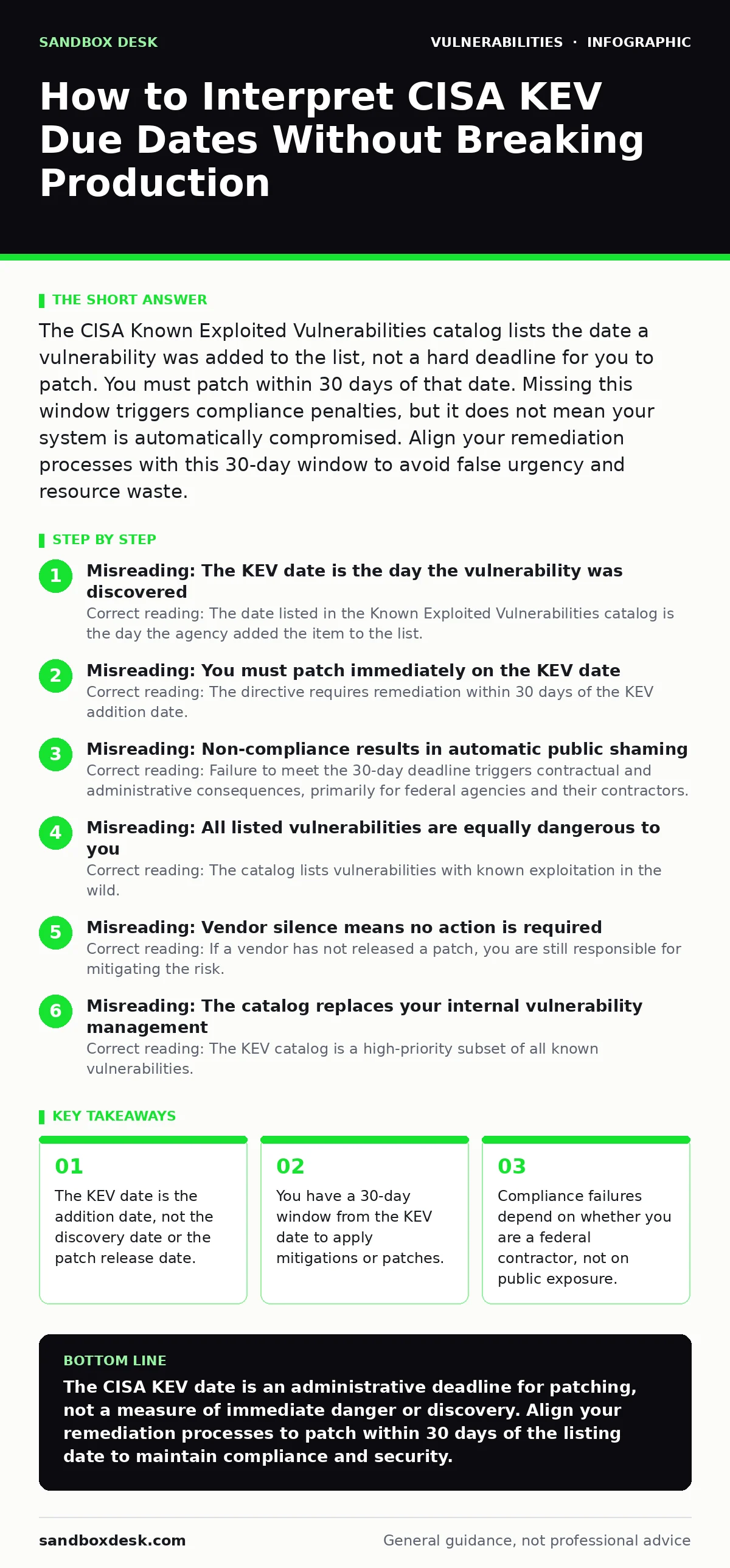
Misreading: You must patch immediately on the KEV date
Correct reading: The directive requires remediation within 30 days of the KEV addition date. Immediate patching is not mandated unless a specific incident response order applies. This 30-day window allows for testing, staging, and coordination. Rushing to patch on day one often introduces instability. It disrupts service availability and increases the risk of introducing new bugs.
Imagine a critical database server that requires a maintenance window. Patching it immediately without testing causes downtime. The 30-day rule exists to balance security with operational stability. You should schedule the patch as soon as your internal processes allow, but you do not need to halt development. Align your internal vulnerability remediation SLAs with this external deadline. This alignment ensures you meet compliance without sacrificing system reliability.
Misreading: Non-compliance results in automatic public shaming
Correct reading: Failure to meet the 30-day deadline triggers contractual and administrative consequences, primarily for federal agencies and their contractors. It does not result in automatic public listing of your organization’s name. The consequences are internal to the contracting process. They may include withholding of funds, contract termination, or mandatory remediation plans.
Public disclosure of specific organizational failures is rare and usually follows a broader breach. The primary pressure comes from audit requirements. You must be able to demonstrate compliance during reviews. Keeping records of patching efforts is critical. These records prove you acted within the required timeframe. Do not confuse administrative penalties with reputational damage. The risk is financial and operational, not necessarily public.
Misreading: All listed vulnerabilities are equally dangerous to you
Correct reading: The catalog lists vulnerabilities with known exploitation in the wild. It does not rank them by likelihood of affecting your specific environment. A vulnerability in a legacy protocol may not apply to your modern stack. Applying equal urgency to all items wastes resources. You must filter the list against your asset inventory.
Suppose a vulnerability affects a web server software you do not use. Patching it provides no security benefit. It consumes time and testing resources. Focus on vulnerabilities that match your installed software versions. Cross-reference the KEV catalog with your configuration management database. This filtering reduces noise. It allows your team to focus on genuine threats. Prioritization is a technical decision, not an administrative one.
Misreading: Vendor silence means no action is required
Correct reading: If a vendor has not released a patch, you are still responsible for mitigating the risk. The directive applies to the organization operating the vulnerable system, not the software vendor. You must implement compensating controls. These controls include network segmentation, virtual patching, or disabling the vulnerable feature.
Relying on the vendor to fix the issue shifts responsibility incorrectly. You operate the risk. If the software is end-of-life, you must replace it or isolate it. Documenting your compensating controls is part of compliance. This documentation shows you have addressed the risk despite the lack of a patch. Ignoring the vulnerability because no patch exists is a compliance failure. It leaves your systems exposed to known exploits.
See also: Secure SDLC: Concrete Benefits and Hidden Costs for Engineering Teams · CVSS Score Explained: What the Number Actually Means for Your Code
Misreading: The catalog replaces your internal vulnerability management
Correct reading: The KEV catalog is a high-priority subset of all known vulnerabilities. It does not replace your comprehensive vulnerability management program. You must still scan for and patch unlisted vulnerabilities. The catalog highlights critical risks, but it is not exhaustive. Your internal processes should feed into the KEV workflow, not be replaced by it.
Imagine relying solely on the KEV list for security updates. You would miss thousands of lower-severity flaws that attackers chain together. The catalog focuses on immediate, proven threats. Your broader program addresses the long-tail of risks. Integrate KEV checks into your existing workflow. This integration ensures high-priority items are handled quickly. It maintains a holistic view of your security posture.
Misreading: Patching once satisfies the requirement forever
Correct reading: The 30-day window applies to the specific version of the software at the time of the KEV listing. If you deploy new instances of the same software, you must patch them immediately. The requirement is ongoing. It applies to your entire estate, not just the systems you scanned on day one.
New deployments often bypass initial security checks. They may install vulnerable versions by default. You must ensure your build pipelines include up-to-date packages. Continuous monitoring is necessary. A one-time patch job does not prevent future drift. Integrate KEV checks into your deployment pipeline. This integration ensures new systems are secure from the start. It prevents accumulation of technical debt.
Misreading: The KEV date is the same as the CVSS score release
Correct reading: The KEV date is administrative. The CVSS score is a technical severity rating. These two dates are unrelated. A high CVSS score does not guarantee KEV listing. A low CVSS score does not prevent KEV listing. Exploitation evidence drives KEV inclusion, not severity scores.
Suppose a vulnerability has a low CVSS score but is actively exploited. It will appear on the KEV list. You must patch it within 30 days. Conversely, a high CVSS score with no known exploitation may not appear. You should still patch it, but the urgency is different. Do not conflate technical severity with administrative deadlines. Use both metrics to inform your strategy.
How to verify your understanding
Correct reading: Test your internal processes against the KEV timeline. Create a mock vulnerability scenario. Track it from KEV listing to patching. Measure the time taken. Identify bottlenecks. This exercise reveals gaps in your workflow. It ensures you can meet the 30-day requirement consistently.
Review your documentation. Ensure it distinguishes between discovery, listing, and patching dates. Train your team on this distinction. Misunderstanding leads to panic or neglect. Clear communication prevents both. Regular audits of your KEV compliance process are necessary. They ensure your organization remains aligned with federal expectations. This alignment protects your contracts and your systems.
Key takeaways
- The KEV date is the addition date, not the discovery date or the patch release date.
- You have a 30-day window from the KEV date to apply mitigations or patches.
- Compliance failures depend on whether you are a federal contractor, not on public exposure.
- Exploitation evidence exists, but the specific attack vector may not target your architecture.
The CISA KEV date is an administrative deadline for patching, not a measure of immediate danger or discovery. Align your remediation processes to patch within 30 days of the listing date to maintain compliance and security.
Frequently asked questions
Does the KEV catalog apply to private companies?
The directive primarily applies to federal agencies and their contractors. Private companies are not legally bound by the 30-day rule. However, following the catalog improves security posture and may be required by customer contracts.
What if a vendor never releases a patch?
You must implement compensating controls, such as network segmentation or virtual patching. Document these controls to demonstrate compliance. If the software is critical, consider replacing it with a supported alternative.
How often is the KEV catalog updated?
The catalog is updated regularly, often weekly. You should check for new entries frequently. Automating checks ensures you do not miss new listings. Manual checks are inefficient and prone to delay.
Can I use a 60-day window for non-critical systems?
No, the directive specifies a 30-day window for all known exploited vulnerabilities. Exceptions are rare and require specific justification. Extending the window increases risk and potential compliance failures.
How this guide was produced: written by the Sandbox Desk editorial team with AI assistance, checked against the public references listed below, and reviewed when the facts change. See our editorial policy or report an error.