Data Scraping Meaning: How Automated Extraction Works and What It Costs
Automated web extraction bypasses public interfaces to harvest structured data, creating hidden liabilities for server resources and intellectual property.

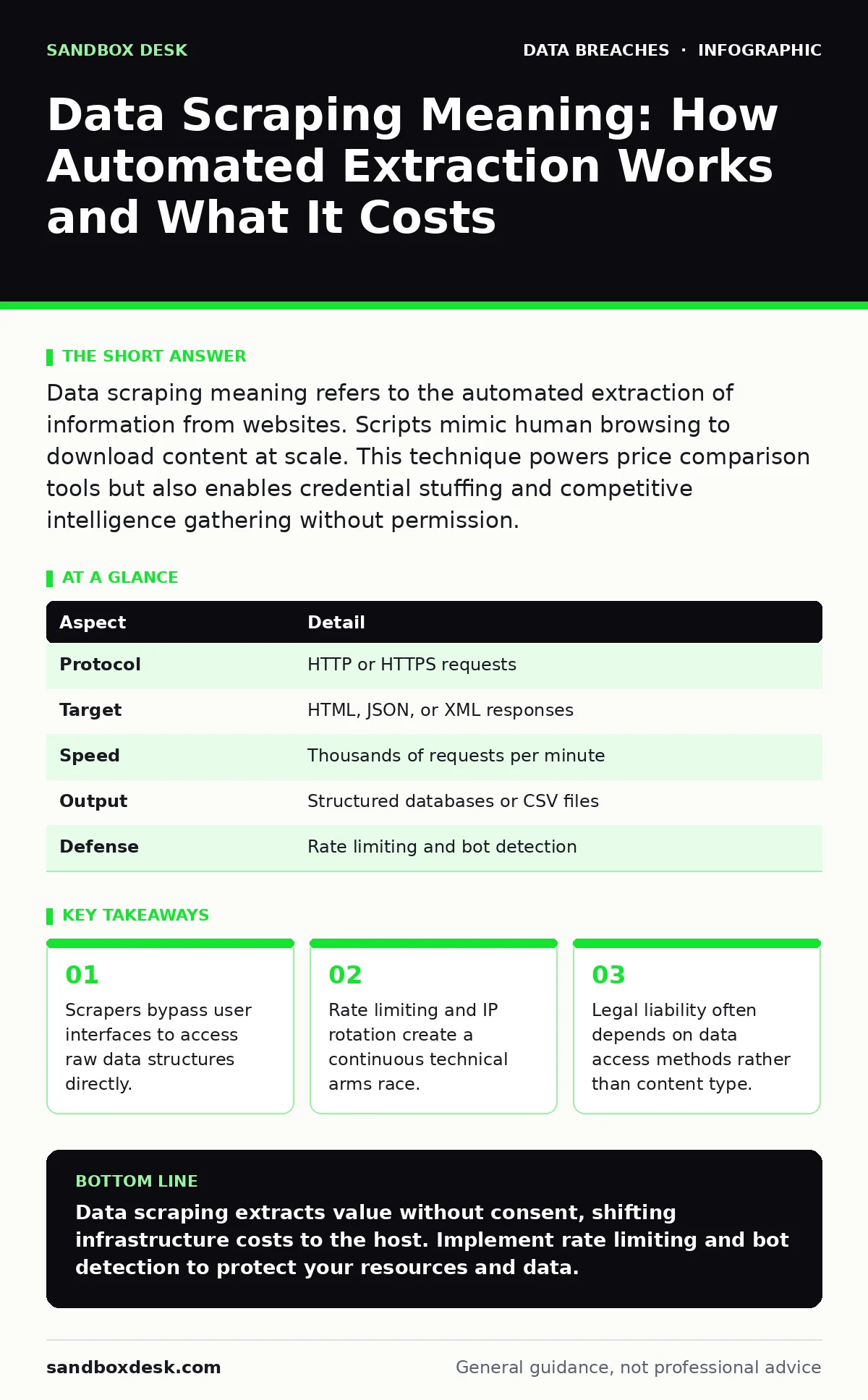
Data scraping meaning refers to the automated extraction of information from websites. Scripts mimic human browsing to download content at scale. This technique powers price comparison tools but also enables credential stuffing and competitive intelligence gathering without permission.
Everyday Analogy for Data Extraction
Imagine a library where patrons must read books at desks. A scraper is a machine that enters the library, scans every page of every book in seconds, and leaves. The machine does not read for enjoyment. It collects text to build a dataset. The library remains open, but the machine extracts value faster than any human could. This speed creates friction between data owners and collectors. The owner controls the physical space. The collector exploits the public nature of the information displayed within it.
Data Scraping Meaning and Core Mechanics
Data scraping meaning centers on automated programs that request web pages and parse their structure. These programs send HTTP requests to servers, just like a browser does. Instead of displaying the result to a user, the scraper analyzes the HTML or JSON response. It identifies specific elements, such as prices, images, or user profiles, and stores them in a structured format. The process repeats thousands of times. The scraper follows links or iterates through URL patterns to expand its dataset. This method works on any site that serves data over standard web protocols.
| Aspect | Detail |
|---|---|
| Protocol | HTTP or HTTPS requests |
| Target | HTML, JSON, or XML responses |
| Speed | Thousands of requests per minute |
| Output | Structured databases or CSV files |
| Defense | Rate limiting and bot detection |
How Scrapers Bypass Public Interfaces
Standard web applications present data through a user interface. This interface includes navigation menus, search bars, and visual styling. A scraper ignores the visual layer. It looks at the underlying Document Object Model or API responses. Many modern applications load data dynamically via JavaScript. Scrapers use headless browsers to execute this JavaScript and capture the resulting data. This technique mimics a real user’s browser environment. It allows the scraper to access data that only appears after page interaction. The scraper does not need to understand the website’s design. It only needs to understand the data structure.
Who Bears the Cost of Extraction
Websites hosting public data bear the infrastructure cost. Each request consumes server resources. A single human user generates a few requests per session. A scraper generates thousands. This volume increases bandwidth costs and slows response times for legitimate users. Developers must implement defenses that distinguish humans from bots. This requires computational overhead for challenge-response systems. Data subjects also bear risk. When personal information is scraped, it often aggregates into datasets sold to third parties. This aggregation enables targeted advertising or identity theft. The harm is diffuse and difficult to trace back to the initial extraction event.
Common Misconceptions About Web Harvesting
Many believe that public data is free to take. This view ignores the resource cost of serving that data. It also ignores intellectual property rights in compilation. Another misconception is that robots.txt files provide legal protection. They do not. Robots.txt is a polite convention, not a legal barrier. Scrapers ignore these files without penalty. Some assume that scraping static pages is safe. Dynamic content scraping is often more aggressive and harder to detect. The distinction between scraping and web crawling matters for defense. Crawlers index content for search engines. Scrapers extract specific data for reuse.
See also: SEO Poisoning Mistakes That Compromise Your Site Authority · Log Retention Strategy: Benefits, Limits, and When to Stop
Technical Defenses and Their Trade-offs
Defending against scraping requires balancing security and usability. Rate limiting restricts the number of requests per IP address. This stops simple bots but blocks legitimate users on shared networks. CAPTCHAs challenge users to prove they are human. This adds friction for all users. JavaScript challenges require the client to execute code. This filters out basic scripts but not advanced headless browsers. IP reputation lists block known malicious addresses. Scrapers use proxy networks to rotate IPs, bypassing these lists. Each defense layer adds complexity. Each layer also introduces false positives that block valid traffic.
Legal Boundaries and Data Ownership
The legality of scraping depends on jurisdiction and method. Accessing publicly available data without authentication is often permissible. Bypassing authentication or terms of service agreements changes the legal landscape. The Computer Fraud and Abuse Act in the United States addresses unauthorized access. The General Data Protection Regulation in Europe restricts processing of personal data.
Scraping personal data often violates privacy laws. Even public profiles may contain protected information. Companies must review their terms of service. They should explicitly prohibit automated extraction if they wish to enforce restrictions. Legal action is costly and uncertain. Technical prevention is more reliable.
Mitigation Strategies for Data Owners
Implement layered defenses to reduce scraping impact. Monitor traffic patterns for anomalies. Look for high request rates from single IP ranges. Identify user-agent strings that lack browser identification. Block suspicious traffic at the network edge. Use content delivery networks to absorb bot traffic. These networks have built-in bot management features. They challenge suspected bots before reaching your origin server. Regularly update your defenses. Scrapers evolve to mimic human behavior. Static rules become obsolete quickly. Combine technical controls with legal notices. Make your data policy clear. This strengthens your position if litigation becomes necessary.
Related risks often stem from the data once extracted. If scraped credentials are used to access accounts, this becomes account takeover fraud. If personal records are harvested for financial crime, this relates to tax identity theft. Organizations must also consider data exfiltration risks where internal data leaves the network. Proper log retention helps trace the origin of unauthorized access. Email account compromise often follows the leakage of credentials found in scraped datasets.
Key takeaways
- Scrapers bypass user interfaces to access raw data structures directly.
- Rate limiting and IP rotation create a continuous technical arms race.
- Legal liability often depends on data access methods rather than content type.
Data scraping extracts value without consent, shifting infrastructure costs to the host. Implement rate limiting and bot detection to protect your resources and data.
Frequently asked questions
Is scraping public data illegal?
Accessing publicly available data without bypassing authentication is often legal. However, violating terms of service or privacy laws can create liability. Jurisdiction matters significantly.
How do I know if my site is being scraped?
Monitor server logs for high request volumes from single IPs. Look for unusual user-agent strings. Watch for traffic patterns that lack typical user navigation behavior.
Can robots.txt stop scrapers?
No. Robots.txt is a convention, not a technical barrier. Respectful bots follow it. Malicious scrapers ignore it. You must use technical controls like rate limiting.
What is the difference between crawling and scraping?
Crawling indexes content for search visibility. Scraping extracts specific data for reuse or analysis. Crawlers usually follow links broadly. Scrapers target specific data points.
How this guide was produced: written by the Sandbox Desk editorial team with AI assistance, checked against the public references listed below, and reviewed when the facts change. See our editorial policy or report an error.