Implementing Vulnerability Remediation SLAs: A Step-by-Step Framework
Static time limits fail because they ignore code complexity, causing teams to patch low-risk noise while critical logic flaws remain exposed for dangerous periods.
Build remediation timelines around exploitability, not just severity scores. Map dependencies first, automate detection, and enforce deadlines through merge gates. Verify success by tracking mean time to remediation and ensuring zero overdue items in production.
Define Exploitability Before Setting Deadlines
You cannot set a deadline for a fix until you know how easy it is to exploit the flaw. Severity scores alone are insufficient because they often ignore context. A high-score bug in an internal tool with no network access poses less risk than a medium-score bug in a public-facing API. You must assess the attack path.
Determine if the vulnerability requires authentication, user interaction, or specific network conditions. This assessment determines the urgency. If the flaw allows remote code execution without authentication, the timeline shrinks. If it requires local access and a specific role, the timeline expands. This distinction prevents teams from wasting resources on low-risk issues while ignoring critical exposures.
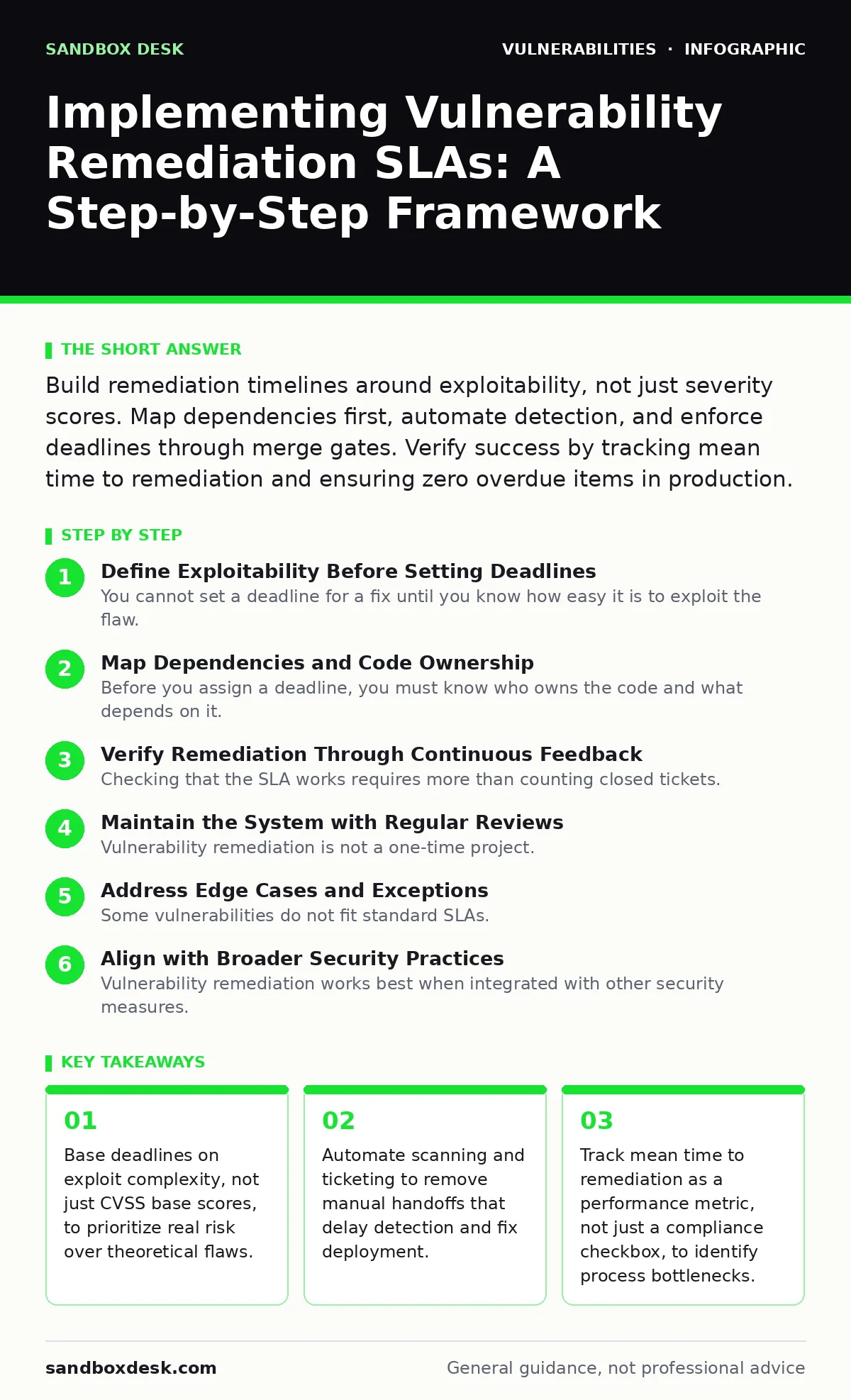
Map Dependencies and Code Ownership
Before you assign a deadline, you must know who owns the code and what depends on it. Vulnerabilities often live in shared libraries or third-party dependencies. If you patch a library, you risk breaking applications that rely on its old behavior. You need a dependency graph that links every vulnerability to the specific services that use it. This mapping reveals hidden costs. Fixing one component might require testing five downstream services. You must identify these relationships early. If you do not map dependencies, you will miss the deadline because you did not account for integration testing. This step ensures your SLA reflects the actual effort required to ship a safe fix.
Step 1: Inventory All Attack Surfaces
List every external entry point your software exposes. Include APIs, web interfaces, and file upload handlers. Do not forget internal services that other teams consume. You need to know where the code lives. Use automated tools to scan your repositories. Cross-reference these findings with your service registry. The verification is simple. You should be able to trace every reported vulnerability to a specific owner and a specific service. If a ticket lacks an owner, the inventory is incomplete. Re-run the scan and update the registry. This step creates the baseline for all future remediation work.
Step 2: Classify Risk by Context
Group vulnerabilities by their real-world impact. Ignore generic severity labels. Instead, ask if the flaw can be exploited from the internet. Ask if it requires credentials. Ask if it leads to data loss or system takeover. Create three tiers. Tier one covers remote, unauthenticated exploits. Tier two covers authenticated flaws with high impact. Tier three covers low-impact or complex exploits. Assign a maximum fix time to each tier. Tier one might require a fix within 48 hours. Tier three might allow 30 days. This classification aligns effort with risk. You verify this step by reviewing the last batch of tickets. Ensure the assigned tiers match the actual exploit conditions.
Step 3: Automate Ticket Creation and Assignment
Manual ticketing introduces delays and errors. Configure your scanning tool to create tickets automatically when a vulnerability is found. The ticket must include the exploit context, the affected service, and the assigned deadline. Route the ticket to the correct team based on the code ownership data. Use labels or tags to indicate the risk tier. This automation removes the bottleneck of human triage. You verify this step by checking the time between detection and ticket creation. It should be near zero. If tickets sit in a queue for review, you have failed to automate. Fix the integration. This ensures every finding enters the workflow immediately.
Step 4: Enforce Deadlines via Merge Gates
Do not rely on reminders or polite requests. Enforce the SLA through your deployment pipeline. Configure your merge request tools to block changes if a known vulnerability remains open past its deadline. If a team cannot fix the bug, they must apply a compensating control, such as a firewall rule or input validation. This control must be documented and approved. The gate ensures that risky code never reaches production. You verify this step by attempting to merge a branch with an overdue vulnerability. The build must fail. If it succeeds, your gates are misconfigured. This step makes compliance automatic rather than cultural.
Step 5: Track Mean Time to Remediation
Monitor how long fixes actually take. Compare the actual time to the SLA deadline. Calculate the mean time to remediation for each tier. This metric reveals process inefficiencies. If Tier one fixes consistently take longer than the deadline, your process is broken. You may need more resources or better tooling. Use this data to adjust future SLAs. Do not punish teams for missing deadlines if the deadlines are unrealistic. Adjust the tiers or the timelines. This continuous improvement keeps the system honest. You verify this step by reviewing the monthly trend. The mean time should stay well within the SLA limits.
Verify Remediation Through Continuous Feedback
Checking that the SLA works requires more than counting closed tickets. You must verify that the fixes are effective and that the process is sustainable. Run regular audits. Select a random sample of closed vulnerabilities. Verify that the code change actually addresses the root cause. Look for band-aid fixes that suppress alerts without fixing the bug. Check if the fix introduced new issues.
Review the dependency graph again. Ensure that the fix did not break downstream services. This verification step catches quality issues before they become incidents. It also provides data to refine your risk classification. If you find that many Tier three bugs are actually exploitable, you must upgrade their tier. This feedback loop keeps your SLA accurate.
Maintain the System with Regular Reviews
Vulnerability remediation is not a one-time project. It is a continuous process. Review your SLA definitions every quarter. Assess whether the current deadlines still reflect your risk tolerance. Update your dependency maps as your architecture changes. New services introduce new risks. Old services may be decommissioned. Keep your automation rules current.
Scanning tools update their signatures frequently. Ensure your ticketing integration works with the latest versions. Train new team members on the SLA process. Explain why exploitability matters more than severity scores. Share examples of how the process prevented incidents. This upkeep ensures the system remains relevant. If you neglect maintenance, the SLA will drift and become meaningless.
Address Edge Cases and Exceptions
Some vulnerabilities do not fit standard SLAs. Legacy systems may not be able to patch quickly. Third-party components may have no fix available. You need an exception process. Allow teams to request extensions if they can demonstrate mitigating controls. Require a risk owner to approve these exceptions. Document the reason for the extension and the planned fix date.
Review these exceptions monthly. If a vulnerability remains in exception status for too long, escalate it. This prevents exceptions from becoming the norm. You verify this step by auditing the exception log. Ensure that every exception has a valid reason and a clear path to resolution. This flexibility keeps the system practical while maintaining security.
See also: Secure SDLC: Concrete Benefits and Hidden Costs for Engineering Teams · CVSS Score Explained: What the Number Actually Means for Your Code
Align with Broader Security Practices
Vulnerability remediation works best when integrated with other security measures. Combine it with least privilege access to limit the impact of exploited flaws. Use broken object level authorization (BOLA) checks to prevent unauthorized data access. Monitor for WebSocket vulnerabilities that might bypass traditional HTTP security.
Consider null pointer dereference bugs that could crash services and cause denial of service. Understand OpenSSL vulnerabilities that affect cryptographic operations. Each of these areas requires specific attention. Your SLA should account for the unique risks in each category. By aligning remediation with these practices, you create a defense-in-depth strategy. This approach reduces the overall risk profile of your software.
Key takeaways
- Base deadlines on exploit complexity, not just CVSS base scores, to prioritize real risk over theoretical flaws.
- Automate scanning and ticketing to remove manual handoffs that delay detection and fix deployment.
- Track mean time to remediation as a performance metric, not just a compliance checkbox, to identify process bottlenecks.
Frequently asked questions
How do I handle vulnerabilities in third-party libraries?
Treat third-party vulnerabilities like your own code. Apply the same SLA tiers based on exploitability. If no patch exists, apply compensating controls or isolate the service. Track the vendor's release schedule for fixes.
What if a team consistently misses their SLA deadlines?
Investigate the root cause. The deadlines may be unrealistic for the complexity of the code. Adjust the tier assignment or provide additional resources. Do not simply punish the team without fixing the process.
Can I use AI tools to speed up remediation?
AI tools can suggest fixes, but they do not guarantee correctness. You must still verify every fix manually. Use AI to reduce the initial effort, but keep the verification step human-led to ensure safety.
How often should I review my SLA definitions?
Review your SLA definitions every quarter. Architecture changes and new threat models may require adjustments. Ensure your risk tiers still reflect the actual business impact and exploit difficulty.
How this guide was produced: written by the Sandbox Desk editorial team with AI assistance, checked against the public references listed below, and reviewed when the facts change. See our editorial policy or report an error.