National Cyber Emergency Declaration: What It Means for Operations
A national cyber emergency declaration shifts incident response from voluntary coordination to mandatory federal support, altering data retention and reporting obligations immediately.

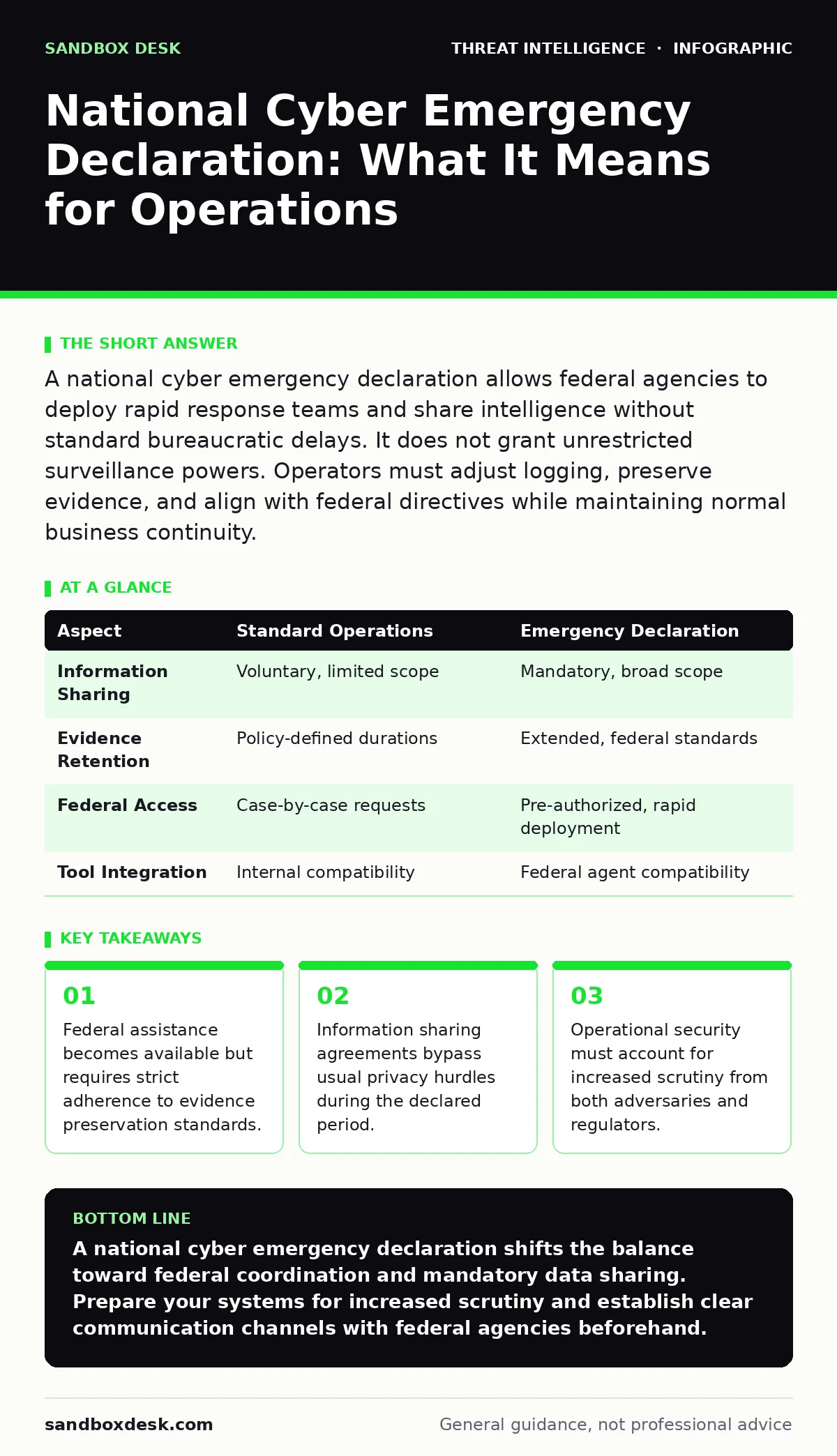
A national cyber emergency declaration allows federal agencies to deploy rapid response teams and share intelligence without standard bureaucratic delays. It does not grant unrestricted surveillance powers. Operators must adjust logging, preserve evidence, and align with federal directives while maintaining normal business continuity.
What authority does a national cyber emergency declaration grant?
A national cyber emergency declaration authorizes federal agencies to provide immediate technical assistance and coordinate responses across jurisdictions. It does not transfer ownership of private systems to the government. The declaration creates a legal framework for rapid information sharing between public and private sectors. This framework reduces the time required to identify attack vectors. Agencies can bypass standard procurement for emergency tools. The authority expires when the declaration is rescinded.
How does this declaration change incident response procedures?
Incident response procedures shift from internal containment to coordinated federal support. Teams must document all actions for potential federal review. Standard playbooks may be overridden by federal directives. You must preserve logs with higher fidelity than usual. Data retention policies must align with federal evidence handling standards. This ensures that forensic data remains admissible if legal action follows. Coordination channels open directly with federal fusion centers.
What are the data privacy implications for operators?
Data privacy constraints relax to allow broader sharing of threat indicators. Operators can share sensitive network data with federal partners without standard consent forms. This facilitates faster identification of common attack patterns. However, this sharing is limited to the duration of the emergency. Personal identifiable information must still be minimized where possible. Anonymization techniques remain necessary for non-essential data. The trade-off is speed versus long-term privacy liability.
How does federal assistance integrate with existing security tools?
Federal assistance integrates by providing additional monitoring capabilities and threat intelligence. Agencies may deploy agents to critical infrastructure for deeper visibility. These agents operate alongside existing security information and event management systems. You must ensure your tools can ingest federal data formats. Standardization allows for seamless correlation of events. This integration helps identify patterns that local tools might miss. It requires temporary access credentials for federal responders.
What happens to evidence handling during the declaration?
Evidence handling becomes stricter due to potential federal involvement. Chain of custody documentation must be impeccable. Digital forensics teams may work alongside federal investigators. You must preserve volatile memory and disk images. Standard deletion policies are suspended for relevant systems. This ensures that no potential evidence is lost. The cost is increased storage requirements and administrative overhead. Legal counsel should review all handling procedures.
See also: Log Retention Strategy: Benefits, Limits, and When to Stop · Is Command the Same as Control in C2 Infrastructure?
How do threat intelligence sharing agreements change?
Threat intelligence sharing agreements become reciprocal and mandatory for critical sectors. Operators receive detailed indicators of compromise from federal sources. They must also contribute their own findings to the national pool. This bidirectional flow improves collective defense. It exposes operators to more sensitive data about adversary tactics. Understanding the Diamond Model of intrusion analysis helps contextualize this shared intelligence. The model provides a framework for categorizing actor, infrastructure, capability, and pattern.
What are the operational costs for private organizations?
Operational costs rise due to increased logging, reporting, and coordination. Staff must dedicate time to federal liaison duties. System performance may degrade under additional monitoring agents. Storage costs increase for retained logs and evidence. There is a hidden cost in employee fatigue and stress. The benefit is access to resources that would otherwise be unavailable. Organizations must budget for these temporary spikes in resource usage.
How does this affect legacy system security?
Legacy systems become higher priority targets for federal attention. Older protocols may be flagged as immediate risks. Operators must provide temporary compensating controls for unsupported systems. Federal teams may recommend immediate isolation of vulnerable assets. This can disrupt business operations significantly. The pressure to modernize increases during the emergency. Delaying upgrades becomes a liability rather than a strategic choice.
| Aspect | Standard Operations | Emergency Declaration |
|---|---|---|
| Information Sharing | Voluntary, limited scope | Mandatory, broad scope |
| Evidence Retention | Policy-defined durations | Extended, federal standards |
| Federal Access | Case-by-case requests | Pre-authorized, rapid deployment |
| Tool Integration | Internal compatibility | Federal agent compatibility |
How do operators maintain business continuity?
Operators maintain business continuity by segmenting emergency response from core operations. Dedicated teams handle federal coordination while others manage daily tasks. This prevents resource exhaustion. You must have clear handoff procedures. Automation helps manage the increased volume of alerts. Prioritization matrices adjust to reflect federal guidance. This ensures that critical services remain available.
What is the role of identity protection during this period?
Identity protection becomes paramount as adversaries target access credentials. Techniques like pass-the-ticket attacks become more prevalent during chaos. Operators must enforce strict verification for privileged access. Multi-factor authentication remains mandatory for all remote connections. Monitoring for anomalous login patterns is critical. This prevents attackers from exploiting the confusion. Identity logs must be preserved for forensic analysis.
How does the declaration impact third-party vendors?
Third-party vendors face increased scrutiny and reporting requirements. They must comply with the same data sharing rules as the primary operator. Supply chain attacks become a higher priority for federal investigation. Vendors with access to critical systems are monitored closely. This may delay service updates or maintenance windows. Communication with vendors must be formalized and documented.
What happens after the declaration ends?
The declaration ends when the threat is contained or resolved. Federal teams withdraw and return systems to normal control. Operators must review all data collected during the emergency. Lessons learned are documented and integrated into future plans. This post-event analysis is critical for improving resilience. The return to normal operations should be gradual. Systems are re-baselined to ensure no residual changes remain.
How does this relate to other attack vectors?
This declaration context highlights the importance of defending against specific attack vectors. Remote desktop abuse becomes a primary vector for initial access. Operators must restrict remote access to trusted networks only. Scheduled task abuse can be used to maintain persistence. Auditing scheduled tasks is essential during the response. NTLM relay attacks remain a threat in hybrid environments. Understanding these vectors helps prioritize defenses.
How do operators prepare for future declarations?
Operators prepare by establishing clear communication channels with federal agencies. Pre-approved agreements for data sharing reduce friction. Training exercises simulate emergency coordination. This ensures that staff are familiar with federal procedures. Documentation of system architectures helps responders understand the environment. Regular updates to incident response runbooks keep procedures current. Preparation reduces the shock of sudden federal involvement.
Key takeaways
- Federal assistance becomes available but requires strict adherence to evidence preservation standards.
- Information sharing agreements bypass usual privacy hurdles during the declared period.
- Operational security must account for increased scrutiny from both adversaries and regulators.
A national cyber emergency declaration shifts the balance toward federal coordination and mandatory data sharing. Prepare your systems for increased scrutiny and establish clear communication channels with federal agencies beforehand.
Frequently asked questions
Does a national cyber emergency declaration allow the government to shut down private networks?
No, the declaration does not grant the government authority to shut down private networks. It allows for technical assistance and information sharing. Operators retain control of their systems but must cooperate with federal directives.
How long does a national cyber emergency declaration typically last?
The duration depends on the severity and persistence of the threat. It remains in effect until the declared threat is contained or resolved. There is no fixed time limit, but it is intended to be temporary.
Can federal agencies access my personal data during the declaration?
Federal agencies may access data relevant to the cyber incident. This is limited to technical data and threat indicators. Personal data is protected unless directly relevant to the investigation. Minimization principles still apply.
Do I need to change my security tools during the declaration?
You may need to configure existing tools to accept federal data formats. New federal agents may be deployed for monitoring. These changes are temporary and reversible. Ensure your tools support standard integration protocols.
How this guide was produced: written by the Sandbox Desk editorial team with AI assistance, checked against the public references listed below, and reviewed when the facts change. See our editorial policy or report an error.