Is Command the Same as Control in C2 Infrastructure?
Command and control channels hide inside normal traffic patterns, making protocol inspection alone insufficient for detection without behavioral context.
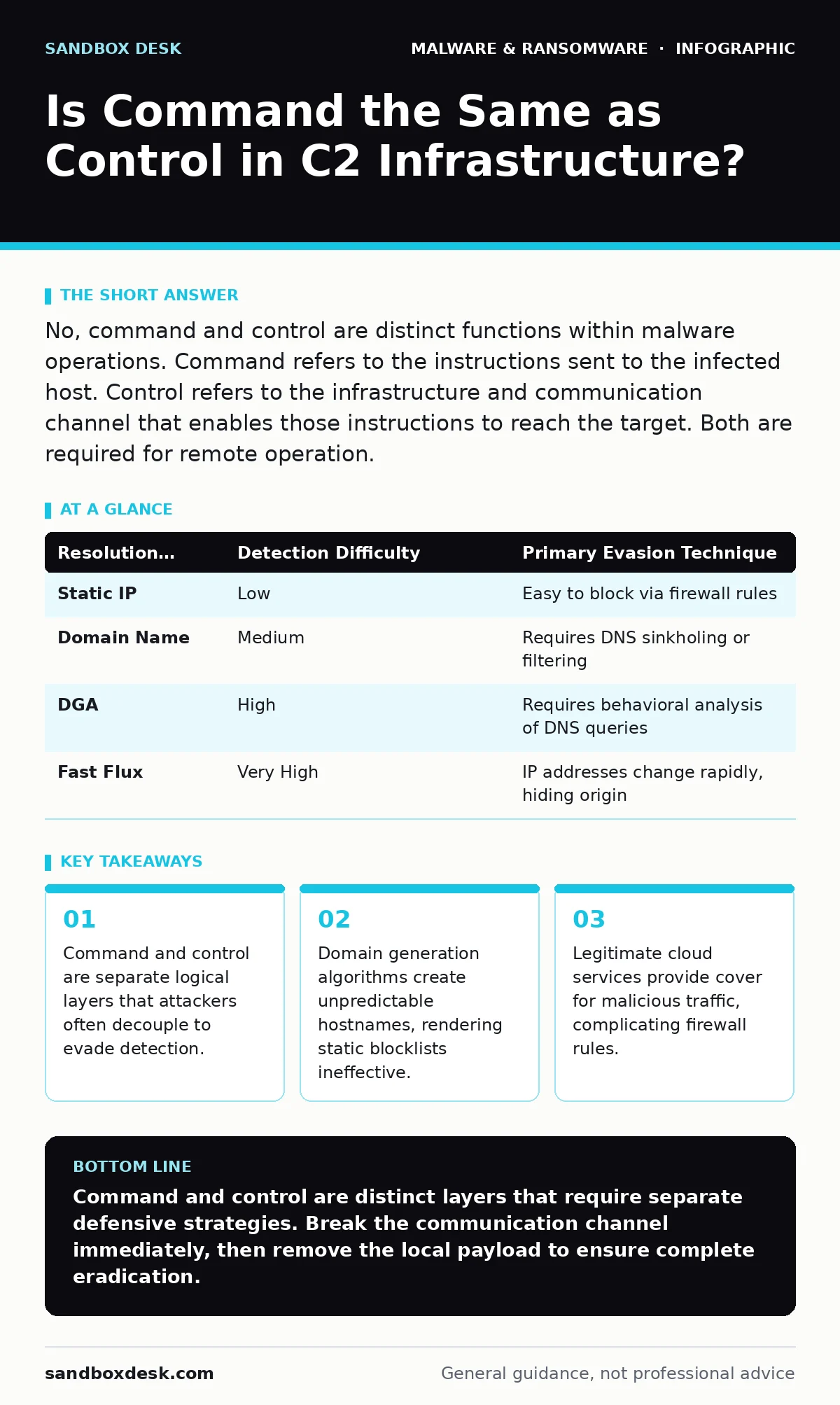
No, command and control are distinct functions within malware operations. Command refers to the instructions sent to the infected host. Control refers to the infrastructure and communication channel that enables those instructions to reach the target. Both are required for remote operation.
Is command the same as control in malware operations?
Command and control are not the same thing, though they function together as a single operational loop. The command is the specific instruction, such as "exfiltrate this file" or "execute this script." The control is the mechanism that delivers that instruction, including the server, the protocol, and the encryption method. You must distinguish between the payload and the pipeline to defend against them effectively.
How do attackers separate these two components?
Attackers separate command and control to limit the blast radius of their infrastructure. If you take down the control server, the malware on the victim machine may still hold the command logic locally. This decoupling means that removing one component does not stop the other. The malware can switch to a backup channel or wait for a new signal. This resilience makes eradication difficult.
Imagine a botnet where the central server is seized by law enforcement. The malware on thousands of computers still contains the code to steal data. It simply stops receiving new instructions. The attacker loses the ability to direct the attack, but the initial compromise remains. This is why host-based defenses matter as much as network monitoring.
Why do blocklists fail against modern C2 traffic?
Static blocklists fail because modern malware uses dynamic resolution methods. Domain generation algorithms create thousands of random domain names on the fly. The malware tries to connect to each one until it finds a live server. By the time you block one domain, the malware has already moved to the next. This cat-and-mouse game exhausts defensive resources.
| Resolution Method | Detection Difficulty | Primary Evasion Technique |
|---|---|---|
| Static IP | Low | Easy to block via firewall rules |
| Domain Name | Medium | Requires DNS sinkholing or filtering |
| DGA | High | Requires behavioral analysis of DNS queries |
| Fast Flux | Very High | IP addresses change rapidly, hiding origin |
Can legitimate services hide malicious activity?
Yes, attackers use legitimate services to mask their control channels. This technique is known as domain fronting or using compromised websites as intermediaries. Traffic to a popular cloud provider looks normal to firewalls. The malicious payload is hidden inside the encrypted stream of a trusted service. You cannot simply block the destination because it is a legitimate provider. This forces you to inspect content, not just connections.
What role do droppers play in this architecture?
Malware droppers and loaders act as the initial bridge to the control channel. They do not contain the full malicious payload. Instead, they fetch it from the command and control server after executing on the victim machine. This keeps the initial infection small and stealthy. It also allows the attacker to update the malware without re-infecting the system. The dropper is the key that unlocks the door to the control infrastructure.
See also: Zero Trust Security: 8 Practices to Verify Every Request · How to Implement Intrusion Detection Systems Without Noise
How does encryption impact your ability to see commands?
Encryption prevents you from reading the command content directly. When traffic is encrypted, you see that data is moving, but not what it says. This protects the attacker's instructions from network inspection tools. You must rely on metadata, such as packet size, timing, and frequency, to detect anomalies. Encrypted command and control channels are harder to analyze because they lack visible indicators of compromise. This shifts the burden to behavioral detection.
Why is behavior-based detection more effective than signatures?
Behavior-based detection looks for actions rather than known file hashes. Signatures fail when malware changes its code slightly. Behavior-based detection identifies the pattern of communication, such as periodic check-ins or unusual outbound connections. It catches new variants because the behavior remains consistent even if the code changes. This approach reduces false negatives for novel threats. It requires careful tuning to avoid blocking legitimate software updates.
What happens when the control channel is cut?
When the control channel is severed, the malware becomes dormant or useless. It may continue to run silently on the disk, but it cannot receive new commands. It cannot exfiltrate data unless it was already buffered. It cannot spread to other systems without further instructions. This state is called a "zombie" infection. You must still remove the malware from the host, as it may reactivate if the attacker restores the channel. Disconnection is not remediation.
How should you structure your incident response?
A ransomware incident response plan must address the control channel explicitly. You must isolate the infected host to break the connection. Then, you must identify the communication pattern to find other infected systems. Finally, you must remove the malware and patch the entry point. Without breaking the control link, the attacker can re-infect the system or trigger ransom notes. Coordination between network and host teams is necessary for complete remediation.
Key takeaways
- Command and control are separate logical layers that attackers often decouple to evade detection.
- Domain generation algorithms create unpredictable hostnames, rendering static blocklists ineffective.
- Legitimate cloud services provide cover for malicious traffic, complicating firewall rules.
Command and control are distinct layers that require separate defensive strategies. Break the communication channel immediately, then remove the local payload to ensure complete eradication.
Frequently asked questions
Does antivirus software stop command and control traffic?
Traditional antivirus software focuses on file signatures and may miss network-based control channels. Next-generation antivirus includes behavioral monitoring, which is more effective at detecting active command and control activity.
Can I use a firewall to block all C2 traffic?
You can block known malicious IPs, but firewalls cannot stop encrypted traffic to legitimate domains. You need additional layers like DNS filtering and endpoint detection to catch sophisticated control channels.
What is a logic bomb in this context?
A logic bomb is code that triggers an action when a specific condition is met, such as a date or the loss of contact with the control server. It can serve as a backup trigger if the primary command channel fails.
Do disaster recovery plans cover C2 infections?
Disaster recovery plans focus on restoring data and systems after an outage. They do not prevent infection. You need separate security measures to detect and block command and control before data loss occurs.
How this guide was produced: written by the Sandbox Desk editorial team with AI assistance, checked against the public references listed below, and reviewed when the facts change. See our editorial policy or report an error.