Diamond Model of Intrusion Analysis for Small Business Defense
The Diamond Model converts raw network noise into structured adversary profiles, allowing small teams to prioritize threats based on capability rather than volume.

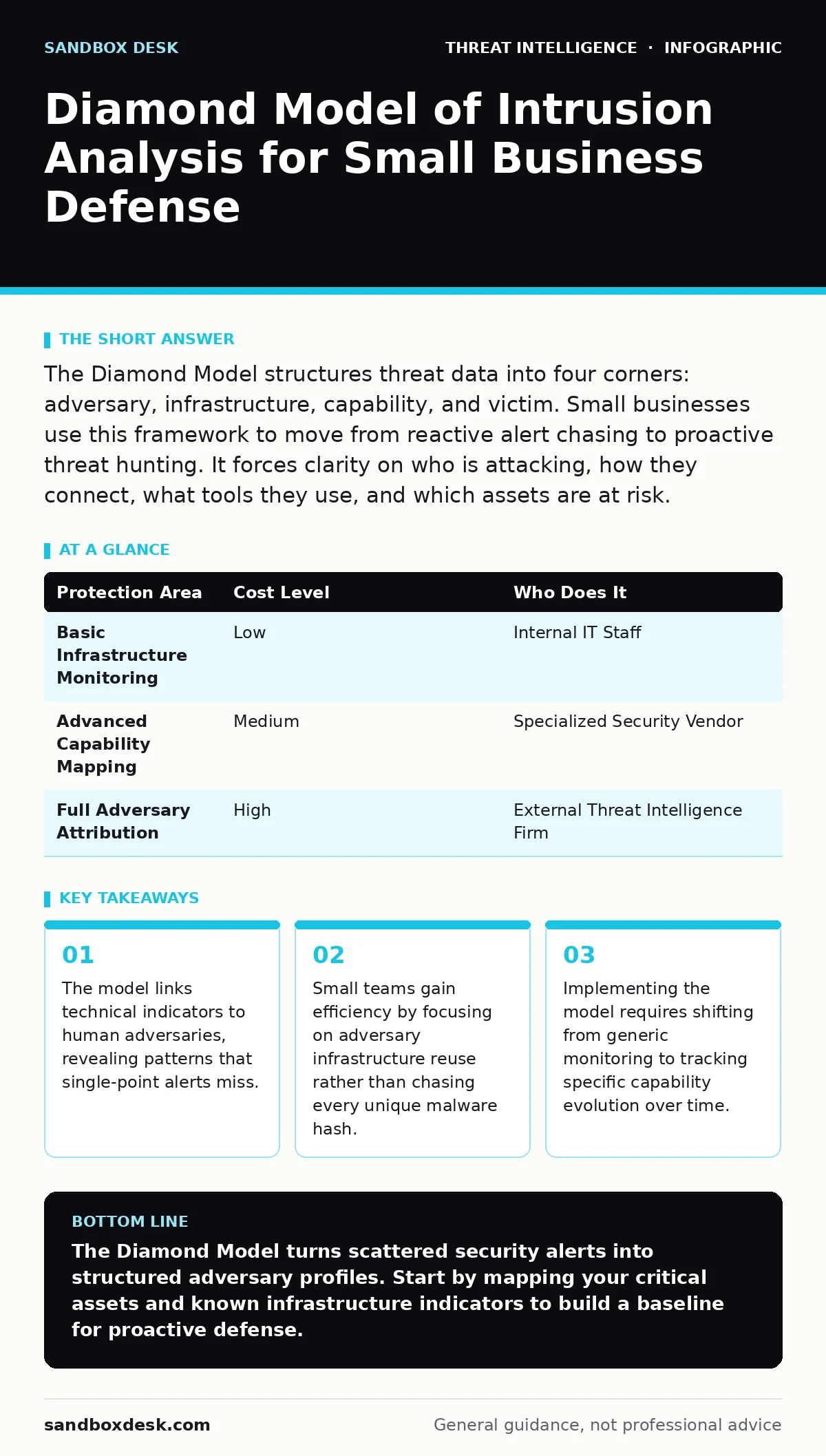
The Diamond Model structures threat data into four corners: adversary, infrastructure, capability, and victim. Small businesses use this framework to move from reactive alert chasing to proactive threat hunting. It forces clarity on who is attacking, how they connect, what tools they use, and which assets are at risk.
Understanding the Four Corners of Intrusion
The Diamond Model of intrusion analysis organizes cyber threat data into four interconnected categories. Each corner provides a different lens for understanding the attack. The infrastructure corner covers the technical means of communication, such as domains, IP addresses, and hosting services. Adversaries often reuse infrastructure to maintain persistence. Tracking these elements reveals operational habits. The capability corner describes the tools and techniques used.
This includes malware families, exploit kits, and specific attack methods. Understanding capabilities helps predict future behavior. The victim corner identifies the target systems, sectors, or geographies. Some adversaries specialize in specific industries. Recognizing this specialization allows for proactive hardening. The adversary corner represents the human or organizational element. This is the most difficult corner to fill but provides the most context. Linking infrastructure and capabilities to a specific group reduces uncertainty.
Why Structure Matters at Small Scale
Small organizations lack the personnel to monitor every log entry continuously. The Diamond Model provides a prioritization framework. It forces a distinction between high-value targets and low-value noise. Without this structure, small teams waste resources on false positives. The model emphasizes relationships between data points. A single IP address is less informative than an IP address linked to a known capability and a specific victim profile. This contextual depth allows for better resource allocation.
You can ignore low-risk traffic that does not fit your threat profile. You can focus on connections that match known adversary patterns. This efficiency is critical when staff are limited. The model also aids in communication. It provides a common language for discussing threats with leadership. You can explain why a specific server needs patching based on adversary capability rather than vague risk. This clarity supports budget decisions and security investments.
Practical Implementation Steps
Implementing the Diamond Model does not require expensive software. It requires a disciplined approach to data collection. Start by defining your victim corner. Document critical assets, their roles, and their value. This baseline allows you to identify when an asset becomes a target. Next, collect infrastructure data. Use open-source intelligence to map known bad indicators. Tools for OSINT investigations can help populate this corner. Do not rely solely on internal logs. External context is vital for identifying infrastructure reuse.
Then, analyze capabilities. Correlate observed behaviors with known tactics. The MITRE ATT&CK Navigator provides a standardized framework for this. Mapping your observations to this framework reveals gaps in your defenses. Finally, attempt to identify the adversary. This is often speculative at small scale. Look for patterns in timing, language, or specific tool usage. Even partial attribution improves situational awareness. Document these findings in a centralized repository. This creates a historical record for trend analysis.
Integrating with Existing Operations
The Diamond Model complements existing security operations. It enhances blue team operations by providing context for alerts. Instead of treating every alert as equal, analysts can score them based on Diamond coverage. An alert with populated infrastructure and capability corners is higher priority. The model also supports incident response runbooks. When an incident occurs, the runbook can include steps to populate the Diamond. This ensures consistent data collection. You can integrate the model into packet capture analysis.
Reviewing network traffic through the lens of infrastructure and capability reveals hidden connections. For example, encrypted traffic to a known bad domain is a strong infrastructure signal. The model also aids in threat intelligence reports. Instead of listing raw indicators, reports can present structured adversary profiles. This makes intelligence actionable for technical teams. You can use the model to validate threat feeds. If a feed lacks capability or adversary context, its value is limited.
Asking the Right Questions of Providers
Managed service providers often offer generic security monitoring. You need to verify if their approach aligns with structured analysis. Do not accept vague promises of "24/7 monitoring." Ask specific questions about their analytical framework. Understanding their methodology ensures you are paying for depth, not just volume. The following table outlines key protection areas and associated costs.
| Protection Area | Cost Level | Who Does It |
|---|---|---|
| Basic Infrastructure Monitoring | Low | Internal IT Staff |
| Advanced Capability Mapping | Medium | Specialized Security Vendor |
| Full Adversary Attribution | High | External Threat Intelligence Firm |
Cost levels are relative and depend on your specific needs. Basic monitoring is often included in standard IT support. Advanced mapping requires specialized tools and expertise. Full attribution is rarely necessary for small businesses. Focus on infrastructure and capability mapping. These corners provide the most immediate defensive value. You do not need to know the exact name of the adversary. You need to know what they can do and how they connect. Ensure your provider can demonstrate this capability. Ask for examples of how they have linked infrastructure to capability in the past. This evidence shows practical application of the model.
See also: Scheduled Task Abuse Prevention Checklist for Secure Systems
Questions to Ask Your IT Provider
Use these questions to evaluate your provider’s analytical maturity. They reveal whether the provider uses structured frameworks or reactive checking.
- How do you correlate infrastructure indicators with specific attack capabilities?
- Do you maintain a historical database of adversary behavior patterns?
- How do you integrate external threat intelligence into your internal monitoring?
- Can you provide examples of incidents where adversary context changed the response?
- How do you prioritize alerts based on the Diamond Model corners?
- What is your process for updating victim profiles when assets change?
- Do you use standardized frameworks like MITRE ATT&CK for capability mapping?
- How do you handle false positives in your infrastructure tracking?
- What is your retention period for Diamond Model data?
- How do you communicate structured threat findings to non-technical staff?
These questions force specific answers. They move the conversation from marketing claims to operational reality. If the provider cannot answer these clearly, their monitoring may be superficial. You need a partner who understands the relationships between data points. This understanding is the core value of the Diamond Model. It transforms raw data into strategic insight. This insight drives better security decisions. It allows you to defend against what matters, not just what is loud.
Common Pitfalls and Edge Cases
The Diamond Model is not a magic bullet. It has limitations that you must understand. The adversary corner is often speculative. Small businesses should not invest heavily in attribution efforts. Focus on infrastructure and capability. These are more verifiable and actionable. Another pitfall is data overload. Collecting too much data without structure creates noise. Stick to the four corners. Discard data that does not fit. The model also assumes some level of adversary consistency.
Sophisticated groups may change infrastructure and capabilities rapidly. This requires continuous updating of your data. Stale data leads to false confidence. Regularly review and refresh your Diamond entries. Finally, the model does not replace technical controls. You still need firewalls, patching, and access controls. The model informs how you configure and monitor these controls. It adds context, not capability. Do not treat it as a substitute for basic hygiene.
Key takeaways
- The model links technical indicators to human adversaries, revealing patterns that single-point alerts miss.
- Small teams gain efficiency by focusing on adversary infrastructure reuse rather than chasing every unique malware hash.
- Implementing the model requires shifting from generic monitoring to tracking specific capability evolution over time.
The Diamond Model turns scattered security alerts into structured adversary profiles. Start by mapping your critical assets and known infrastructure indicators to build a baseline for proactive defense.
Frequently asked questions
Does the Diamond Model replace MITRE ATT&CK?
No, the Diamond Model provides a structural framework for organizing threat data, while MITRE ATT&CK provides a standardized taxonomy for tactics and techniques. They work best together, with ATT&CK populating the capability corner.
Can small businesses implement this without expensive tools?
Yes, the model is a conceptual framework. You can start with spreadsheets and open-source intelligence. The value comes from the disciplined process of linking data points, not from the software used.
How often should Diamond entries be updated?
Update entries whenever new data is available or when an incident occurs. Infrastructure and capabilities can change rapidly. Regular reviews ensure your threat profiles remain accurate and relevant.
Is adversary attribution necessary for small businesses?
No, full attribution is rarely necessary. Focus on infrastructure and capability mapping. These provide actionable intelligence for defense without the high cost and uncertainty of identifying the specific adversary group.
How this guide was produced: written by the Sandbox Desk editorial team with AI assistance, checked against the public references listed below, and reviewed when the facts change. See our editorial policy or report an error.