Null Pointer Dereference: Immediate Response and System Recovery
A null pointer dereference often indicates deeper memory corruption that can allow remote attackers to execute arbitrary code on your servers.

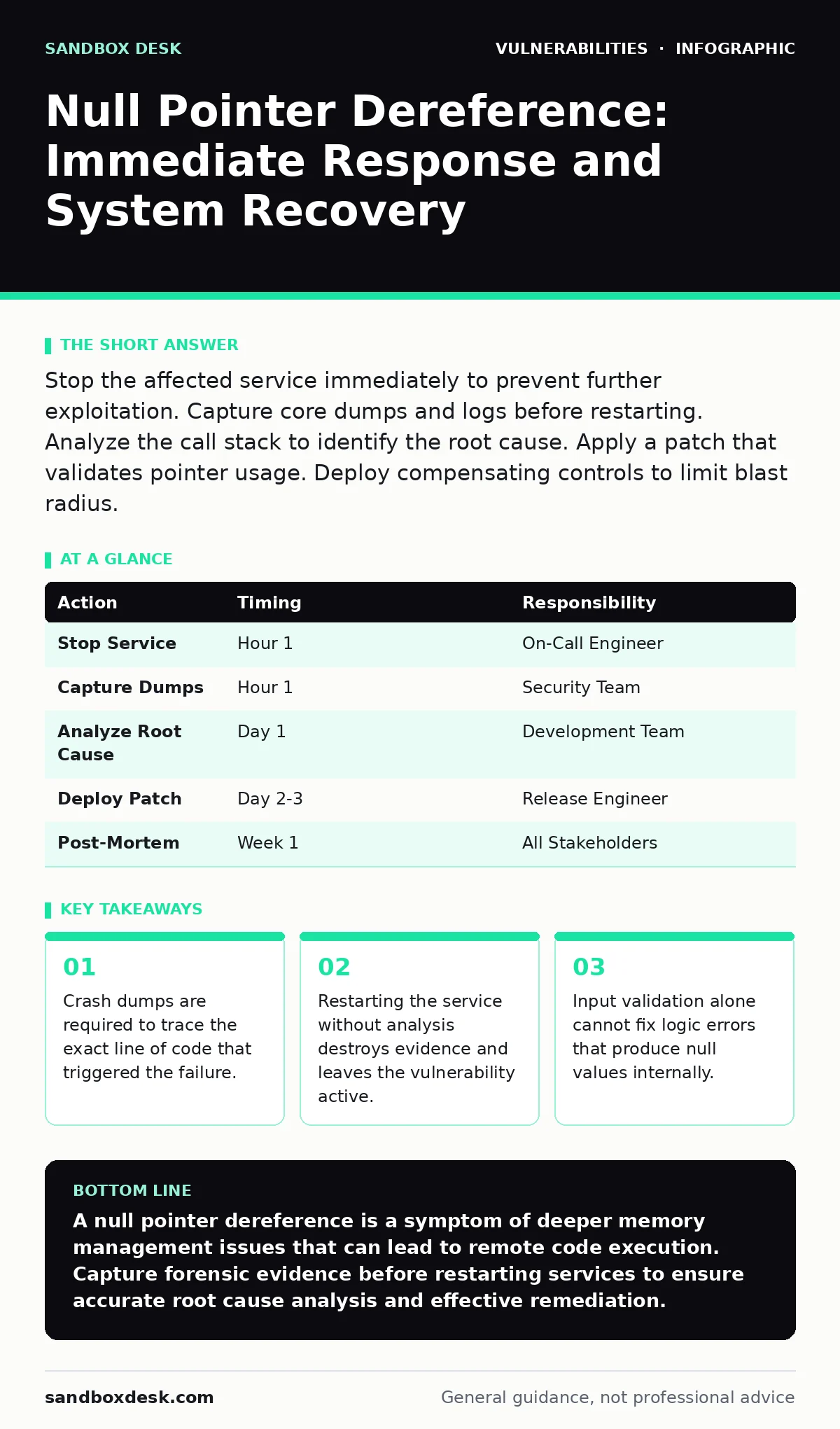
Stop the affected service immediately to prevent further exploitation. Capture core dumps and logs before restarting. Analyze the call stack to identify the root cause. Apply a patch that validates pointer usage. Deploy compensating controls to limit blast radius.
Immediate Containment Actions
The first hour after detecting a null pointer dereference determines whether the incident remains a simple crash or becomes a full compromise. You must isolate the affected component immediately. A null pointer dereference occurs when code attempts to access memory through a pointer that does not point to a valid object. This usually causes the application to terminate abruptly.
You need to stop the process gently if possible to preserve stack traces. If the system is unresponsive, a hard kill is necessary. Document the exact time of the crash. This timestamp helps correlate events in other logs. Check if the crash is reproducible. Reproducibility simplifies debugging but also confirms an active attack vector if triggered by external input.
- Stop the affected service or container instance.
- Capture core dumps or memory snapshots.
- Copy application and system logs to a secure location.
- Block suspicious source IPs at the firewall level.
- Notify the on-call engineering team and security lead.
Forensic Analysis and Root Cause
The first day focuses on understanding why the pointer was null. You must analyze the core dump using a debugger. Look at the call stack to see the sequence of function calls leading to the crash. The immediate cause is often a missed validation check. The root cause is usually a design flaw in data flow.
Identify whether the null value came from external input or internal logic. If it came from external input, check if attackers manipulated headers or parameters. If it came from internal logic, look for race conditions. Race conditions occur when multiple threads access shared data simultaneously without proper synchronization.
Check your National Vulnerability Database entries for similar issues in your dependencies. Many libraries have known null pointer issues that are patched. Verify you are using updated versions. Do not assume your code is clean just because the error is in a library. Your integration might trigger edge cases the library authors did not test.
Recovery and System Restoration
Restoring service requires more than starting the process again. You must verify that the underlying condition causing the null pointer is resolved. If you cannot patch the code immediately, you must implement temporary mitigations. These mitigations reduce the impact but do not fix the bug.
Consider routing traffic away from the vulnerable instance. Use a load balancer to drain connections. This allows you to fix the instance without affecting users. Once the patch is ready, deploy it to a staging environment first. Run automated tests that specifically target the path that caused the crash.
Ensure your least privilege access policies are enforced. Even if the null pointer dereference allows code execution, limited system permissions reduce the damage. An attacker with root access can pivot to other systems. An attacker with limited access may be trapped in the container.
Preventing Recurrence Through Code Changes
The first week is for permanent fixes. You must modify the code to handle null values gracefully. This often involves adding defensive checks before dereferencing pointers. However, adding checks everywhere is inefficient and hides design flaws. You should fix the logic that produces the null value in the first place.
Integrate static analysis tools into your build pipeline. These tools detect potential null dereferences before code runs. They catch many common patterns but may produce false positives. Tune the tools to focus on critical paths.
Review your memory management practices. In languages with manual memory management, ensure pointers are initialized and freed correctly. In managed languages, check for null returns from methods. Consider using optional types or similar constructs to make nullability explicit in your type system.
Compensating Controls and Architecture
Code fixes are not always immediate. You need architectural safeguards to survive the gap. Compensating controls reduce risk when primary defenses fail. These controls do not eliminate the vulnerability but limit its exploitability.
Implement strict input validation at the edge. This stops malformed requests from reaching the vulnerable code. While input validation cannot catch internal logic errors, it reduces the attack surface. Use CORS misconfigurations checks to ensure cross-origin requests are handled correctly, preventing external sites from triggering your endpoints.
Monitor for abnormal crash rates. A sudden spike in crashes often indicates exploitation. Set up alerts for these spikes. This allows you to detect attacks in progress and respond faster.
See also: Log Retention Strategy: Benefits, Limits, and When to Stop · Is Command the Same as Control in C2 Infrastructure?
Communication and Reporting
You must tell specific people about the incident. The engineering team needs the technical details. The security team needs the risk assessment. Management needs the business impact. Do not share raw logs with management. Summarize the findings.
Create an incident report. Include the timeline, root cause, and remediation steps. This report becomes a reference for future incidents. It helps identify patterns across your infrastructure.
Check if the vulnerability is on any CISA KEV due dates list. If it is, you have a strict deadline for patching. Ignoring these deadlines can lead to regulatory penalties.
Long Term Security Hygiene
After the immediate fire is out, you must improve your overall security posture. Regular code reviews should focus on memory safety. Train developers on common pitfalls in pointer usage.
Consider migrating to safer languages or using memory-safe subsets of your current language. This reduces the likelihood of null pointer dereferences and other memory errors.
Review your OpenSSL vulnerabilities and other library dependencies regularly. Outdated libraries are a common source of these bugs. Automate dependency updates to stay current.
| Action | Timing | Responsibility |
|---|---|---|
| Stop Service | Hour 1 | On-Call Engineer |
| Capture Dumps | Hour 1 | Security Team |
| Analyze Root Cause | Day 1 | Development Team |
| Deploy Patch | Day 2-3 | Release Engineer |
| Post-Mortem | Week 1 | All Stakeholders |
Key takeaways
- Crash dumps are required to trace the exact line of code that triggered the failure.
- Restarting the service without analysis destroys evidence and leaves the vulnerability active.
- Input validation alone cannot fix logic errors that produce null values internally.
A null pointer dereference is a symptom of deeper memory management issues that can lead to remote code execution. Capture forensic evidence before restarting services to ensure accurate root cause analysis and effective remediation.
Frequently asked questions
How do I know if a null pointer dereference was exploited?
Check for unexpected network connections, new user accounts, or modified files after the crash. Compare system hashes against known good baselines to detect tampering.
Can input validation prevent null pointer dereferences?
Input validation prevents external data from causing null values, but it cannot stop internal logic errors. You must validate both external input and internal state transitions.
Should I use address sanitizers in production?
Address sanitizers add significant performance overhead and are not recommended for production. Use them in staging and development to catch bugs early before deployment.
What is the difference between a null pointer and a dangling pointer?
A null pointer explicitly points to nothing, while a dangling pointer points to memory that has been freed. Both cause crashes, but dangling pointers are harder to detect and often lead to data corruption.
How this guide was produced: written by the Sandbox Desk editorial team with AI assistance, checked against the public references listed below, and reviewed when the facts change. See our editorial policy or report an error.