Incident Response Runbooks Explained: How to Automate Chaos
Runbooks turn panic into procedure by removing decision fatigue during outages, allowing teams to act faster than their training alone permits.

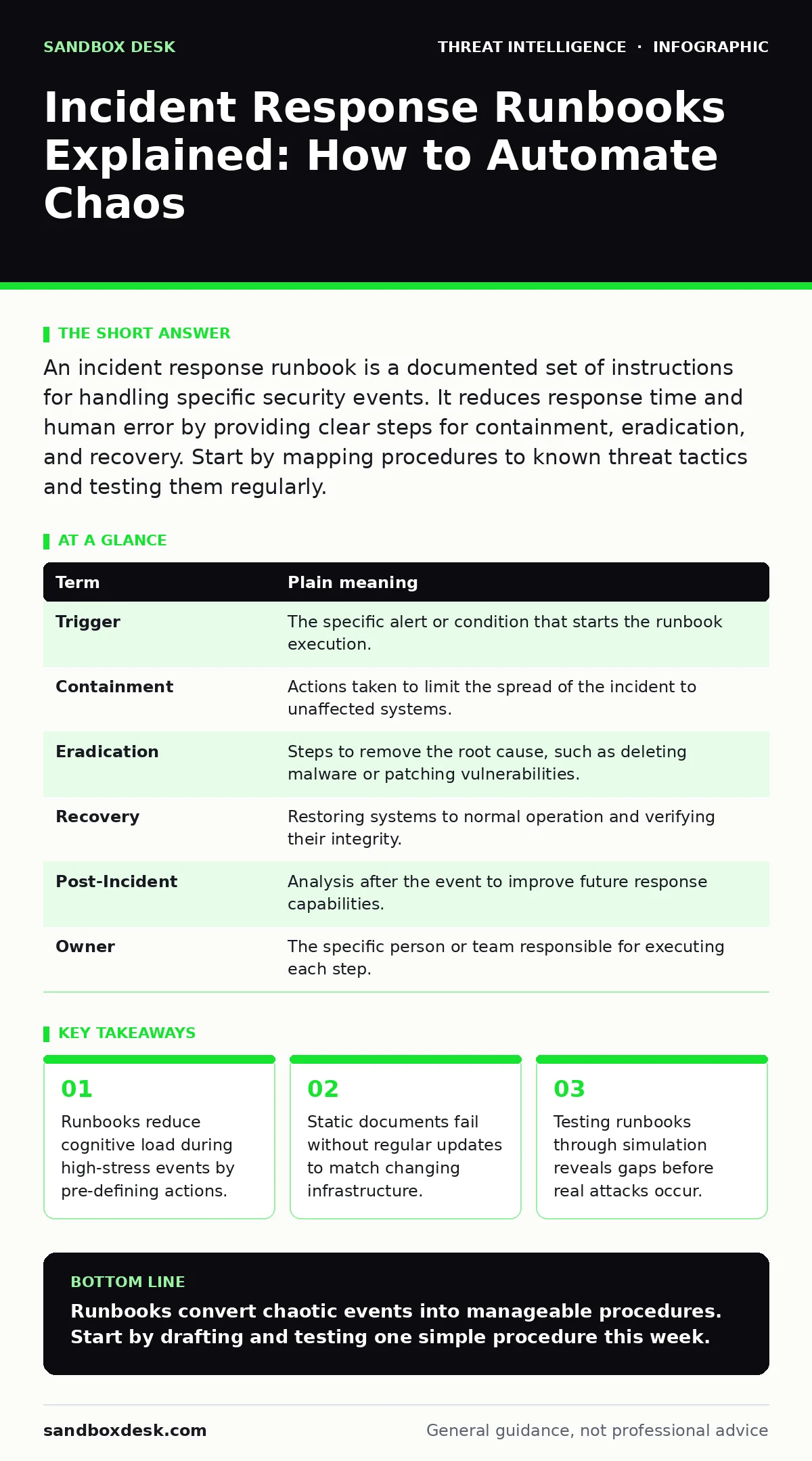
An incident response runbook is a documented set of instructions for handling specific security events. It reduces response time and human error by providing clear steps for containment, eradication, and recovery. Start by mapping procedures to known threat tactics and testing them regularly.
The Kitchen Fire Analogy
Imagine a professional kitchen. When a grease fire starts, no one stops to debate which extinguisher to use. They follow a rehearsed sequence: shut off the heat, cover the pan, evacuate if smoke spreads. This reaction is not instinct; it is training encoded into muscle memory.
In cybersecurity, an incident response runbook serves this same function. It is a detailed, step-by-step procedure for handling a specific type of security incident. Without it, responders hesitate, argue, or make mistakes under pressure.
Defining the Mechanism
A runbook is distinct from a general incident response plan. The plan is the strategy; the runbook is the tactic for a specific scenario. For example, a plan might state that you will contain ransomware. The runbook details which switches to flip, which logs to capture, and which accounts to disable.
This distinction matters because speed dictates outcome. In blue team operations, seconds count when an adversary is moving laterally. A runbook removes the need for real-time consensus on basic actions.
Core Terminology
To discuss runbooks effectively, you must agree on the language. The following table defines key terms used in this domain.
| Term | Plain meaning |
|---|---|
| Trigger | The specific alert or condition that starts the runbook execution. |
| Containment | Actions taken to limit the spread of the incident to unaffected systems. |
| Eradication | Steps to remove the root cause, such as deleting malware or patching vulnerabilities. |
| Recovery | Restoring systems to normal operation and verifying their integrity. |
| Post-Incident | Analysis after the event to improve future response capabilities. |
| Owner | The specific person or team responsible for executing each step. |
The Hidden Cost of Static Docs
Most organizations treat runbooks as static documents. This is a critical error. Infrastructure changes constantly. If your runbook references a server that no longer exists, the procedure fails. Worse, responders may trust the document blindly and execute invalid commands.
Consider DCSync attacks. If your runbook assumes a specific domain controller architecture, but you have recently migrated to a new schema, the containment steps may be ineffective. You must review runbooks whenever infrastructure changes.
Integrating Threat Intelligence
Runbooks do not exist in a vacuum. They rely on accurate context. Threat intelligence reports provide the data needed to update triggers and actions. If a new variant of malware emerges, your runbook must reflect its unique behavior.
For instance, OSINT investigations might reveal that a threat group is using a specific exploit kit. Your runbook for web application attacks should then include steps to detect that specific kit. This integration ensures your response is current, not historical.
See also: How Tabletop Exercises Work: Step-by-Step Mechanism and Limits · Log Retention Strategy: Benefits, Limits, and When to Stop
Simulation and Validation
Writing a runbook is only half the work. You must test it. Adversary emulation allows you to simulate attacks against your environment to see if the runbook holds up. You might find that a step takes ten minutes instead of the estimated two.
Use the MITRE ATT&CK Navigator to map your runbooks to specific techniques. This ensures coverage across the attack surface. If you have no runbook for NTLM relay attacks, you have a gap. Fill it by drafting and testing a procedure.
Try This Now
- Identify one common alert type, such as a failed login spike, and draft a simple five-step procedure for it.
- Assign a clear owner for each step. Do not use generic roles like "admin." Use names or specific job titles.
- Test the procedure in a non-production environment. Time how long it takes and note any ambiguities.
Key takeaways
- Runbooks reduce cognitive load during high-stress events by pre-defining actions.
- Static documents fail without regular updates to match changing infrastructure.
- Testing runbooks through simulation reveals gaps before real attacks occur.
Runbooks convert chaotic events into manageable procedures. Start by drafting and testing one simple procedure this week.
Frequently asked questions
How often should I update my incident response runbooks?
Update them whenever your infrastructure changes or after every incident. Quarterly reviews are a minimum standard.
Can I use the same runbook for different types of attacks?
No. Specific attacks require specific containment and eradication steps. Generic runbooks lead to ineffective responses.
Who should write the runbooks?
The people who will execute them. Engineers and responders know the practical realities of their tools and systems.
Do runbooks replace human judgment?
No. They handle the routine steps so humans can focus on complex, novel aspects of the incident.
How this guide was produced: written by the Sandbox Desk editorial team with AI assistance, checked against the public references listed below, and reviewed when the facts change. See our editorial policy or report an error.