Blue Team Operations: Seven Practices for Defensible Security
Effective defense relies on reducing noise through precise telemetry and validating controls with structured adversary emulation rather than chasing every alert.

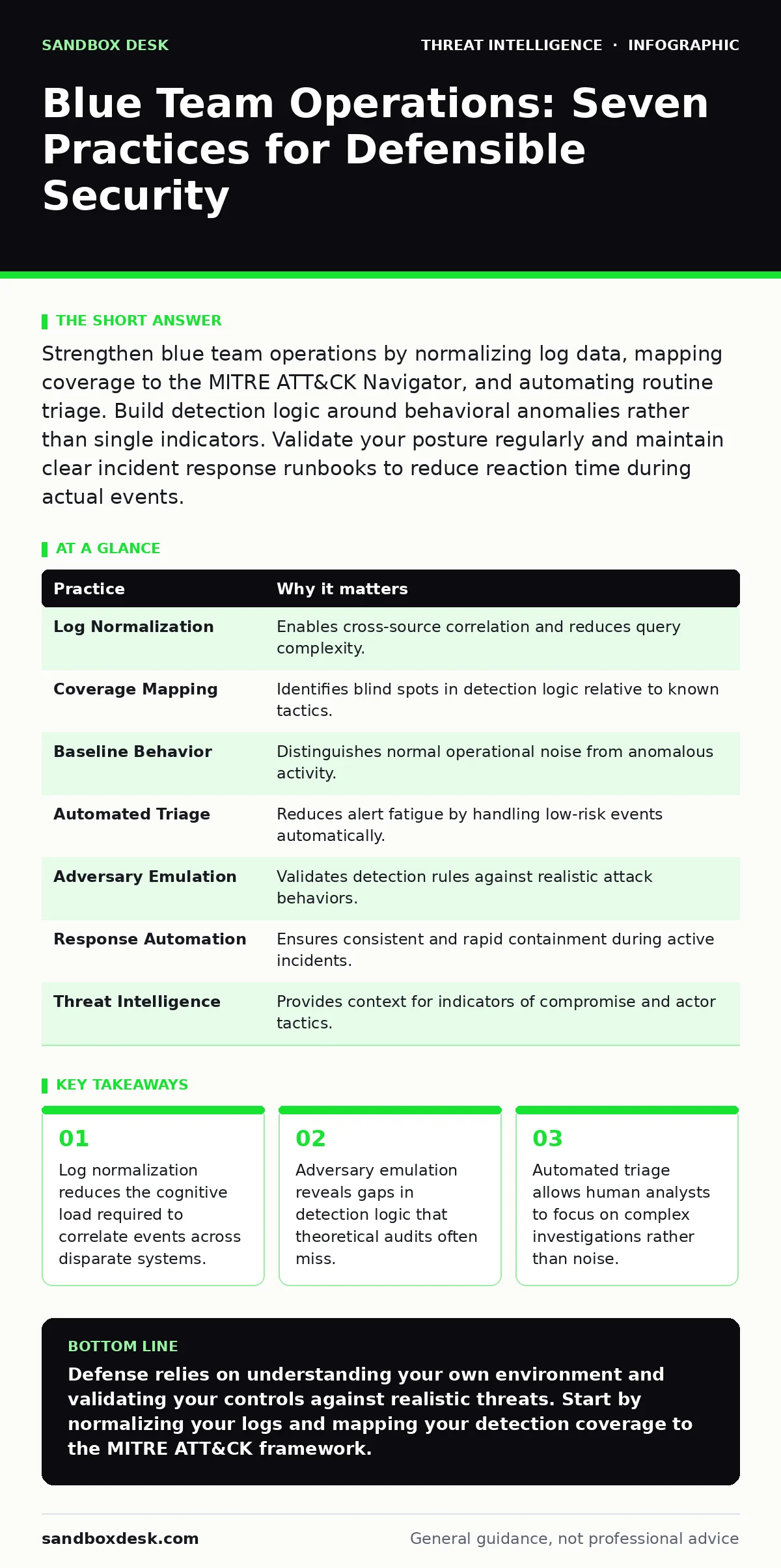
Strengthen blue team operations by normalizing log data, mapping coverage to the MITRE ATT&CK Navigator, and automating routine triage. Build detection logic around behavioral anomalies rather than single indicators. Validate your posture regularly and maintain clear incident response runbooks to reduce reaction time during actual events.
1. Normalize Telemetry Before Correlation
Raw logs from different vendors use inconsistent field names and timestamp formats. If you attempt to correlate events without a common schema, your detection rules will fail silently or produce false positives. Normalization maps disparate data sources into a unified structure, allowing you to search for user actions or network flows regardless of the originating system. This process requires upfront effort in defining a schema, but it pays dividends when you need to trace an attack path across multiple domains.
Tip: Define a strict schema for high-value events like authentication and process creation. Enforce this schema at the ingestion point, dropping or flagging records that do not conform.
| Practice | Why it matters |
|---|---|
| Log Normalization | Enables cross-source correlation and reduces query complexity. |
| Coverage Mapping | Identifies blind spots in detection logic relative to known tactics. |
| Baseline Behavior | Distinguishes normal operational noise from anomalous activity. |
| Automated Triage | Reduces alert fatigue by handling low-risk events automatically. |
| Adversary Emulation | Validates detection rules against realistic attack behaviors. |
| Response Automation | Ensures consistent and rapid containment during active incidents. |
| Threat Intelligence | Provides context for indicators of compromise and actor tactics. |
2. Map Detection to Known Tactics
Writing rules for specific file hashes or IP addresses is a losing battle. Those indicators change with every campaign. Instead, map your detection logic to the MITRE ATT&CK Navigator, a framework that organizes adversary behavior into tactics and techniques. This approach ensures you are detecting the intent of an action, such as privilege escalation, rather than just a specific tool. It allows you to see where your coverage is thin and prioritize improvements that address the most likely attack paths.
Tip: Review your existing detection rules quarterly. Tag each rule with the specific ATT&CK technique it addresses. Identify techniques with zero coverage and prioritize them for new rule development.
3. Establish Behavioral Baselines
Anomalies are only detectable if you know what normal looks like. Most organizations collect massive amounts of data but rarely analyze it to understand their own environment. Establishing baselines for user activity, network traffic volume, and process execution helps you spot deviations that might indicate compromise. For example, a service account that suddenly initiates interactive logins is suspicious, even if the credentials are valid. Without a baseline, this event might be dismissed as routine maintenance.
Tip: Use machine learning models or statistical thresholds to identify outliers in routine operations. Focus on high-fidelity signals like login times, geographic locations, and data transfer volumes.
4. Automate Low-Value Triage
Human analysts have limited attention spans and cognitive resources. Spending hours investigating phishing emails that were already quarantined by the gateway wastes time that could be spent on complex investigations. Automation handles the repetitive tasks of enrichment, such as checking IP reputations or validating file hashes. This reduces the number of alerts that reach a human analyst, allowing them to focus on events that require nuanced judgment.
Tip: Implement playbooks that automatically enrich alerts with context from threat intelligence feeds. Only escalate events that exceed a defined risk threshold or involve critical assets.
5. Validate with Adversary Emulation
Theoretical assessments often fail to reveal practical gaps. Adversary emulation involves simulating real-world attack techniques to test your detection and response capabilities. This is not the same as a penetration test, which focuses on finding vulnerabilities. Emulation focuses on whether your security controls can detect and respond to specific behaviors. It reveals whether your analysts can actually see the activity when it happens in your environment.
Tip: Schedule regular emulation exercises that target specific tactics identified in your threat intelligence reports. Measure not just detection, but the time to containment and the accuracy of the analyst’s response.
See also: How Tabletop Exercises Work: Step-by-Step Mechanism and Limits · Log Retention Strategy: Benefits, Limits, and When to Stop
6. Maintain Incident Response Runbooks
Panic impairs decision-making. Incident response runbooks provide step-by-step instructions for handling specific types of incidents, such as ransomware or data exfiltration. These documents should be living artifacts, updated after every exercise or real incident. They ensure that junior analysts can perform complex tasks correctly and that senior analysts are not bogged down by routine decisions. Clear procedures reduce the mean time to contain an incident.
Tip: Write runbooks that are actionable and specific. Include exact commands, contact lists, and decision trees. Test these runbooks during tabletop exercises to ensure they work under pressure.
7. Integrate Contextual Threat Intelligence
Raw indicators of compromise, such as malicious IP addresses, have a short lifespan. OSINT investigations and curated threat intelligence reports provide context about the actor, their motivations, and their typical methods. Integrating this context into your security operations center allows you to prioritize alerts based on relevance to your industry and technology stack. It helps you distinguish between opportunistic scanning and targeted attacks.
Tip: Automate the ingestion of threat intelligence feeds into your SIEM. Use this data to enrich alerts in real-time, providing analysts with immediate context about the source of an alert.
8. Monitor for Protocol Abuse
Attackers often abuse legitimate protocols to move laterally or exfiltrate data. NTLM relay attacks and remote desktop abuse are common techniques that bypass traditional perimeter defenses. Monitoring for unusual protocol usage, such as large volumes of traffic on non-standard ports or unexpected authentication methods, can reveal these activities. Understanding the normal usage patterns of these protocols in your environment is key to detecting abuse.
Tip: Enable verbose logging for authentication protocols. Look for anomalies such as logins from unexpected locations or during unusual hours. Correlate these events with other suspicious activity.
9. Analyze Network Traffic for Hidden Channels
Not all malicious activity generates logs on endpoints. Packet capture analysis can reveal covert channels used for command and control or data exfiltration. While full packet capture is resource-intensive, analyzing flow data and metadata can still provide valuable insights. Look for patterns such as beaconing, where a compromised host communicates with a command server at regular intervals. This behavior is often invisible to endpoint detection tools.
Tip: Deploy network detection and response tools that can analyze traffic patterns. Focus on identifying beaconing behavior and unusual data flows to external destinations.
Key takeaways
- Log normalization reduces the cognitive load required to correlate events across disparate systems.
- Adversary emulation reveals gaps in detection logic that theoretical audits often miss.
- Automated triage allows human analysts to focus on complex investigations rather than noise.
Defense relies on understanding your own environment and validating your controls against realistic threats. Start by normalizing your logs and mapping your detection coverage to the MITRE ATT&CK framework.
Frequently asked questions
How often should we update our detection rules?
Update rules quarterly or whenever new threat intelligence indicates a change in adversary tactics. Regular reviews ensure your defenses remain effective against evolving threats.
How do we start log normalization?
Begin by identifying your most critical data sources, such as identity and endpoint logs. Define a common schema for these sources and enforce it at the point of ingestion.
How this guide was produced: written by the Sandbox Desk editorial team with AI assistance, checked against the public references listed below, and reviewed when the facts change. See our editorial policy or report an error.