Implement Incident Response Runbooks: A Step-by-Step Guide
Most incident response runbooks fail because they assume human cognition remains stable under stress, leading responders to skip critical validation steps when pressure mounts.

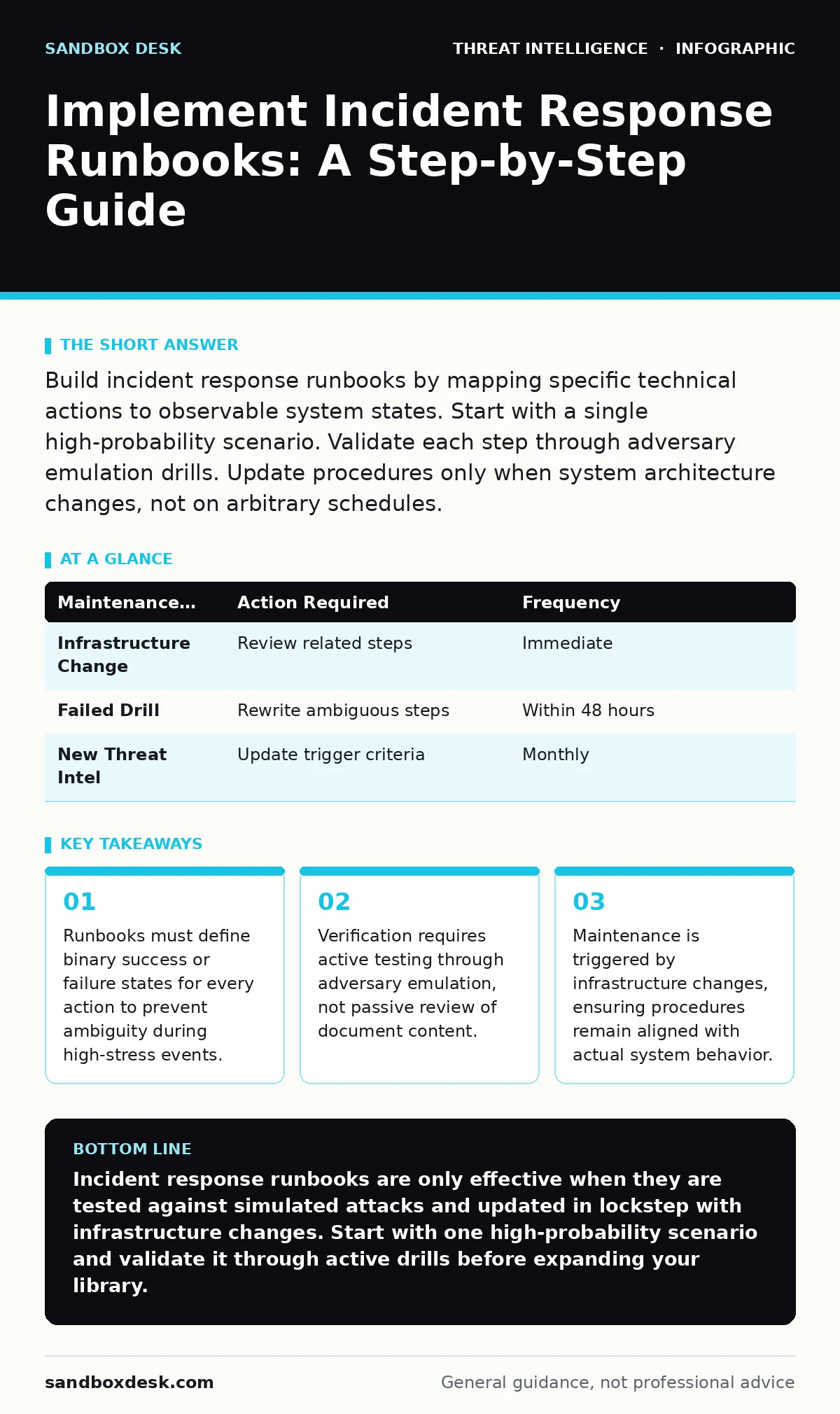
Build incident response runbooks by mapping specific technical actions to observable system states. Start with a single high-probability scenario. Validate each step through adversary emulation drills. Update procedures only when system architecture changes, not on arbitrary schedules.
Map the Decision Path First
You cannot write a procedure for a process you have not isolated. Incident response is not a linear sequence of commands. It is a branching tree of decisions based on observable evidence. Before drafting steps, identify the specific indicators that trigger each branch.
Start by selecting one containment scenario. Do not attempt to cover every possible breach vector at once. Pick a scenario that aligns with your current infrastructure weaknesses. For example, if your environment relies heavily on legacy authentication protocols, map the response to an NTLM relay attack. This specific focus ensures the initial runbook is actionable and testable.
Define the entry condition clearly. The runbook begins only when a specific alert fires or a specific log pattern appears. Vague triggers like "suspicious activity" lead to paralysis. Precise triggers, such as "three failed logins from an external IP within ten seconds," allow for immediate action.
Step 1: Define the Scope and Roles
A runbook is useless if responders do not know who owns which action. Ambiguity in responsibility causes delays that allow adversaries to expand their foothold. Assign specific roles to specific tasks. One person isolates the host. Another person captures forensic data. A third person manages communication.
Document these assignments explicitly. Do not rely on job titles. Titles change; responsibilities in an incident do not. Specify that the network engineer handles traffic filtering while the system administrator manages host-level containment. This separation prevents conflicting actions, such as rebooting a server while a colleague is attempting to extract memory dumps.
Verify this step by reviewing the contact matrix. Ensure that each role has a designated backup. If the primary responder is unavailable, the secondary must have immediate access to the necessary tools and credentials.
Step 2: Draft the Technical Actions
Write the technical steps as imperative statements. Use the active voice. Avoid conditional language. The responder should not have to interpret intent. Each step must correspond to a single, verifiable action.
For instance, do not write "Isolate the affected server." Instead, write "Disable the network interface card on the host identified in the alert." Specify the tool or interface used. If the action requires a specific command, include it. If it requires a GUI click, describe the path.
Consider the trade-offs of each action. Disabling a network interface may disrupt critical services. Acknowledge this risk in the runbook. Provide the exact approval chain required before executing high-impact actions. This prevents unauthorized shutdowns that could impact business continuity.
Step 3: Integrate Evidence Preservation
Containment often destroys volatile evidence. If you reboot a compromised system before capturing memory, you lose active malware artifacts. Your runbook must prioritize evidence preservation before aggressive containment.
Specify the order of operations. Capture memory dumps and disk images before modifying the system state. Define the storage location for this evidence. It must be secure and isolated from the production network.
Include instructions for verifying the integrity of the captured data. Use cryptographic hashes to ensure the evidence has not been altered. This step is critical for any subsequent investigation or legal proceeding.
Verify Through Active Drills
Writing a runbook is not the same as validating it. You must test the procedure under simulated conditions. Passive review identifies formatting errors, not logical flaws. Active testing reveals missing steps and unclear instructions.
Use adversary emulation to trigger the response. Simulate the specific threat you mapped in the preparation phase. If your runbook addresses remote desktop abuse, simulate an unauthorized RDP session. Observe the responders as they execute the steps.
Measure two metrics: time to containment and accuracy of actions. Did the responders skip steps? Did they encounter errors in the instructions? Document every deviation. These deviations indicate where the runbook fails to support the responder.
See also: How Tabletop Exercises Work: Step-by-Step Mechanism and Limits · Log Retention Strategy: Benefits, Limits, and When to Stop
Establish a Feedback Loop
A runbook is a living document. It degrades as soon as the underlying infrastructure changes. If you add a new firewall rule or change a logging destination, the runbook may no longer apply.
Create a change management trigger. Any significant infrastructure update must prompt a review of related runbooks. Do not wait for an annual audit. Link the review process to the deployment pipeline. This ensures that procedures remain synchronized with reality.
Incorporate lessons learned from real incidents. If a response failed or was delayed, update the runbook to address the root cause. If the delay was due to unclear instructions, rewrite them. If the delay was due to tooling issues, update the technical steps.
Maintain Through Continuous Improvement
Do not treat runbooks as static artifacts. They require ongoing maintenance. Schedule regular reviews, but do not rely solely on schedules. Use data to drive updates.
Analyze alert noise. If a runbook is triggered frequently by false positives, refine the trigger criteria. If a runbook is rarely used, assess whether the threat is still relevant. Relevance dictates priority.
Integrate findings from OSINT investigations to anticipate new threats. While OSINT provides context, it does not dictate action. Use it to update your threat models, which in turn update your runbooks. This creates a closed loop of intelligence and response.
| Maintenance Trigger | Action Required | Frequency |
|---|---|---|
| Infrastructure Change | Review related steps | Immediate |
| Failed Drill | Rewrite ambiguous steps | Within 48 hours |
| New Threat Intel | Update trigger criteria | Monthly |
Align with Broader Operations
Your runbooks do not exist in a vacuum. They must integrate with your broader blue team operations. Ensure that the data collected during the incident feeds into your threat intelligence reports. This allows for better detection of similar attacks in the future.
Consider how your response affects packet capture analysis. If you alter network routing during containment, ensure that your capture tools are adjusted accordingly. Misaligned tools lead to missing data, which hampers post-incident analysis.
Finally, recognize the limits of automation. While scripts can execute containment steps, human judgment is required for scope decisions. Do not automate the decision to shut down a service. Automate the execution, not the judgment.
Key takeaways
- Runbooks must define binary success or failure states for every action to prevent ambiguity during high-stress events.
- Verification requires active testing through adversary emulation, not passive review of document content.
- Maintenance is triggered by infrastructure changes, ensuring procedures remain aligned with actual system behavior.
Incident response runbooks are only effective when they are tested against simulated attacks and updated in lockstep with infrastructure changes. Start with one high-probability scenario and validate it through active drills before expanding your library.
Frequently asked questions
How often should incident response runbooks be updated?
Update them immediately after any infrastructure change or after every drill reveals a flaw. Do not rely on fixed annual schedules.
Can I use the same runbook for different types of breaches?
No. Different threats require different containment strategies. A runbook for a ransomware attack differs significantly from one for data exfiltration.
What is the biggest mistake in runbook creation?
Assuming responders will remember technical details under stress. Every command and decision must be explicitly written.
How do I know if my runbook is working?
Measure the time to containment and the accuracy of actions during a simulated adversary emulation drill.
How this guide was produced: written by the Sandbox Desk editorial team with AI assistance, checked against the public references listed below, and reviewed when the facts change. See our editorial policy or report an error.