DCSync Attacks: How Small Businesses Stop Credential Theft
Attackers replicate domain controller databases locally to extract hashes without triggering standard authentication logs or alerting on network traffic.

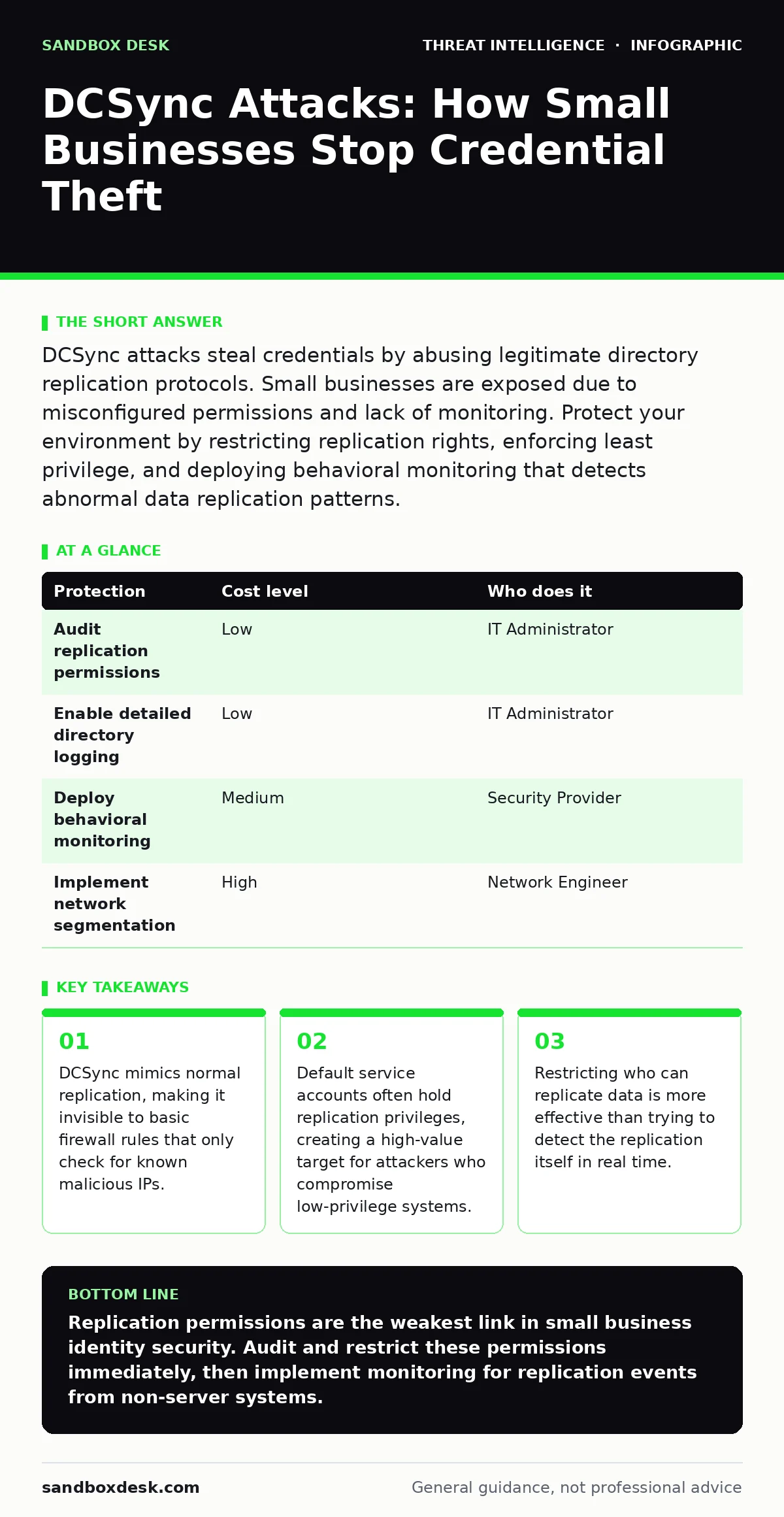
DCSync attacks steal credentials by abusing legitimate directory replication protocols. Small businesses are exposed due to misconfigured permissions and lack of monitoring. Protect your environment by restricting replication rights, enforcing least privilege, and deploying behavioral monitoring that detects abnormal data replication patterns.
The Mechanics of Replication Abuse
Directory services rely on replication to keep identity data synchronized across multiple servers. In a healthy environment, one server copies user records to another to ensure redundancy. Attackers exploit this trust by masquerading as a server requesting a copy of the data. This technique is known as a DCSync attack.
The attacker does not need to hack the encryption or break into the database directly. Instead, they present themselves as a legitimate partner in the replication process. If the attacker’s account has the necessary permissions, the domain controller responds by sending a copy of the credential hashes. These hashes are the encrypted versions of passwords used for verification.
Because the protocol used for replication is standard and expected, network monitoring tools often ignore this traffic. The data flow appears identical to a backup process or a server synchronization event. This makes the attack difficult to detect using traditional perimeter defenses.
Why Small Organizations Are Exposed
Small businesses often assume their size makes them invisible to sophisticated threats. However, attackers frequently target smaller organizations because they lack dedicated security teams and advanced monitoring. The initial breach might be simple, such as a compromised employee password or an unpatched software vulnerability.
The real danger lies in the configuration of identity management systems. Many small setups use default configurations for service accounts. These accounts often retain excessive privileges, including the right to replicate directory data. An attacker who gains access to a low-level account can escalate their access if that account has been granted unintended replication rights.
Furthermore, small teams may not monitor internal traffic closely. They focus on external threats, assuming that once inside the network, the attacker is already present. This blind spot allows replication attacks to proceed without interruption. The lack of segmentation means an attacker can move freely between the compromised workstation and the identity server.
The Hidden Cost of Default Permissions
A common mistake is assuming that only administrators can replicate data. In many directory structures, certain service accounts are granted replication privileges to support backups or third-party applications. These accounts are often overlooked during security reviews.
If an attacker compromises a service account with replication rights, they can extract credentials from any user in the directory. This includes the most privileged accounts, such as domain administrators. The attacker does not need to steal the administrator’s password directly; they only need the hash. With the hash, they can perform pass-the-hash attacks to impersonate the administrator.
This creates a chain reaction. One compromised service account leads to full control of the environment. The cost of fixing this is not just the breach response, but the time required to audit and reconfigure every service account to remove unnecessary privileges.
Low-Cost Protections for Identity Security
You do not need expensive security suites to mitigate this risk. The most effective protections are configuration changes that limit what accounts can do. Start by auditing which accounts have replication permissions. Remove these rights from any account that does not strictly require them for operational reasons.
Implement least privilege principles across the board. Service accounts should have only the permissions necessary to perform their specific tasks. If a backup application needs to read data, it should not have the right to replicate the entire directory. Use separate accounts for different functions to limit the blast radius of a compromise.
Monitor for replication events from unexpected sources. If a workstation initiates a replication request, it is likely malicious. Configure alerts for any replication activity that does not originate from a known domain controller. This can be done with built-in logging tools without additional software costs.
| Protection | Cost level | Who does it |
|---|---|---|
| Audit replication permissions | Low | IT Administrator |
| Enable detailed directory logging | Low | IT Administrator |
| Deploy behavioral monitoring | Medium | Security Provider |
| Implement network segmentation | High | Network Engineer |
Detecting Anomalous Behavior
Detection relies on understanding what normal behavior looks like. In a healthy network, replication only happens between specific servers at scheduled intervals or when changes occur. Any deviation from this pattern is suspicious.
Look for replication requests originating from workstations or non-server systems. These devices should never initiate directory replication. Also watch for large volumes of data being transferred during off-hours. While backups may happen at night, they should originate from designated backup servers, not random user machines.
Integrate these detection rules into your incident response runbooks. When an alert triggers, the response team should know exactly how to isolate the affected system and revoke the compromised credentials. This preparation reduces the time between detection and containment.
What to Ask Your IT Provider
If you rely on an external provider for IT support, you need to verify their security practices. Do not assume they have addressed identity security. Ask specific questions about how they manage permissions and monitor for abuse.
- How do you audit accounts with replication privileges?
- What logging mechanisms are in place to detect unauthorized replication?
- How quickly can you revoke access for a compromised account?
- Do you perform regular reviews of service account permissions?
These questions reveal whether your provider understands the specific risks associated with identity management. A provider who cannot answer these questions may not be adequately protecting your directory services. You may need to engage a specialist for blue team operations to fill these gaps.
Beyond Basic Monitoring
Standard antivirus and firewall tools are insufficient for stopping replication attacks. You need visibility into the protocol itself. Consider using tools that can analyze directory traffic for anomalies. This goes beyond simple signature-based detection.
For deeper analysis, you might look into MITRE ATT&CK Navigator techniques related to credential dumping and lateral movement. This framework helps you understand the broader context of how attackers operate. It also helps you evaluate whether your defenses cover the specific tactics used in replication attacks.
Regularly test your defenses with adversary emulation. This involves simulating an attack to see if your detection systems trigger. If you cannot detect a simulated replication attack, your real-world defenses are likely ineffective. This testing helps you identify blind spots before an attacker does.
Key takeaways
- DCSync mimics normal replication, making it invisible to basic firewall rules that only check for known malicious IPs.
- Default service accounts often hold replication privileges, creating a high-value target for attackers who compromise low-privilege systems.
- Restricting who can replicate data is more effective than trying to detect the replication itself in real time.
Replication permissions are the weakest link in small business identity security. Audit and restrict these permissions immediately, then implement monitoring for replication events from non-server systems.
Frequently asked questions
Can DCSync attacks happen on cloud-based identity services?
Cloud services use different protocols and permission models, but similar abuse of replication rights is possible. The specific mechanisms differ, so you must check your cloud provider's security documentation.
Do I need to disable replication to stop these attacks?
No, disabling replication breaks redundancy and causes service outages. Instead, restrict who can initiate replication and monitor for unauthorized requests.
How do I know if an attack has already occurred?
Check your directory logs for replication events from unexpected sources. Look for large data transfers or replication requests from workstations.
Is changing passwords enough to stop DCSync?
Changing passwords does not remove the permissions that allowed the attack. You must also revoke replication rights and monitor for further abuse.
How this guide was produced: written by the Sandbox Desk editorial team with AI assistance, checked against the public references listed below, and reviewed when the facts change. See our editorial policy or report an error.