OSINT Investigations: Answers to 10 Common Questions
Open source intelligence relies on correlating fragmented public data rather than accessing hidden systems, making data hygiene more critical than tool selection for accurate results.

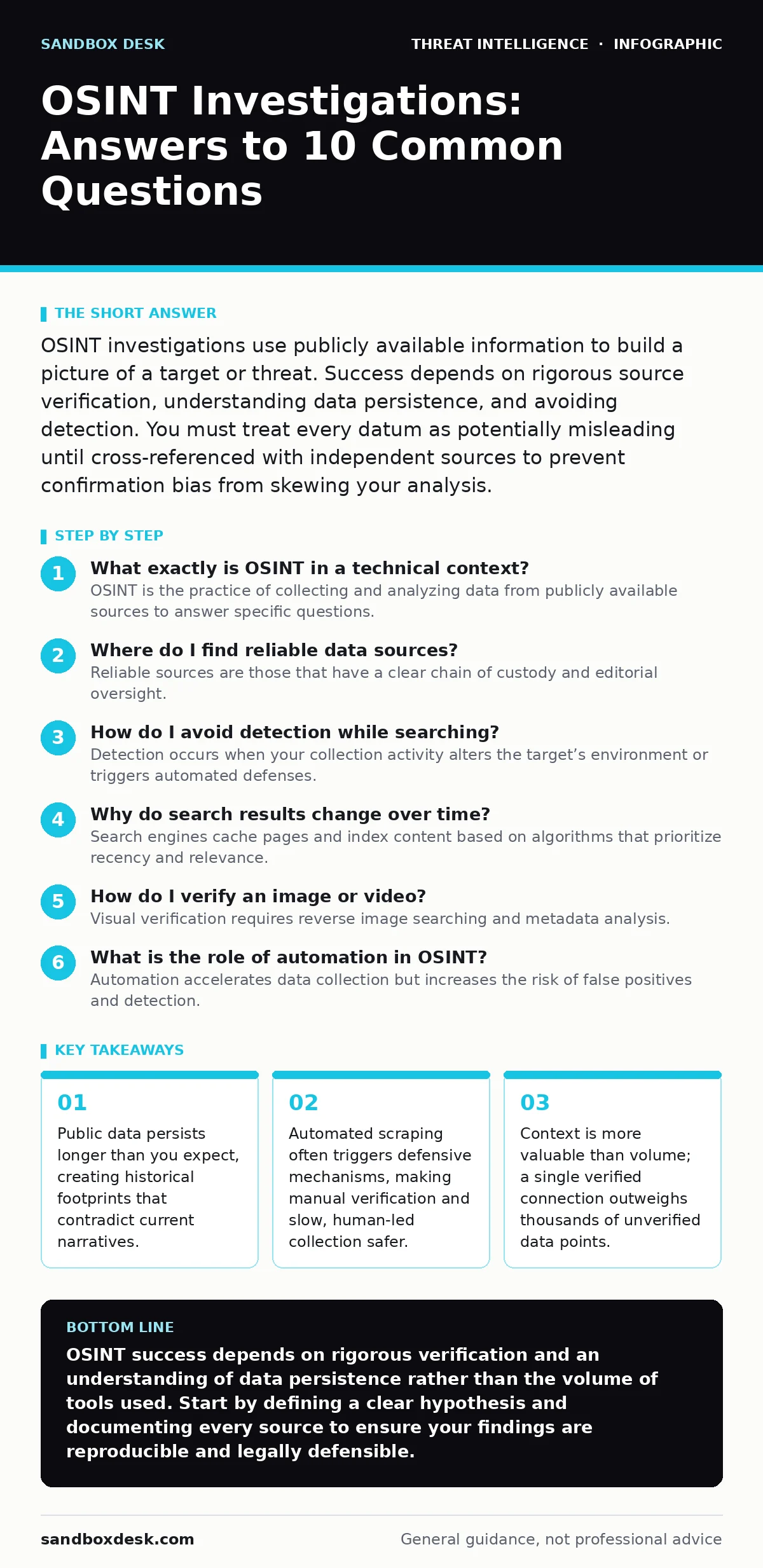
OSINT investigations use publicly available information to build a picture of a target or threat. Success depends on rigorous source verification, understanding data persistence, and avoiding detection. You must treat every datum as potentially misleading until cross-referenced with independent sources to prevent confirmation bias from skewing your analysis.
What exactly is OSINT in a technical context?
OSINT is the practice of collecting and analyzing data from publicly available sources to answer specific questions. It does not involve hacking, social engineering, or accessing restricted systems. The definition hinges on accessibility: if you can reach it without credentials or illegal access, it is open source. This includes search engines, public databases, social media, and academic repositories.
Where do I find reliable data sources?
Reliable sources are those that have a clear chain of custody and editorial oversight. Government publications, official domain registration records, and peer-reviewed technical documents provide higher fidelity than anonymous forums or unmoderated social feeds. You should prioritize primary sources over secondary aggregators. Aggregators may introduce errors during their own data processing or filtering stages.
How do I avoid detection while searching?
Detection occurs when your collection activity alters the target’s environment or triggers automated defenses. You mitigate this by using passive techniques that do not interact directly with the target infrastructure. Imagine querying a DNS record through a third-party resolver rather than pinging the server directly. This keeps your IP address out of the target’s logs. Refer to packet capture analysis techniques to understand how your traffic appears to network defenders.
Why do search results change over time?
Search engines cache pages and index content based on algorithms that prioritize recency and relevance. As new content appears, older results drop in ranking or disappear from the index entirely. This creates a moving target for investigators. You must document the exact date and time of your findings. A URL that returns useful data today may return a 404 error tomorrow. This temporal volatility requires you to archive evidence immediately upon discovery.
How do I verify an image or video?
Visual verification requires reverse image searching and metadata analysis. You compare the image against known databases to find its origin or previous uses. Metadata, such as EXIF data, can reveal camera models, timestamps, and geographic coordinates. However, social media platforms often strip this metadata upon upload. You must therefore rely on visual cues like lighting, shadows, and background landmarks. Cross-referencing these visual elements with satellite imagery or local news reports confirms authenticity.
See also: Pass-the-Ticket Attacks: Risks and Protection for Small Businesses
What is the role of automation in OSINT?
Automation accelerates data collection but increases the risk of false positives and detection. Scripts can scrape thousands of pages in minutes, but they lack the nuance to understand context. You should use automation for broad discovery phases, not for final verification. Human analysts must review automated outputs to filter out noise. Over-reliance on tools can lead to alert fatigue, where genuine signals are buried under irrelevant data.
How do I handle conflicting information?
Conflicting data arises because different sources have different incentives and biases. One source may omit details to protect privacy, while another exaggerates for attention. You resolve conflicts by triangulating data from independent sources. If two unrelated sources agree on a specific detail, the likelihood of accuracy increases. You should document the source of each claim. This allows you to trace the lineage of information and identify potential points of failure or manipulation.
| Data Type | Primary Source | Verification Method | Reliability Score |
|---|---|---|---|
| Domain Registration | WHOIS Database | Cross-check with historical archives | High |
| Social Media Post | Platform Archive | Metadata and visual analysis | Medium |
| News Article | Publisher Website | Cross-reference with wire services | High |
| Forum Comment | Forum Archive | User history and sentiment analysis | Low |
Can OSINT identify active threats?
OSINT can identify indicators of compromise, such as malicious IP addresses or file hashes, shared in public threat feeds. However, it rarely identifies the specific intent of an adversary in real-time. You use OSINT to contextualize alerts generated by your security tools. For example, if your firewall blocks an IP, OSINT can tell you if that IP is associated with known scanning activity. This helps prioritize incident response efforts. See threat intelligence reports for structured ways to present this context to stakeholders.
What are the legal boundaries of OSINT?
Legality depends on jurisdiction and the terms of service of the data source. Accessing public data is generally legal, but automating access may violate a website’s robots.txt file or terms of service. You must review the legal framework applicable to your location and the target. Unauthorized access to systems, even for testing, is illegal. OSINT stays within legal bounds by relying solely on data that is intentionally or negligently made public. Ethical considerations also apply; you should not use OSINT to harass individuals or invade privacy without a legitimate security purpose.
How do I structure an OSINT investigation?
A structured investigation begins with a clear hypothesis and ends with a validated conclusion. You define the scope and objectives before collecting data. This prevents scope creep and ensures you focus on relevant information. You then collect data, verify sources, and analyze findings. Finally, you document the process and results. This structure allows other analysts to reproduce your work. It also provides a clear audit trail for legal or operational reviews. Refer to incident response runbooks for standardized procedures that can integrate OSINT findings.
How does OSINT support blue team operations?
Blue teams use OSINT to understand the external threat environment and harden defenses. By monitoring public discussions and technical forums, defenders can identify emerging vulnerabilities or attack techniques before they are exploited. This proactive stance allows for faster patching and configuration changes. OSINT also helps in understanding how adversaries view the organization. This external perspective can reveal blind spots in internal security policies. See blue team operations for broader strategies on defensive security.
What are the common pitfalls in OSINT?
Confirmation bias is the most significant pitfall. Analysts may seek out information that supports their initial hypothesis while ignoring contradictory evidence. You mitigate this by actively seeking disconfirming evidence. Another pitfall is source pollution, where false information spreads rapidly across multiple platforms. You address this by tracing information back to its origin. Finally, tool dependency can lead to missed insights. You must balance automated tools with manual analysis to capture nuanced details.
How do I present OSINT findings effectively?
Effective presentation focuses on clarity and actionability. You should summarize key findings at the beginning, followed by supporting evidence. Use visual aids like timelines or network graphs to illustrate relationships. Avoid jargon and explain technical terms. Ensure that your recommendations are specific and feasible. This helps decision-makers understand the risk and take appropriate action. For more complex scenarios, you might use the MITRE ATT&CK Navigator to map observed techniques to known adversary behaviors.
Key takeaways
- Public data persists longer than you expect, creating historical footprints that contradict current narratives.
- Automated scraping often triggers defensive mechanisms, making manual verification and slow, human-led collection safer.
- Context is more valuable than volume; a single verified connection outweighs thousands of unverified data points.
OSINT success depends on rigorous verification and an understanding of data persistence rather than the volume of tools used. Start by defining a clear hypothesis and documenting every source to ensure your findings are reproducible and legally defensible.
Frequently asked questions
Can I use OSINT to find personal information about individuals?
You can find publicly available information, but using it to harass or invade privacy is unethical and potentially illegal. Always respect terms of service and local laws regarding data usage.
Can OSINT help in investigating insider threats?
OSINT can identify external communications or public posts that may indicate insider risk. However, it cannot monitor internal activities. You must combine OSINT with internal monitoring for a complete picture.
How this guide was produced: written by the Sandbox Desk editorial team with AI assistance, checked against the public references listed below, and reviewed when the facts change. See our editorial policy or report an error.