Adversary Emulation Explained: How to Test Defenses Like a Real Threat
Adversary emulation reveals that your controls work on paper but fail in practice by simulating specific threat behaviors rather than running generic vulnerability scans.

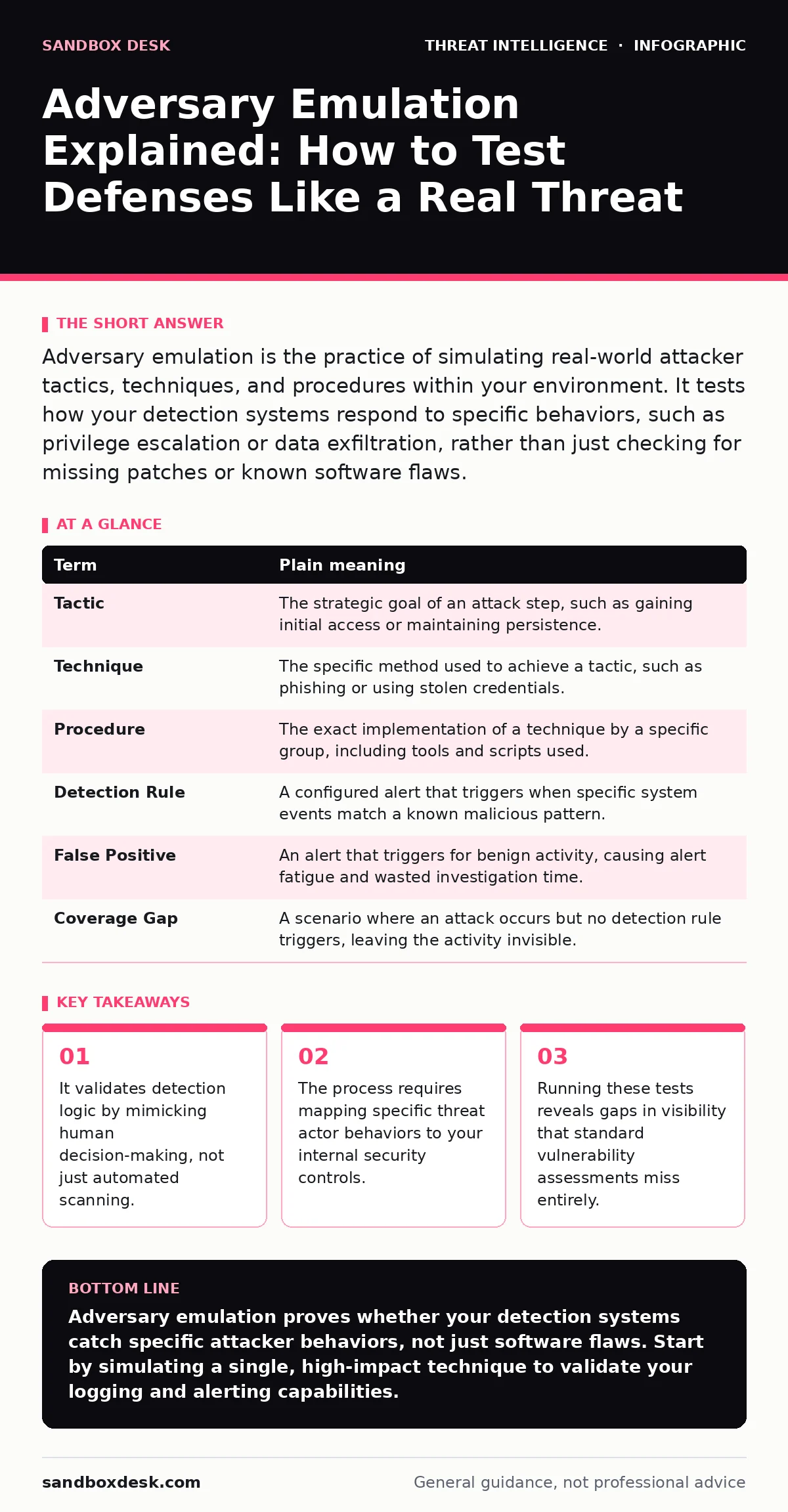
Adversary emulation is the practice of simulating real-world attacker tactics, techniques, and procedures within your environment. It tests how your detection systems respond to specific behaviors, such as privilege escalation or data exfiltration, rather than just checking for missing patches or known software flaws.
The Home Security Analogy
Imagine you hire a locksmith to test your home’s security. A standard audit involves checking if the deadbolt is installed and if the window locks engage. This is a vulnerability assessment. It tells you if the hardware is present and functional.
Adversary emulation is different. You hire an actor to pretend they are a burglar who specifically targets houses with smart locks. They do not try to break the window. Instead, they study how the smart lock interacts with the garage door opener. They test if they can trigger the garage door to open, which then unlocks the front door via a linked automation routine.
This approach tests the system’s behavior under specific conditions. It reveals that while every individual lock is secure, the combination of devices creates a new entry point. The burglar did not break anything. They simply followed a path your security design did not anticipate.
Defining the Core Mechanisms
To emulate an adversary, you must understand the language of their behavior. Security teams use the MITRE ATT&CK framework to catalog these behaviors. This framework maps the tactics and techniques used by attackers during the lifecycle of an intrusion.
| Term | Plain meaning |
|---|---|
| Tactic | The strategic goal of an attack step, such as gaining initial access or maintaining persistence. |
| Technique | The specific method used to achieve a tactic, such as phishing or using stolen credentials. |
| Procedure | The exact implementation of a technique by a specific group, including tools and scripts used. |
| Detection Rule | A configured alert that triggers when specific system events match a known malicious pattern. |
| False Positive | An alert that triggers for benign activity, causing alert fatigue and wasted investigation time. |
| Coverage Gap | A scenario where an attack occurs but no detection rule triggers, leaving the activity invisible. |
Why Standard Scans Fall Short
Vulnerability scanners are excellent at finding known issues. They check for unpatched software or misconfigured services. However, they assume that if a system is patched, it is safe. This assumption fails when attackers use living-off-the-land techniques.
Living-off-the-land means using legitimate system tools to perform malicious actions. An attacker might use PowerShell, a standard Windows administration tool, to download malware. A vulnerability scanner sees PowerShell as a legitimate, patched component. It reports no issues.
An emulation test runs the same PowerShell command in your environment. If your detection system does not alert on this specific usage pattern, you have a coverage gap. You are vulnerable despite having no open ports or missing patches.
Designing Your First Simulation
You do not need to simulate every possible attack. Start with a high-impact, low-complexity behavior. For example, focus on credential dumping. This is the act of extracting password hashes from memory to bypass authentication controls.
Select a single technique from a threat intelligence report that is relevant to your industry. Map this technique to your internal controls. Ask what logs should generate when this action occurs. Does your endpoint detection platform record process creation? Does your server log authentication attempts?
If you cannot answer these questions, you cannot emulate the attack effectively. You must know what success looks like before you begin. This preparation ensures you are testing detection, not just causing chaos.
Executing the Test Safely
Run your simulation in a controlled manner. Isolate the test environment if possible, or schedule the test during a maintenance window. You must have explicit authorization from leadership. Unauthorized testing can trigger incident response runbooks, wasting resources and creating confusion.
Execute the technique exactly as described in your plan. Record every action you take. Note which logs are generated and which are missing. Do not rely on memory. Write down the exact commands and the resulting system behavior.
See also: How Tabletop Exercises Work: Step-by-Step Mechanism and Limits · How Vulnerability Scanning Works: The Hidden Mechanics and Limits
Analyzing the Results
The value of emulation lies in the analysis, not the execution. Review the logs generated during your test. Did your detection rules trigger? If yes, how long did it take? If no, why did the system miss the activity?
A lack of alerts indicates a coverage gap. You must create or tune detection rules to catch this behavior. An abundance of false positives indicates a noisy rule. You must refine the rule to reduce noise without losing visibility.
This feedback loop improves your security posture. It moves your defenses from theoretical to proven. You are no longer guessing if your controls work. You have evidence of their effectiveness.
Iterating and Expanding
Adversary emulation is not a one-time event. Attackers change their methods. Your environment changes with new software and configurations. You must repeat the process regularly.
Expand your scope over time. Start with a single technique. Move to a chain of techniques. Simulate an attacker who gains initial access, escalates privileges, and moves laterally. This requires more planning but provides deeper insights.
Consider how this fits into your broader blue team operations. Emulation provides the test data that validates your monitoring. It connects directly to incident response runbooks by showing exactly what evidence responders will see.
Key takeaways
- It validates detection logic by mimicking human decision-making, not just automated scanning.
- The process requires mapping specific threat actor behaviors to your internal security controls.
- Running these tests reveals gaps in visibility that standard vulnerability assessments miss entirely.
Adversary emulation proves whether your detection systems catch specific attacker behaviors, not just software flaws. Start by simulating a single, high-impact technique to validate your logging and alerting capabilities.
Frequently asked questions
How is adversary emulation different from red teaming?
Red teaming is a broad, goal-oriented exercise that tries to breach specific assets. Adversary emulation focuses on testing specific detection capabilities against known techniques, often within a constrained scope.
Do I need specialized tools to perform adversary emulation?
No. Many effective tests use standard operating system commands. Specialized frameworks can automate the process, but the core value comes from the analysis of logs and detection gaps.
Can I run emulation tests in a cloud environment?
Yes. Cloud environments often provide better isolation and logging capabilities. Ensure you configure cloud trail logs or equivalent auditing before starting any simulation.
How often should I run adversary emulation tests?
Run them regularly, especially after significant changes to your infrastructure or security tools. Quarterly testing is a common baseline, but critical systems may require more frequent validation.
How this guide was produced: written by the Sandbox Desk editorial team with AI assistance, checked against the public references listed below, and reviewed when the facts change. See our editorial policy or report an error.