Malware Targeting AI Infrastructure: Threats and Defense
Adversaries compromise model weights and training data to alter behavior, creating threats that traditional signature-based security tools cannot detect or block.

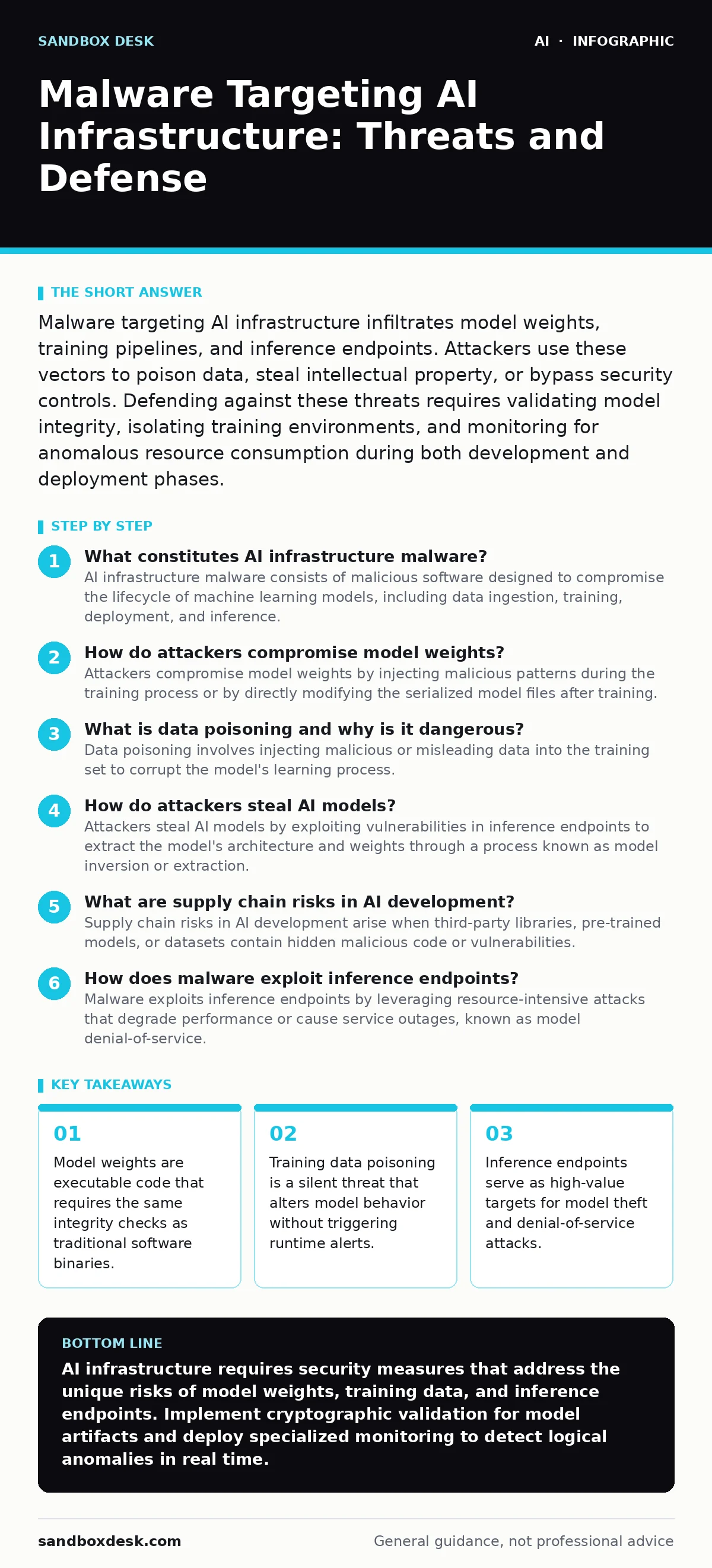
Malware targeting AI infrastructure infiltrates model weights, training pipelines, and inference endpoints. Attackers use these vectors to poison data, steal intellectual property, or bypass security controls. Defending against these threats requires validating model integrity, isolating training environments, and monitoring for anomalous resource consumption during both development and deployment phases.
What constitutes AI infrastructure malware?
AI infrastructure malware consists of malicious software designed to compromise the lifecycle of machine learning models, including data ingestion, training, deployment, and inference. Unlike traditional malware that targets operating systems or databases, this variant attacks the mathematical models and the data pipelines that feed them. It can manifest as backdoors in model weights, corrupted training datasets, or exploits in the containerized environments hosting the models. The threat surface expands beyond servers to include the algorithms themselves, which act as the core logic of the application.
How do attackers compromise model weights?
Attackers compromise model weights by injecting malicious patterns during the training process or by directly modifying the serialized model files after training. Model weights are the learned parameters that determine how a model interprets input data. If an adversary gains write access to the storage location of these weights, they can insert a backdoor. This backdoor causes the model to behave normally for most inputs but to produce a specific, malicious output when presented with a trigger phrase or image. This technique allows the attacker to control the model's behavior without altering its primary function, making detection difficult through standard testing.
What is data poisoning and why is it dangerous?
Data poisoning involves injecting malicious or misleading data into the training set to corrupt the model's learning process. This is dangerous because it alters the fundamental logic of the model before it is ever deployed. If an attacker can influence the data used for fine-tuning, they can cause the model to ignore certain security rules or misclassify harmful content as benign.
The corruption is baked into the model's architecture, meaning it does not appear as an external attack during runtime. Detecting poisoned data requires rigorous validation of data sources and statistical analysis of the training distribution, as the model will perform well on clean data while failing on specific adversarial inputs.
How do attackers steal AI models?
Attackers steal AI models by exploiting vulnerabilities in inference endpoints to extract the model's architecture and weights through a process known as model inversion or extraction. Since models are often expensive to train, they represent significant intellectual property value. An attacker can send a large number of queries to the model and analyze the responses to reconstruct the model's internal parameters. This allows them to create a functional copy of the model without needing direct access to the training environment. Protecting against this requires rate limiting, output perturbation, and monitoring for unusual query patterns that suggest systematic extraction attempts.
What are supply chain risks in AI development?
Supply chain risks in AI development arise when third-party libraries, pre-trained models, or datasets contain hidden malicious code or vulnerabilities. Developers often rely on open-source models and frameworks to accelerate development, but these components may not undergo rigorous security audits. A compromised dependency can introduce vulnerabilities into the entire application stack. This risk is amplified by the complexity of AI toolchains, where multiple layers of abstraction make it difficult to trace the origin of a bug or a backdoor. You must verify the integrity of all external components and isolate their execution to limit the blast radius of a compromise.
See also: What Makes Generative AI Unique: The Architecture of Synthetic Output
How does malware exploit inference endpoints?
Malware exploits inference endpoints by leveraging resource-intensive attacks that degrade performance or cause service outages, known as model denial-of-service. These attacks target the computational resources required for real-time prediction, overwhelming the CPU or GPU and preventing legitimate users from accessing the service.
Additionally, attackers may use inference endpoints to execute arbitrary code if the model processing pipeline lacks proper input validation. This can lead to remote code execution on the hosting server. Securing these endpoints involves implementing strict input sanitization, resource quotas, and network segmentation to isolate the inference service from other critical systems.
Why do traditional security tools fail against AI threats?
Traditional security tools fail against AI threats because they rely on signature-based detection and known behavioral patterns, which do not apply to dynamic model behavior. Machine learning models can generate novel outputs that do not match any known malicious signature, allowing adversarial inputs to slip through.
Furthermore, these tools cannot inspect the internal state of a model or detect subtle changes in its decision-making logic. This gap requires specialized security measures, such as AI model monitoring, to detect anomalies in model performance and output distribution. Without these specialized controls, organizations remain blind to attacks that manipulate the model's logic rather than its infrastructure.
| Attack Vector | Primary Impact | Detection Difficulty | Mitigation Strategy |
|---|---|---|---|
| Model Weight Tampering | Logic manipulation | High | Cryptographic signing of weights |
| Data Poisoning | Training corruption | Very High | Data validation and lineage |
| Model Extraction | IP theft | Medium | Rate limiting and output noise |
| Inference DoS | Service disruption | Low | Resource quotas and scaling |
How do you validate model integrity?
You validate model integrity by using cryptographic signatures to verify that model weights have not been altered since their creation or last approved update. This process treats the model file as a critical software artifact that requires authentication before deployment. You should implement a pipeline that checks the digital signature of the model against a trusted key store. If the signature does not match, the deployment fails, preventing a compromised model from reaching production. This approach ensures that only authorized and verified models are executed, reducing the risk of backdoors or tampering.
What is the role of secure AI agents?
The role of secure AI agents is to enforce strict boundaries on model actions, preventing unauthorized access to sensitive systems or data. AI agents often have the ability to interact with external APIs, databases, and tools, making them a potential vector for lateral movement if compromised. By implementing least-privilege access controls and sandboxing agent execution, you limit the damage an attacker can cause if they exploit the agent. This involves defining explicit permissions for each action the agent can take and monitoring these actions for anomalies. See the guide on securing AI agents for detailed implementation strategies.
How do you monitor for AI-specific anomalies?
You monitor for AI-specific anomalies by tracking metrics such as prediction confidence, input distribution shifts, and resource utilization patterns. Sudden changes in these metrics can indicate that the model is being attacked or that its behavior has been compromised. Implementing AI model monitoring allows you to detect deviations from expected performance in real time. This includes watching for inputs that cause unusually low confidence scores or for spikes in computational demand that suggest extraction attempts. By correlating these signals with infrastructure logs, you can identify attacks that traditional security tools miss.
Key takeaways
- Model weights are executable code that requires the same integrity checks as traditional software binaries.
- Training data poisoning is a silent threat that alters model behavior without triggering runtime alerts.
- Inference endpoints serve as high-value targets for model theft and denial-of-service attacks.
AI infrastructure requires security measures that address the unique risks of model weights, training data, and inference endpoints. Implement cryptographic validation for model artifacts and deploy specialized monitoring to detect logical anomalies in real time.
Frequently asked questions
Can malware hide inside a trained AI model?
Yes, malware can hide inside model weights as a backdoor that triggers specific malicious outputs only when presented with a particular input pattern, remaining dormant otherwise.
Is encrypting AI models enough to prevent theft?
No, encryption protects models at rest but does not prevent extraction attacks during inference, where attackers can reconstruct the model by analyzing inputs and outputs.
How do I prevent data poisoning in my training pipeline?
Prevent data poisoning by validating data sources, using statistical checks to identify outliers, and implementing strict access controls to prevent unauthorized data injection.
What is the difference between AI malware and traditional malware?
AI malware targets the logic and data of machine learning models, whereas traditional malware targets operating systems, applications, or user data, requiring different detection and mitigation strategies.
How this guide was produced: written by the Sandbox Desk editorial team with AI assistance, checked against the public references listed below, and reviewed when the facts change. See our editorial policy or report an error.