AI Usage Policies at Work: Definition, Scope, and Control
AI usage policies shift risk management from perimeter defense to behavioral oversight, addressing threats that traditional security tools cannot see.

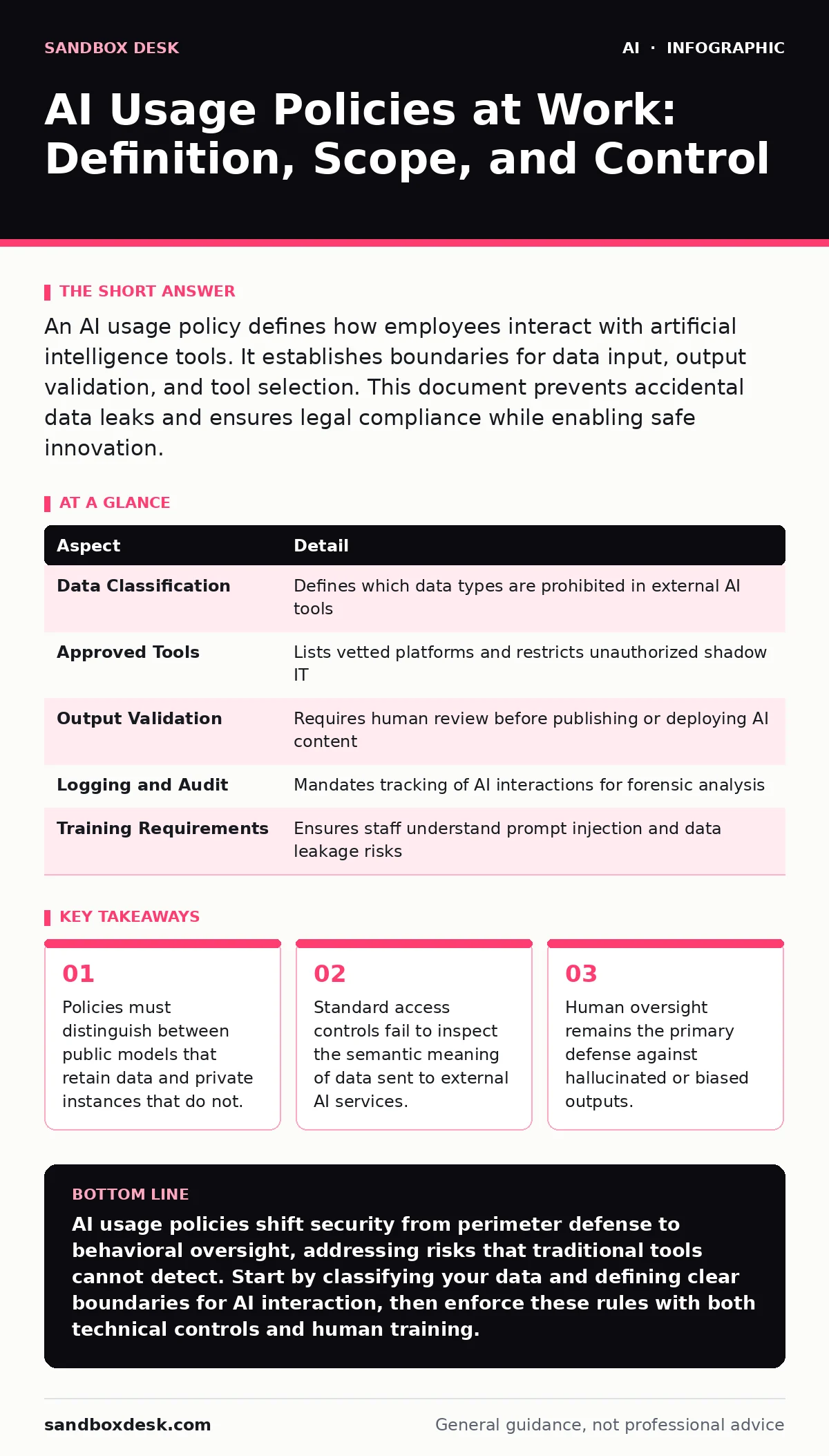
An AI usage policy defines how employees interact with artificial intelligence tools. It establishes boundaries for data input, output validation, and tool selection. This document prevents accidental data leaks and ensures legal compliance while enabling safe innovation.
The Digital Concierge Analogy
Imagine you hire a highly efficient concierge to handle your correspondence. You trust them to draft emails, summarize meetings, and organize files. However, you do not give them a copy of your safe combination. You provide only the information necessary for the task. An AI usage policy is the set of rules that defines what the concierge can touch, where they can go, and what they must never reveal.
In a corporate environment, the concierge is an external large language model or an internal AI assistant. Without clear boundaries, employees may treat these tools as infinite scratchpads. They paste proprietary code, customer records, or strategic plans into public interfaces. The policy exists to prevent this leakage while allowing the utility of the technology.
Why Traditional Controls Fall Short
Traditional security relies on perimeter defenses. Firewalls block unauthorized network traffic. Data loss prevention tools scan for credit card numbers or social security numbers. These mechanisms work well for structured data moving through known channels. They struggle with semantic context and unstructured text.
When an employee sends a paragraph of financial strategy to a public AI model, the data leaves the network. The firewall sees only encrypted web traffic. The data loss prevention tool sees only generic text. The policy fills this gap by defining acceptable behavior rather than just blocking specific patterns. It shifts the focus from technical enforcement to human decision-making.
Core Components of the Policy
A functional policy addresses three distinct areas. First, it defines the classification of data. Not all information carries the same risk. Public marketing copy is low risk. Source code and customer health data are high risk. The policy must provide clear examples of each class.
Second, it specifies approved tools. Some models are vetted for security and privacy. Others are experimental or lack transparency. The policy lists which tools are permitted for which tasks. It may also require the use of enterprise-managed instances where data is not used for training.
Third, it mandates output validation. AI models can generate plausible but incorrect information. The policy requires human review of all AI-generated content before it reaches customers or enters production systems. This step prevents the propagation of errors and biases.
| Aspect | Detail |
|---|---|
| Data Classification | Defines which data types are prohibited in external AI tools |
| Approved Tools | Lists vetted platforms and restricts unauthorized shadow IT |
| Output Validation | Requires human review before publishing or deploying AI content |
| Logging and Audit | Mandates tracking of AI interactions for forensic analysis |
| Training Requirements | Ensures staff understand prompt injection and data leakage risks |
The Hidden Cost of Convenience
The most significant risk is not malicious intent but convenience. An employee wants to debug a complex error quickly. They paste the entire stack trace into a public chatbot. The trace contains internal server names, IP addresses, and potentially sensitive user data. The model ingests this data. It may be used to train future models. It may be accessible to other users.
This scenario highlights a non-obvious consequence. Even if the data is not stolen, it is now public. Competitors can access it. Attackers can use it to map your infrastructure. The policy must explicitly forbid this behavior. It must provide a safe alternative, such as an internal AI tool that does not retain data.
Integration with Other Defences
An AI usage policy does not replace technical controls. It complements them. You should align the policy with your existing security framework. For instance, if you are building custom AI features, refer to the OWASP Top 10 for LLM applications to understand specific vulnerabilities like prompt injection. This list helps you identify risks that a general policy might miss.
For organizations operating in regulated regions, the policy must reflect legal requirements. The EU AI Act imposes strict obligations on high-risk AI systems. Your policy should ensure that employees do not use tools that violate these regulations. It should also address transparency, requiring disclosure when AI is used in customer-facing interactions.
Consider also the risks of third-party integrations. Insecure AI plugins and agents can expose your data through weak permissions. The policy should restrict the installation of such plugins. It should require security reviews before any new AI tool is added to the corporate stack. This prevents the accumulation of unvetted access points.
See also: What Makes Generative AI Unique: The Architecture of Synthetic Output
What People Usually Get Wrong
Many organizations treat the policy as a static document. They write it once and file it away. This approach fails because AI technology evolves rapidly. New models emerge with different capabilities and risks. The policy must be reviewed regularly. It should adapt to new threats and new tools.
Another common mistake is focusing only on input. Teams worry about what data goes into the AI. They forget about what comes out. AI-generated code may contain vulnerabilities. AI-generated text may contain biased or defamatory statements. The policy must address both directions of data flow. It must require validation of outputs as well as sanitization of inputs.
Finally, some teams assume that blocking public AI tools is sufficient. This creates a shadow IT problem. Employees will find ways to bypass blocks. They will use personal devices or unauthorized services. A better approach is to provide safe, approved alternatives. Make the right way the easy way. This reduces the incentive to circumvent controls.
Operationalizing the Policy
Writing the policy is only the first step. You must enforce it. This requires technical controls and cultural change. Deploy data loss prevention tools that can detect sensitive information in AI prompts. Configure these tools to block or alert on high-risk data transfers.
Provide training that goes beyond compliance checkboxes. Show employees real-world examples of data leakage. Explain how prompt injection works. Discuss the concept of explainable AI and why it matters for trust and safety. When employees understand the risks, they are more likely to follow the rules.
Monitor the usage of AI tools. Look for anomalies. If an employee is generating large volumes of code or text, investigate. This does not mean micromanagement. It means ensuring that the usage aligns with business needs and security requirements. Use AI model monitoring techniques to detect drift or unexpected behavior in internal models.
The Role of Human Judgment
No policy can account for every scenario. AI is unpredictable. It can generate novel outputs that were not anticipated. The policy must empower employees to exercise judgment. If something feels wrong, they should stop and ask for help.
Encourage a culture of questioning. Employees should feel comfortable reporting potential security issues. They should not fear punishment for making a mistake. Instead, they should be rewarded for identifying risks. This human layer is the most effective defense against complex AI threats.
Remember that securing AI agents is an ongoing process. As agents become more autonomous, the risks increase. The policy must evolve to address these new capabilities. It must define the boundaries of agent autonomy and require human oversight for critical actions.
Key takeaways
- Policies must distinguish between public models that retain data and private instances that do not.
- Standard access controls fail to inspect the semantic meaning of data sent to external AI services.
- Human oversight remains the primary defense against hallucinated or biased outputs.
AI usage policies shift security from perimeter defense to behavioral oversight, addressing risks that traditional tools cannot detect. Start by classifying your data and defining clear boundaries for AI interaction, then enforce these rules with both technical controls and human training.
Frequently asked questions
Does an AI policy restrict innovation?
No, it enables safe innovation. By providing clear boundaries and approved tools, employees can use AI confidently without fearing data breaches or compliance violations.
How do we handle AI-generated code?
Treat it as untrusted code. Require peer review and static analysis before integration. The policy should mandate that all AI-generated code is validated by a human developer.
Can we use public AI tools for internal tasks?
Only if the data is non-sensitive. The policy should define what constitutes non-sensitive data. For anything else, use enterprise-managed instances that do not retain data.
Who is responsible for enforcing the policy?
Security teams enforce technical controls. Managers enforce cultural norms. Employees are responsible for following the rules. It is a shared responsibility across the organization.
How this guide was produced: written by the Sandbox Desk editorial team with AI assistance, checked against the public references listed below, and reviewed when the facts change. See our editorial policy or report an error.