How Training Data Leakage Works: A Step-by-Step Mechanism
Models memorize specific data points rather than general patterns, allowing attackers to reconstruct private information from standard model outputs without accessing source code.

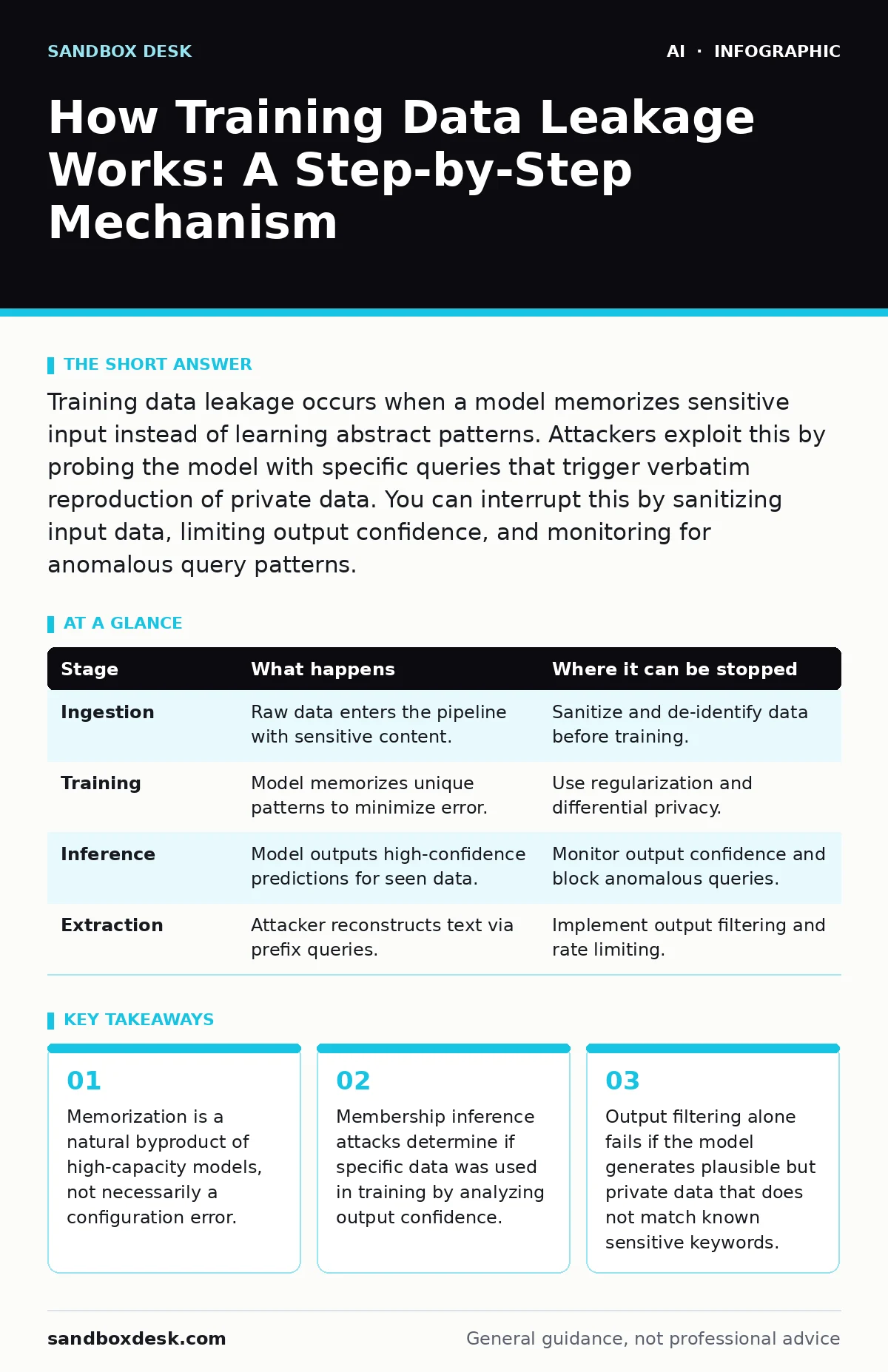
Training data leakage occurs when a model memorizes sensitive input instead of learning abstract patterns. Attackers exploit this by probing the model with specific queries that trigger verbatim reproduction of private data. You can interrupt this by sanitizing input data, limiting output confidence, and monitoring for anomalous query patterns.
The Mechanics of Memorization
Large language models do not understand meaning in the way humans do. They predict the next token in a sequence based on statistical probability derived from their training set. When the dataset contains repetitive or unique patterns, the model often memorizes these sequences verbatim. This behavior is distinct from generalization, where the model learns underlying rules. Memorization creates a direct bridge between the training data and the model’s internal weights.
This process happens silently during the optimization phase. The model adjusts its parameters to minimize prediction error. If a specific document appears frequently, the error reduction comes from storing that exact text. The result is a model that can reproduce private emails, code snippets, or personal identifiers when prompted with the right context. You cannot simply turn off memorization without degrading the model’s overall performance on standard tasks.
Data Ingestion and Preprocessing
The first stage of potential leakage begins with how data enters the training pipeline. Raw data often contains personally identifiable information, proprietary code, or confidential business records. If this data is not sanitized before ingestion, it becomes part of the model’s foundational memory. Many teams assume that anonymization is sufficient, but this assumption is fragile.
Anonymization often leaves behind quasi-identifiers. These are data points that do not identify a user alone but can do so when combined with other available information. For instance, a job title combined with a specific office location might uniquely identify an individual. If the model ingests these combinations, it can reconstruct identities. The preprocessing step must go beyond simple redaction. It should involve semantic understanding to detect and remove sensitive contexts, not just specific keywords.
Weight Optimization and Storage
During training, the model updates its weights to capture the statistical relationships in the data. This optimization process is where memorization becomes embedded. The model does not store the raw text in a database; it stores the probability distributions that lead to that text. This distribution is mathematically equivalent to the original data in many cases.
The capacity of the model plays a significant role here. Larger models with more parameters have a higher capacity to memorize. They can fit the noise in the data as well as the signal. This is a known trade-off in machine learning known as the bias-variance trade-off. A model that fits the training data too closely has high variance and low bias. It performs perfectly on training examples but may fail to generalize to new data. This overfitting is the root cause of data leakage.
Membership Inference Attacks
Attackers can determine if a specific data point was used in training without accessing the model’s weights. This is called a membership inference attack. The attacker trains a shadow model on a similar dataset. They then compare the output confidence of the target model with the shadow model. If the target model is unusually confident about a specific input, it likely saw that input during training.
This technique relies on the fact that models behave differently on data they have seen versus data they have not. Seen data triggers higher confidence scores because the model has optimized its weights to predict it accurately. Unseen data results in lower confidence because the model is guessing. By analyzing these confidence levels, an attacker can build a list of probable training data points. This reveals which records are private and which are public.
Extractive Reconstruction
Once an attacker identifies that specific data is in the model, they attempt to extract it. This stage involves crafting inputs that force the model to reproduce the memorized text. This is often done through prefix-based queries. The attacker provides the beginning of a known sentence or document and asks the model to complete it. If the model memorized the text, it will output the rest with high probability.
This method works best for structured data or common phrases. For unique, unstructured text, the attacker may need to use iterative probing. They generate multiple completions and select the one that makes the most sense or matches external knowledge. This process can reconstruct large portions of private documents. The attacker does not need to guess the entire document at once. They can build it piece by piece.
| Stage | What happens | Where it can be stopped |
|---|---|---|
| Ingestion | Raw data enters the pipeline with sensitive content. | Sanitize and de-identify data before training. |
| Training | Model memorizes unique patterns to minimize error. | Use regularization and differential privacy. |
| Inference | Model outputs high-confidence predictions for seen data. | Monitor output confidence and block anomalous queries. |
| Extraction | Attacker reconstructs text via prefix queries. | Implement output filtering and rate limiting. |
See also: Detecting Malware Targeting AI Infrastructure · What Makes Generative AI Unique: The Architecture of Synthetic Output
Interruption Points and Mitigation
You can interrupt the leakage process at several stages. The most effective point is during data ingestion. Removing sensitive data before training prevents memorization entirely. However, this is difficult to achieve perfectly. Post-training mitigations are necessary. Differential privacy adds noise to the training process. This noise prevents the model from memorizing any single data point too accurately. It ensures that the removal or addition of one record does not significantly change the model’s output.
Another mitigation is output filtering. This involves scanning the model’s responses for sensitive patterns before they reach the user. This is reactive rather than preventive. It catches known leaks but may miss novel ones. You must also consider the architecture of your deployment. If you are using fine-tuning on a base model, you must ensure the fine-tuning data is clean. The base model may already contain memorized data, compounding the risk.
Operational Monitoring and Defense
Ongoing monitoring is critical for detecting leakage attempts. You should track query patterns and output confidence scores. Sudden spikes in confidence for specific queries may indicate an extraction attempt. Implementing AI model monitoring allows you to detect these anomalies in real time. You can also use machine learning in cybersecurity to identify malicious query structures.
The threat extends to the broader ecosystem. AI supply chain risks include third-party models that may have been trained on leaked data. You must vet your model sources carefully. Additionally, securing AI agents requires strict access controls. Agents that interact with external systems can inadvertently leak data through their outputs. Regular audits and red teaming exercises help identify these vulnerabilities.
Regulatory and Ethical Context
Regulations like the EU AI Act impose strict requirements on data protection and transparency. Non-compliance can result in significant penalties. You must ensure that your training data usage respects individual privacy rights. This includes obtaining proper consent and providing mechanisms for data deletion. Ethical considerations also play a role. Even if data is publicly available, using it for training may violate user expectations.
The machine learning for fraud detection community has developed techniques to protect data integrity. These techniques can be adapted for privacy preservation. You should stay informed about evolving standards and best practices. The field is moving quickly, and what is acceptable today may not be tomorrow. Proactive measures are better than reactive fixes.
Key takeaways
- Memorization is a natural byproduct of high-capacity models, not necessarily a configuration error.
- Membership inference attacks determine if specific data was used in training by analyzing output confidence.
- Output filtering alone fails if the model generates plausible but private data that does not match known sensitive keywords.
Frequently asked questions
Can I prevent all training data leakage?
No, you cannot eliminate all risk. Memorization is inherent to how models learn. You can mitigate the risk through data sanitization, differential privacy, and output monitoring.
Is differential privacy effective against all extraction attacks?
It significantly reduces the risk by adding noise to the training process. However, it is not foolproof. Attackers may still extract information if the noise level is too low or if they have side information.
How do I know if my model has memorized data?
You can perform membership inference tests. Compare the model’s confidence on held-out data versus training data. High confidence on training data suggests memorization.
Does fine-tuning increase the risk of leakage?
Yes, if the fine-tuning data contains sensitive information. The model will memorize this new data. You must sanitize fine-tuning datasets just as carefully as pre-training datasets. BOTTOM LINE: Memorization is a structural feature of large models, not a bug, making total elimination impossible. Implement differential privacy during training and strict output filtering during inference to minimize exposure.
How this guide was produced: written by the Sandbox Desk editorial team with AI assistance, checked against the public references listed below, and reviewed when the facts change. See our editorial policy or report an error.