How Security Bulletins Drive Real Patching Decisions
Security bulletins transform raw vulnerability data into actionable repair timelines, preventing teams from wasting resources on low-risk noise while missing critical threats.

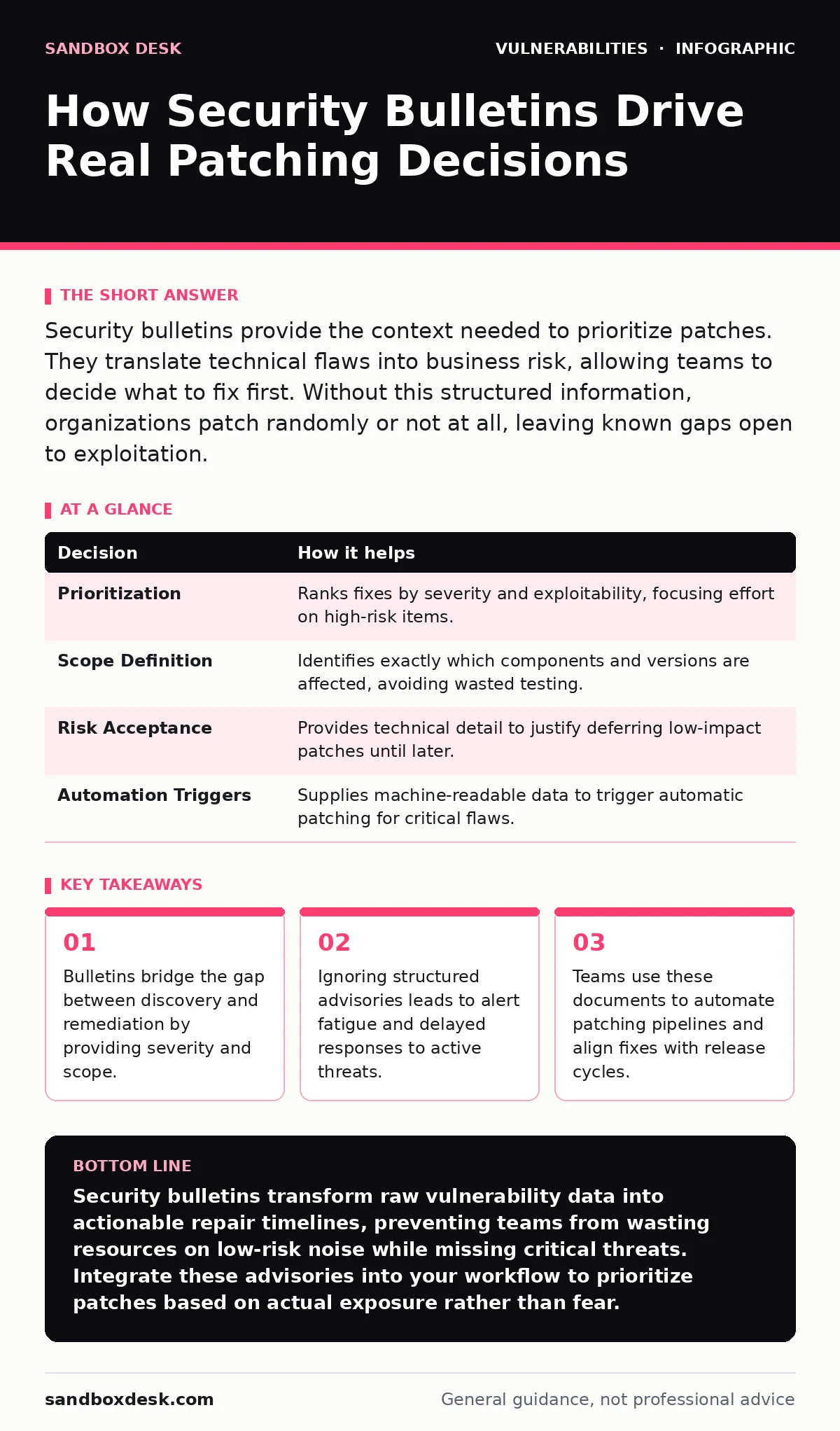
Security bulletins provide the context needed to prioritize patches. They translate technical flaws into business risk, allowing teams to decide what to fix first. Without this structured information, organizations patch randomly or not at all, leaving known gaps open to exploitation.
The Signal in the Noise
Vulnerabilities exist in abundance. New flaws are discovered daily in libraries, operating systems, and frameworks. A raw list of CVE identifiers offers little utility to an engineer. It tells you a hole exists, but not how wide it is, who is digging, or if anyone is standing near the edge. Security bulletins add the necessary context. They describe the mechanism of failure, the affected versions, and the potential impact.
This context allows you to separate signal from noise. Not every vulnerability requires immediate attention. Some affect features you do not use. Others require complex conditions that rarely occur in your environment. A bulletin helps you make that distinction. It moves the conversation from "fix everything" to "fix what matters."
Decisions Informed by Context
Patching is a resource-intensive activity. It requires testing, deployment, and sometimes downtime. You cannot patch everything at once. You must choose. Security bulletins inform these choices by providing a structured view of risk. They help you determine which systems are exposed and which users are at risk.
Consider the difference between a local privilege escalation and a remote code execution. The former requires an attacker to already be inside your network. The latter allows an attacker to execute code from outside. A bulletin clarifies this distinction. It tells you which systems need immediate isolation and which can wait for the next maintenance window. This prioritization prevents burnout and ensures critical assets are protected first.
| Decision | How it helps |
|---|---|
| Prioritization | Ranks fixes by severity and exploitability, focusing effort on high-risk items. |
| Scope Definition | Identifies exactly which components and versions are affected, avoiding wasted testing. |
| Risk Acceptance | Provides technical detail to justify deferring low-impact patches until later. |
| Automation Triggers | Supplies machine-readable data to trigger automatic patching for critical flaws. |
The Cost of Ignorance
Without structured advisories, teams operate in the dark. They may rely on fragmented news sources or social media alerts. These sources often lack technical precision. They may exaggerate the threat or omit key details. This leads to two common failures: overreaction and underreaction.
Overreaction wastes time. Teams patch every minor flaw, disrupting services and burning out engineers. Underreaction leaves critical gaps open. You might miss a flaw because it did not make the headlines. The result is a fragile security posture. You are reacting to noise rather than managing risk. This approach fails to address the secure software development lifecycle because it treats security as an afterthought rather than a continuous process.
How Teams Operate
Effective teams integrate bulletins into their workflow. They do not wait for a crisis. They subscribe to feeds from relevant vendors and public databases. They map these advisories to their asset inventory. This mapping reveals which systems are vulnerable.
Some teams automate this process. They use tools that parse bulletins and create tickets in their project management systems. This reduces the manual effort required to track flaws. It ensures that no critical patch is missed. Human analysts then review the automated suggestions. They consider the specific context of their environment. They decide whether to patch immediately or schedule the fix. This hybrid approach balances speed with accuracy.
Understanding Severity Ratings
Bulletins often include a CVSS score. This number provides a standardized measure of severity. It helps you compare flaws across different products. However, the score is not the whole story. A high score does not always mean high risk. You must consider the environment.
A vulnerability with a high score might affect a system that is isolated from the internet. In that case, the risk is lower. Conversely, a lower score might affect a public-facing API. If that API suffers from API vulnerabilities, the impact could be severe. You must look beyond the number. Read the description. Understand the attack vector. Determine if your architecture exposes that vector. This nuanced view prevents you from chasing ghosts while ignoring real threats.
See also: Secure SDLC: Concrete Benefits and Hidden Costs for Engineering Teams · CVSS Score Explained: What the Number Actually Means for Your Code
Integration with Public Frameworks
Public frameworks provide the raw data for many bulletins. The National Vulnerability Database serves as a central repository. It aggregates information from various sources. This aggregation helps you see the big picture. It shows you how many flaws exist in a particular component. It also highlights trends.
However, raw data from these databases can be overwhelming. You need filtering. Security bulletins act as that filter. They curate the data. They highlight the most relevant issues for your stack. They provide a narrative that connects the dots. This curation saves you time. It allows you to focus on analysis rather than data collection. Without this layer, you drown in information.
The Human Element
Automation helps, but humans make the final call. Engineers understand their code better than any tool. They know which libraries are critical. They know which patches might break existing functionality. Security bulletins empower these engineers. They provide the evidence needed to make informed decisions.
This collaboration between tool and human is key. Tools identify the flaw. Humans assess the impact. Together, they create a resilient system. This approach respects the complexity of software. It acknowledges that there is no one-size-fits-all solution. It builds a culture of informed risk management. This culture is more effective than rigid compliance. It adapts to new threats as they emerge.
Beyond the Patch
Fixing a vulnerability is not just about applying a patch. It is about understanding the root cause. Bulletins often describe the flaw in detail. This description can teach you how to write better code. It can reveal patterns in your architecture that are prone to error.
For instance, a bulletin about NoSQL injection might reveal that your team is not properly validating user input. This insight leads to better practices. It improves the overall quality of your software. It shifts security from a reactive task to a proactive discipline. You start to think like an attacker. You anticipate flaws before they are discovered. This mindset change is the true value of security bulletins.
Key takeaways
- Bulletins bridge the gap between discovery and remediation by providing severity and scope.
- Ignoring structured advisories leads to alert fatigue and delayed responses to active threats.
- Teams use these documents to automate patching pipelines and align fixes with release cycles.
Security bulletins transform raw vulnerability data into actionable repair timelines, preventing teams from wasting resources on low-risk noise while missing critical threats. Integrate these advisories into your workflow to prioritize patches based on actual exposure rather than fear.
Frequently asked questions
How do I choose which security bulletin source to trust?
Prioritize official vendor advisories and established public databases like the National Vulnerability Database. Cross-reference multiple sources to ensure accuracy and completeness.
Can I automate the entire patching process based on bulletins?
You can automate the detection and ticketing, but human review is necessary for prioritization. Automation handles the volume, while humans assess the specific business risk and compatibility.
What if a security bulletin does not provide a fix?
Implement mitigating controls such as network segmentation or input validation. Monitor for updates and apply the patch as soon as it becomes available.
Do security bulletins cover open-source libraries?
Yes, but coverage varies. You must actively monitor feeds for the specific libraries you use. Relying on a single source may leave gaps in your knowledge.
How this guide was produced: written by the Sandbox Desk editorial team with AI assistance, checked against the public references listed below, and reviewed when the facts change. See our editorial policy or report an error.