How to Prevent API Vulnerabilities: A Priority-Based Approach
Most API security failures stem from logic errors in business workflows, not from missing authentication headers or basic network misconfigurations.

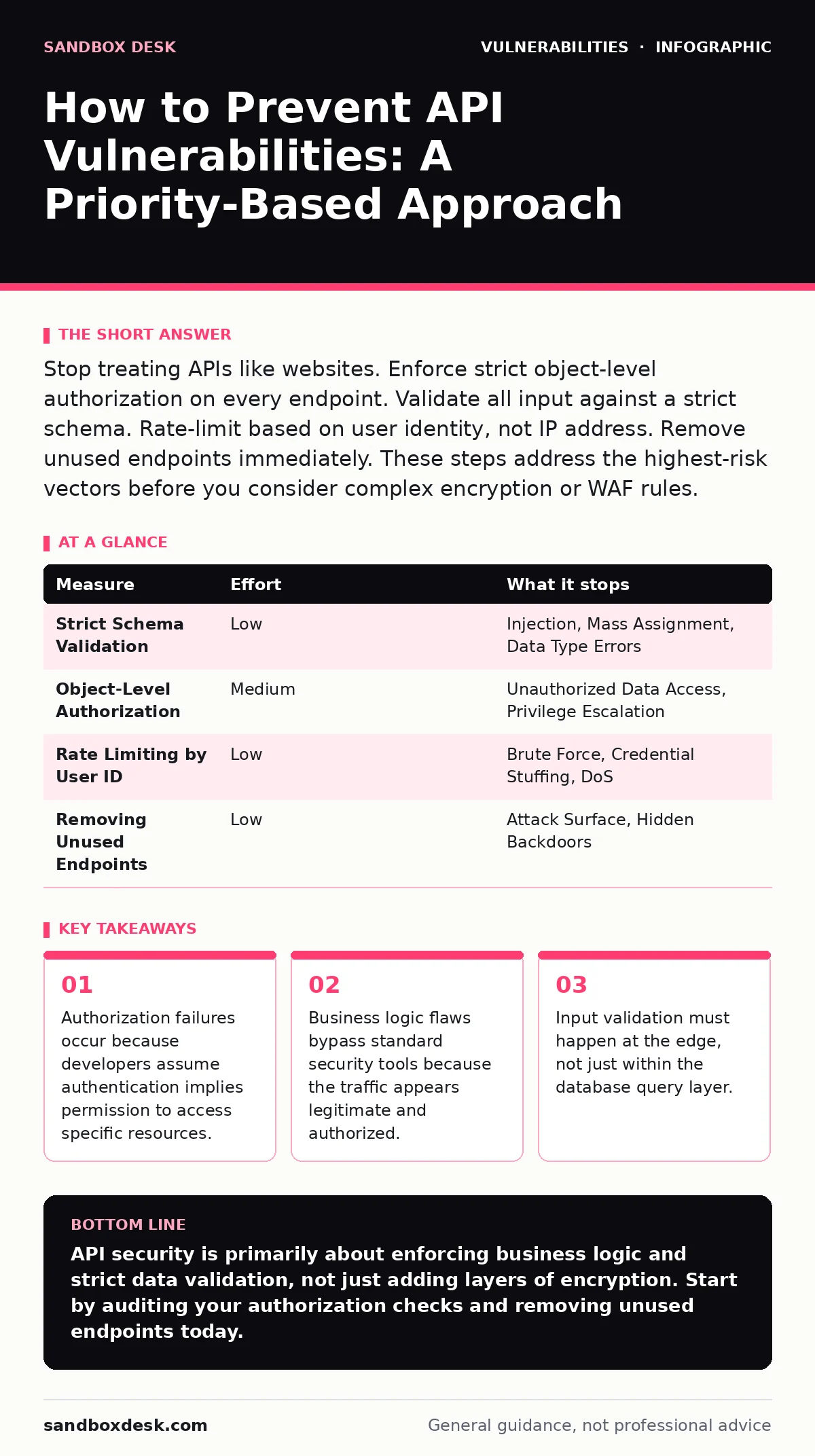
Stop treating APIs like websites. Enforce strict object-level authorization on every endpoint. Validate all input against a strict schema. Rate-limit based on user identity, not IP address. Remove unused endpoints immediately. These steps address the highest-risk vectors before you consider complex encryption or WAF rules.
Stop Assuming Authentication Equals Authorization
Authentication verifies who you are. Authorization determines what you can do. Most API breaches happen because these two concepts are conflated. A user logs in successfully, receiving a valid token. The application then fails to check if that specific user has the right to access the specific resource requested.
This is known as Broken Object Level Authorization. It is not a network issue. It is a logic error. The API accepts the request because the session is valid, but it does not verify ownership or permission for the target object.
You must check permissions for every single object access. Do not rely on hiding IDs in the URL or assuming the frontend will prevent access. The backend must enforce these rules independently. If a user requests GET /api/users/1234, the server must verify that the authenticated user is allowed to view user 1234.
Enforce Strict Input Validation at the Edge
Every input is a potential vector for injection. This includes JSON bodies, query parameters, headers, and path variables. You must define a strict schema for every endpoint. This schema specifies the type, length, format, and allowed values for each field.
If the input does not match the schema, reject it immediately. Do not attempt to sanitize it. Sanitization often misses edge cases. Rejection is safer. This prevents NoSQL injection and other injection flaws by ensuring the data structure matches expectations before any processing occurs.
This practice also protects against mass assignment vulnerabilities. If a user can send an extra field in a JSON object that maps to a database column, they might update fields they should not touch. By validating against a strict schema, you ignore unknown fields entirely.
| Measure | Effort | What it stops |
|---|---|---|
| Strict Schema Validation | Low | Injection, Mass Assignment, Data Type Errors |
| Object-Level Authorization | Medium | Unauthorized Data Access, Privilege Escalation |
| Rate Limiting by User ID | Low | Brute Force, Credential Stuffing, DoS |
| Removing Unused Endpoints | Low | Attack Surface, Hidden Backdoors |
Implement User-Centric Rate Limiting
IP-based rate limiting is insufficient for modern APIs. Users often share IP addresses via NAT or mobile networks. Attackers can rotate IPs to bypass these limits. You must tie rate limits to the authenticated user identity.
If a user is not authenticated, limit them strictly by IP and consider blocking them after a few failed attempts. For authenticated users, track their request volume against a per-user quota. This stops credential stuffing attacks where an attacker tries thousands of passwords against a single account.
It also prevents brute force attacks on password reset endpoints. These endpoints are often less protected than login flows. By limiting how many reset tokens a user can generate, you reduce the window for exploitation.
Audit and Remove Unused Endpoints
Every endpoint is a potential entry point. Many APIs expose deprecated endpoints or internal debugging tools in production. These are often forgotten during security reviews because they are not part of the active feature set.
Conduct a regular audit of your API surface. Identify endpoints that are not used by any current client. Deprecate them clearly and remove them entirely. If you must keep them for legacy support, restrict access to a narrow range of IP addresses or specific API keys.
This reduces the attack surface. Attackers often scan for common endpoint patterns. If those endpoints do not exist, the scanner fails. This is a low-effort win that removes entire classes of vulnerabilities.
Secure the Business Logic Layer
Standard security tools check for syntax errors. They do not check for logic errors. Business logic vulnerabilities occur when an application behaves incorrectly in response to valid inputs. For example, a shopping cart might allow a negative quantity if the validation only checks for positive integers in the frontend.
You must map out your workflows. Identify every step where state changes. Ensure that each step requires the correct permissions and that the sequence cannot be bypassed. This often requires manual review and testing, not just automated scanning.
Consider the interactions between endpoints. An attacker might use one endpoint to set a state and another to exploit it. Automated tools rarely catch these multi-step attacks. You need to think like an attacker who understands your business rules.
See also: WebSocket Vulnerabilities: Definition, Attack Vectors, and Mitigation · NoSQL Injection Myths: Why Your Database Is Not Safe From Code
Adopt a Secure Development Lifecycle
Security cannot be an afterthought. It must be integrated into your development process. This means code reviews that focus on security, not just functionality. It means using static analysis tools that catch common vulnerabilities before they reach production.
Refer to the secure software development lifecycle for a framework. This approach ensures that security requirements are defined early. It also ensures that testing includes security scenarios, not just functional tests.
This reduces the cost of fixing vulnerabilities. Fixing a flaw in production is expensive and risky. Fixing it in code review is cheap and safe. It also builds a culture of security awareness among developers.
Monitor for Anomalies, Not Just Errors
Standard monitoring tracks errors and downtime. It does not track suspicious behavior. You need to monitor for anomalies in usage patterns. For example, a sudden spike in requests for a specific endpoint might indicate an attack.
Look for deviations from normal behavior. A user who never accesses administrative endpoints suddenly doing so is a red flag. A user making requests at a rate far higher than their historical average is another.
These anomalies often indicate an active exploit. By detecting them early, you can respond before significant damage occurs. This requires baseline data on normal usage. Without it, you cannot distinguish between a legitimate surge and an attack.
Closing Checklist for Today
- Review your top five most critical endpoints. Ensure they enforce object-level authorization on every request.
- Implement strict JSON schema validation for all public-facing APIs. Reject any input that does not match the schema.
- Audit your API gateway or backend for unused or deprecated endpoints. Remove them or restrict access immediately.
Key takeaways
- Authorization failures occur because developers assume authentication implies permission to access specific resources.
- Business logic flaws bypass standard security tools because the traffic appears legitimate and authorized.
- Input validation must happen at the edge, not just within the database query layer.
API security is primarily about enforcing business logic and strict data validation, not just adding layers of encryption. Start by auditing your authorization checks and removing unused endpoints today.
Frequently asked questions
Does HTTPS prevent API vulnerabilities?
No. HTTPS encrypts data in transit, preventing eavesdropping. It does not protect against logic errors, injection attacks, or authorization failures. You still need secure code and validation.
How do I handle API versioning securely?
Treat each version as a separate application. Enforce the same security controls on all versions. Deprecate old versions actively and remove them when possible to reduce the attack surface.
Should I use API keys or JWTs?
Both have risks. API keys are simple but hard to revoke. JWTs are stateless but can be long-lived. Use short-lived tokens with refresh mechanisms. Always validate signatures and expiration on the server side.
What is the role of the CISA Known Exploited Vulnerabilities catalog?
It lists vulnerabilities that are actively being exploited in the wild. Check this list regularly to prioritize patching. If your API uses a component with a known exploit, fix it immediately, regardless of its CVSS score.
How this guide was produced: written by the Sandbox Desk editorial team with AI assistance, checked against the public references listed below, and reviewed when the facts change. See our editorial policy or report an error.