CVSS Score Explained: What the Number Actually Means for Your Code
See past the single number to understand how environmental context changes risk, and why a high score does not always mean you must patch immediately.

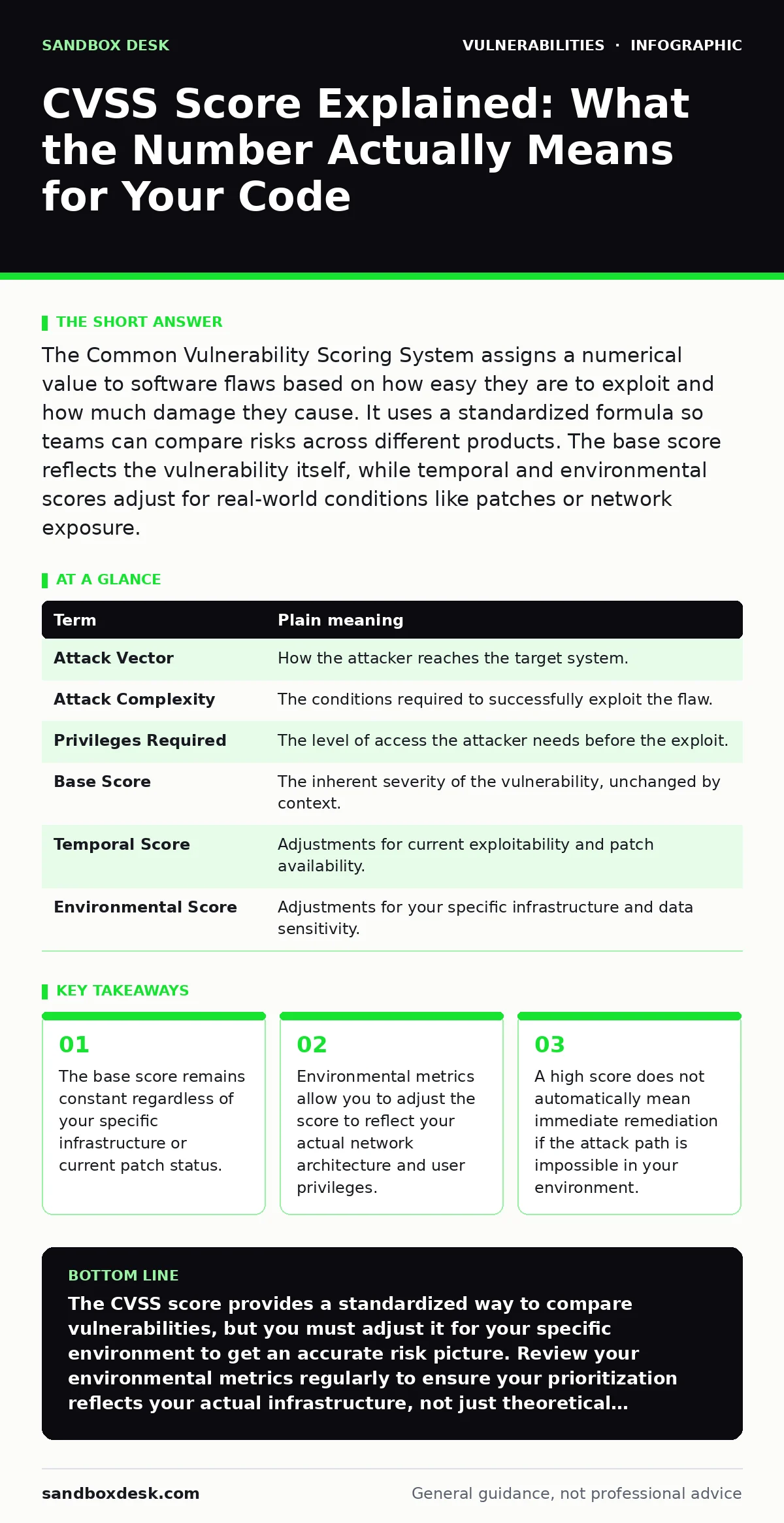
The Common Vulnerability Scoring System assigns a numerical value to software flaws based on how easy they are to exploit and how much damage they cause. It uses a standardized formula so teams can compare risks across different products. The base score reflects the vulnerability itself, while temporal and environmental scores adjust for real-world conditions like patches or network exposure.
The House Fire Analogy
Imagine a vulnerability is a fire hazard in a house. A broken electrical socket in the kitchen is dangerous. A lit match left on a table is dangerous. But they are dangerous in different ways. The CVSS score attempts to quantify that danger so you can decide which one to fix first. You cannot compare the two hazards without a standard ruler. The score is that ruler. It turns a qualitative fear into a quantitative number between zero and ten.
This analogy holds throughout the explanation. The base score is the inherent danger of the hazard itself. The temporal score is whether you have just replaced the socket or if the fire department is currently in the building. The environmental score is whether the house is made of wood or concrete.
Base Metrics: The Hazard Itself
The base score measures the intrinsic properties of the vulnerability. It does not change over time. It does not care about your specific network. It answers the question: if this flaw exists in a vacuum, how bad is it? This score looks at four main areas: attack vector, attack complexity, privileges required, and impact.
The attack vector describes how the attacker reaches the target. Is the socket accessible from the street, or does the attacker need to break into the house first? Network-accessible flaws score higher than local ones. Attack complexity measures how difficult the exploit is. Is it a simple push of a button, or does it require precise timing and rare conditions?
Privileges required asks what the attacker already has. Do they need to be an administrator, or can they do damage as a guest? Impact looks at confidentiality, integrity, and availability. Did the attacker steal secrets, change data, or break the system? These factors combine into a single base number.
Temporal Metrics: The Current Situation
The temporal score adjusts the base score based on current information. This is where the fire department comes in. If a patch exists, the temporal score drops. If the exploit is widely known and active, the score might rise due to the increased likelihood of attack. This metric reflects the maturity of the fix and the current exploitability.
You should update this score when new information emerges. If a vendor releases a mitigation but not a full fix, the temporal score changes. If an attacker demonstrates a working exploit in the wild, the score reflects that immediacy. This number helps you prioritize work that is currently relevant versus theoretical risks.
Environmental Metrics: Your Specific House
This is where most misunderstandings occur. The environmental score tailors the risk to your specific setup. Maybe the vulnerable socket is in a room that is always locked. Maybe your house is made of fireproof concrete. The base score assumes a standard wooden house with open doors. Your environment may not be standard.
You adjust three categories: modified base metrics, confidentiality requirements, and integrity requirements. If your application runs in an isolated container, the attack vector is no longer network-wide. You modify the metric to reflect this isolation. If the data being protected is public information, the confidentiality impact is lower than if it were medical records.
This score is subjective. It requires you to know your architecture better than the vulnerability scanner does. Two teams can look at the same vulnerability and assign different environmental scores. Both can be correct. The score reflects their specific risk tolerance and infrastructure.
Common Points of Confusion
Many teams treat the base score as the final truth. They see a nine-point score and panic. They ignore the environmental context. A high base score is a warning, not a command. It tells you the potential for damage is high. It does not tell you the likelihood of exploitation in your specific case.
Another confusion is assuming the score is static. It is not. The temporal score changes as patches are released. The environmental score changes as you modify your infrastructure. Treating the score as a fixed label leads to poor prioritization. You may spend weeks fixing a high-score flaw that is unreachable, while ignoring a medium-score flaw that is actively being exploited against you.
See also: How Security Bulletins Drive Real Patching Decisions · Secure SDLC: Concrete Benefits and Hidden Costs for Engineering Teams
Glossary of Terms
| Term | Plain meaning |
|---|---|
| Attack Vector | How the attacker reaches the target system. |
| Attack Complexity | The conditions required to successfully exploit the flaw. |
| Privileges Required | The level of access the attacker needs before the exploit. |
| Base Score | The inherent severity of the vulnerability, unchanged by context. |
| Temporal Score | Adjustments for current exploitability and patch availability. |
| Environmental Score | Adjustments for your specific infrastructure and data sensitivity. |
Try This Now
- Pick a recent vulnerability with a high base score in your inventory.
- Map the attack vector to your network diagram. Is it truly accessible?
- Adjust the environmental score to reflect your actual isolation and data sensitivity.
The Limit of the Number
The CVSS score is a tool for communication, not a perfect model of reality. It standardizes language so developers, security teams, and management can agree on priority. It does not replace human judgment. A score of zero is not safe. A score of ten is not always urgent.
You must understand the mechanism behind the score. You must know why a number is high. You must know why your environment might lower that number. The score gives you a starting point. Your context provides the finish line.
Key takeaways
- The base score remains constant regardless of your specific infrastructure or current patch status.
- Environmental metrics allow you to adjust the score to reflect your actual network architecture and user privileges.
- A high score does not automatically mean immediate remediation if the attack path is impossible in your environment.
The CVSS score provides a standardized way to compare vulnerabilities, but you must adjust it for your specific environment to get an accurate risk picture. Review your environmental metrics regularly to ensure your prioritization reflects your actual infrastructure, not just theoretical worst-case scenarios.
Frequently asked questions
Does a higher CVSS score mean a vulnerability is easier to exploit?
Not necessarily. A high score often reflects severe impact, such as total system compromise, even if the attack requires complex conditions or high privileges.
Can I change the CVSS score assigned by a vendor?
You can calculate your own environmental score. The base and temporal scores are generally fixed by the assigner, but your environmental adjustment is your own calculation.
Why do two scanners give different scores for the same vulnerability?
They may be using different versions of the CVSS specification or applying different default environmental assumptions. Always check the version and the specific metrics used.
Is CVSS version 3.1 different from version 4.0?
Version 4.0 introduces new metrics like safety and reputation, and changes how privileges are calculated. The core concept of base, temporal, and environmental remains, but the math and metrics have evolved.
How this guide was produced: written by the Sandbox Desk editorial team with AI assistance, checked against the public references listed below, and reviewed when the facts change. See our editorial policy or report an error.