Secure SDLC: Concrete Benefits and Hidden Costs for Engineering Teams
Embedding security into the development lifecycle prevents costly late-stage fixes, but it adds friction to every commit and requires a cultural shift that resists automation.

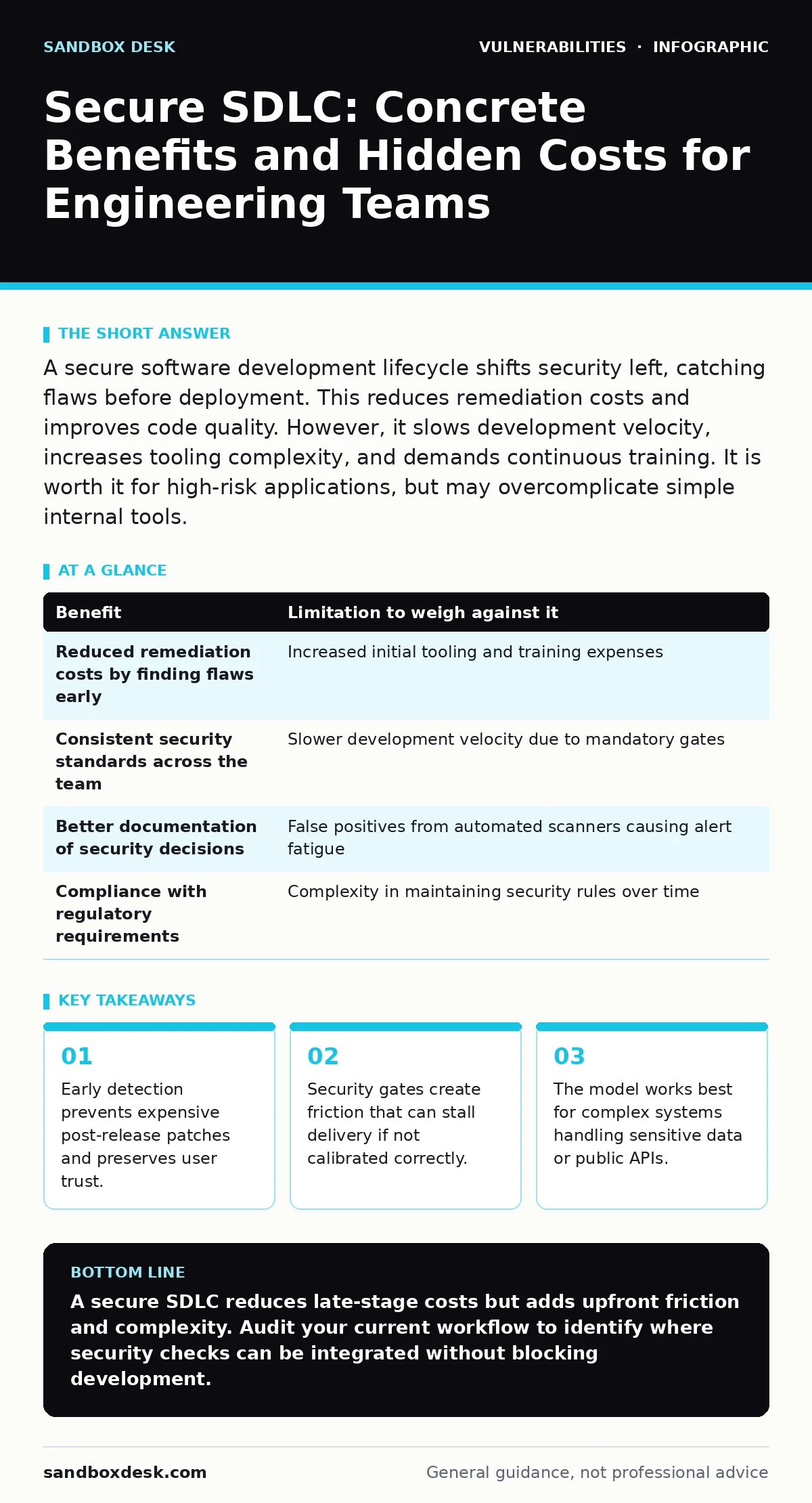
A secure software development lifecycle shifts security left, catching flaws before deployment. This reduces remediation costs and improves code quality. However, it slows development velocity, increases tooling complexity, and demands continuous training. It is worth it for high-risk applications, but may overcomplicate simple internal tools.
The Cost of Late Discovery
Fixing a vulnerability after deployment is significantly more expensive than catching it during design. This cost is not just monetary. It consumes engineering hours that could build features. It also damages reputation when users discover flaws in production.
A secure software development lifecycle (SSDLC) aims to shift these checks earlier. You integrate security into planning, coding, testing, and deployment. This approach treats security as a quality attribute, not an afterthought.
The primary benefit is predictability. You know the security posture of your software before it reaches users. This reduces the shock of emergency patches. It also allows you to prioritize risks based on actual code behavior rather than theoretical threats.
| Benefit | Limitation to weigh against it |
|---|---|
| Reduced remediation costs by finding flaws early | Increased initial tooling and training expenses |
| Consistent security standards across the team | Slower development velocity due to mandatory gates |
| Better documentation of security decisions | False positives from automated scanners causing alert fatigue |
| Compliance with regulatory requirements | Complexity in maintaining security rules over time |
Friction in the Development Flow
Every security check adds a step to the developer's workflow. Static application security testing (SAST) scans code for known patterns. Dynamic application security testing (DAST) probes running applications. Dependency checks verify third-party libraries.
These tools are necessary, but they introduce friction. A developer waiting for a scan to complete loses momentum. If the tool produces false positives, the developer must investigate noise. This erodes trust in the security process.
You must balance security with speed. Too many gates halt progress. Too few leave gaps. The challenge is configuring tools to catch real issues without blocking trivial ones. This requires constant tuning.
The Human Element and Skill Gaps
Tools only check for known patterns. They cannot understand intent. A developer might write code that is syntactically correct but logically insecure. For example, a function might validate input but fail to enforce authorization.
This is where training matters. Developers need to understand common vulnerability classes. They should know how to write secure code from the start. This reduces reliance on downstream fixes.
However, training is often overlooked. Teams assume tools will handle security. This leads to a skill gap. When a complex vulnerability appears, the team lacks the knowledge to fix it properly. This delays resolution and increases risk.
When It Is Worth It
Implementing a full SSDLC makes sense for high-risk applications. These are systems that handle sensitive data, such as health records or financial transactions. They are also systems exposed to the public internet.
If your application interacts with external users, the attack surface is large. You face automated scanning and targeted attacks. The cost of a breach is high. In this case, the overhead of an SSDLC is justified.
Consider applications with complex integrations. If your system connects to multiple services, each connection is a potential entry point. You need rigorous testing to ensure each link is secure. This is especially true for API vulnerabilities, which often arise from improper validation.
When It Is Not
Not every project needs a heavy security process. Simple internal tools with limited access have a small attack surface. The risk of exploitation is low. The cost of implementing an SSDLC may exceed the potential damage.
If the tool is used only by trusted employees on a local network, the threat model changes. You can rely on network segmentation and least privilege access controls. Adding deep code review and automated scanning may waste resources.
Suppose you are building a prototype to test a concept. The code will be discarded in weeks. Spending time on security documentation and rigorous testing is inefficient. Focus on functionality first. You can add security later if the product succeeds.
See also: How Security Bulletins Drive Real Patching Decisions · CVSS Score Explained: What the Number Actually Means for Your Code
Balancing Standards and Reality
A rigid SSDLC can become bureaucratic. Teams may follow procedures without understanding the security rationale. This creates a checkbox mentality. Security becomes a hurdle to clear, not a goal to achieve.
You need to adapt the process to your team's needs. Use metrics to measure effectiveness. Track the number of vulnerabilities found in production versus development. If production bugs remain high, your early checks are failing.
Review your tools regularly. New vulnerabilities emerge constantly. Reference resources like the CISA Known Exploited Vulnerabilities catalog to prioritize patches. Ensure your dependencies are up to date. This keeps your defenses current.
The Role of Continuous Monitoring
Security does not end at deployment. Applications change. New libraries are added. Configuration drift occurs. You need continuous monitoring to detect changes.
Integrate security into your CI/CD pipeline. Run scans on every commit. This provides immediate feedback. Developers fix issues while the context is fresh. This reduces the effort required for remediation.
However, continuous monitoring generates noise. You must filter results. Focus on high-severity issues. Use a CVSS score to prioritize fixes. This ensures your team addresses the most dangerous flaws first.
Conclusion of the Lifecycle
The secure software development lifecycle is a framework, not a product. It requires commitment from leadership and participation from developers. It is not a one-time project. It is an ongoing practice.
The benefits are clear: fewer breaches, lower costs, and better code. The limitations are real: slower velocity, higher complexity, and skill requirements. You must decide if the trade-off is right for your project.
By embedding security early, you build resilience. You prepare for threats that are inevitable. You protect your users and your organization. This is the foundation of trustworthy software.
Key takeaways
- Early detection prevents expensive post-release patches and preserves user trust.
- Security gates create friction that can stall delivery if not calibrated correctly.
- The model works best for complex systems handling sensitive data or public APIs.
A secure SDLC reduces late-stage costs but adds upfront friction and complexity. Audit your current workflow to identify where security checks can be integrated without blocking development.
Frequently asked questions
How does SSDLC differ from traditional security testing?
Traditional testing occurs after development is complete. SSDLC integrates security checks into every phase, from design to deployment, catching issues earlier.
Can small teams implement an SSDLC?
Yes, but they should start with lightweight practices. Focus on dependency scanning and basic code review. Add more complex tools as the team grows.
What is the biggest challenge in adopting SSDLC?
Cultural resistance is often the biggest hurdle. Developers may view security as a burden. Training and demonstrating the value of early fixes help overcome this.
How do I measure the success of my SSDLC?
Track metrics like the number of vulnerabilities found in production versus development. Also, measure the time to remediate issues. Improvement in these areas indicates success.
How this guide was produced: written by the Sandbox Desk editorial team with AI assistance, checked against the public references listed below, and reviewed when the facts change. See our editorial policy or report an error.