Ransomware Incident Response: 6 Common Misreadings Corrected
Treating ransomware as a simple encryption event ignores the lateral movement and data exfiltration that determine whether you can recover without paying.
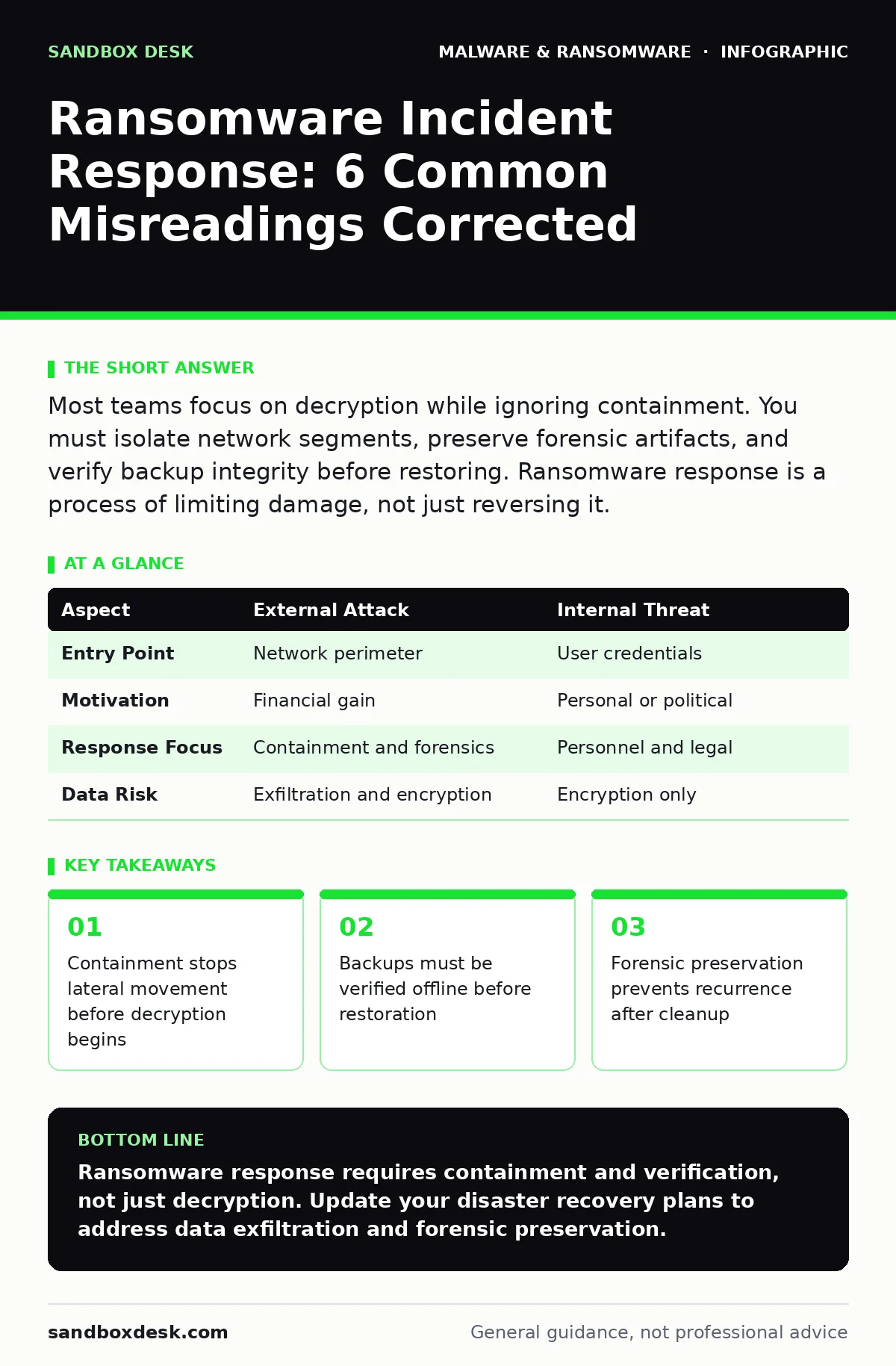
Most teams focus on decryption while ignoring containment. You must isolate network segments, preserve forensic artifacts, and verify backup integrity before restoring. Ransomware response is a process of limiting damage, not just reversing it.
Misreading: Encryption is the only threat
Correct reading: Encryption is the visible symptom, not the entire attack. Modern ransomware operators exfiltrate data before encrypting files. This dual-action threat creates leverage. If you only focus on decrypting files, you ignore the stolen data. The attacker holds two hostages: your operational ability and your privacy. You must assume data has left the network. This changes the priority from speed to secrecy.
Misreading: Restore backups immediately
Correct reading: Restoring from backups without verification spreads the infection. Many ransomware families target backup files or inject themselves into backup repositories. If you restore an infected backup, the malware re-infects the clean system. You must verify backup integrity against a known good state. Check file hashes and timestamps. Ensure the backup source was isolated from the network during the attack. This step prevents the cycle of reinfection.
Misreading: Disconnect everything at once
Correct reading: Blindingly disconnecting all network segments destroys forensic evidence. You need to preserve memory dumps and network traffic logs to understand the entry point. Identify the initial infection vector. Determine how the malware moved laterally. Use segmented shutdowns. Isolate the affected segment first. Keep critical infrastructure online with strict access controls. This balance allows investigation while limiting damage.
Misreading: Antivirus solves the problem
Correct reading: Traditional signature-based detection often fails against new ransomware variants. Fileless malware and polymorphic code evade standard scans. You need behavioral analysis and endpoint detection and response capabilities. These tools look for suspicious actions, not just known file signatures. They can stop the encryption process if configured correctly. Relying solely on perimeter defenses leaves endpoints vulnerable. Internal monitoring is required to catch lateral movement.
Misreading: Paying guarantees decryption
Correct reading: Payment does not guarantee file recovery. Attackers may provide broken decryption keys. They may ignore your payment. They may resell your stolen data regardless. Paying funds further criminal activity. It also marks you as a willing payer. You become a target for repeat attacks. Legal implications may arise in some jurisdictions. The technical risk of failed decryption is high. The business risk of encouraging crime is certain.
See also: Log Retention Strategy: Benefits, Limits, and When to Stop · Is Command the Same as Control in C2 Infrastructure?
Misreading: The incident ends with cleanup
Correct reading: Cleanup is the start of the recovery phase. You must patch the vulnerability that allowed entry. You must reset all credentials. You must audit user permissions. You must review access logs for unauthorized changes. Failure to address the root cause allows re-infection. The attacker may have planted persistence mechanisms. These backdoors remain hidden until discovered. Thorough investigation prevents recurrence.
Misreading: Technical teams decide on payment
Correct reading: The decision to pay is a business and legal choice. Technical teams provide the facts. They assess the likelihood of recovery. They estimate the cost of downtime. They evaluate the risk of data exposure. Leadership weighs these factors against legal obligations. They consider regulatory requirements. They assess reputational damage. Technical staff should not make the final call. They should provide clear, unbiased data.
Misreading: Ransomware is an external attack only
Correct reading: Insider threats can mimic ransomware. Disgruntled employees may encrypt files for leverage. Accidental actions by staff may trigger similar symptoms. You must investigate internal logs. Check for unusual access patterns. Verify user behavior before assuming external origin. This distinction changes the response. External attacks require network isolation. Internal threats require personnel actions. Both require careful handling.
| Aspect | External Attack | Internal Threat |
|---|---|---|
| Entry Point | Network perimeter | User credentials |
| Motivation | Financial gain | Personal or political |
| Response Focus | Containment and forensics | Personnel and legal |
| Data Risk | Exfiltration and encryption | Encryption only |
Misreading: Decryption tools are always available
Correct reading: Decryption tools exist for some older variants. Newer variants use strong encryption. No public tool can reverse them. The attacker holds the private key. You must rely on backups. You must accept data loss. Planning for this scenario is critical. Do not assume a technical fix exists. Prepare for operational disruption. This reality drives the need for offline backups.
Misreading: Incident response is a one-time event
Correct reading: Incident response is a continuous process. Threats evolve constantly. Attackers adapt to defenses. You must update your procedures. You must test your plans regularly. Simulate attacks to find gaps. Train staff on recognition. Review logs for anomalies. This ongoing effort reduces risk. It improves response time. It minimizes damage. Security is not a state. It is a practice.
Misreading: All files must be recovered
Correct reading: Not all files are worth recovering. Some data is easily replaced. Some data is redundant. Focus resources on critical systems. Identify essential business functions. Prioritize recovery of these assets. Accept loss of non-critical data. This triage approach saves time. It reduces downtime. It focuses effort where it matters most. Not every file is equally valuable.
Misreading: The attacker is always sophisticated
Correct reading: Many ransomware attacks use simple methods. Phishing emails remain common. Weak passwords enable access. Unpatched software provides entry. Do not assume complex exploits. Check for basic hygiene failures. Verify user training effectiveness. Ensure patch management is current. Simple mistakes often lead to major breaches. Addressing basics reduces risk significantly.
Misreading: Cloud storage is immune
Correct reading: Cloud storage is not immune to ransomware. Attackers can compromise cloud credentials. They can encrypt cloud-hosted files. They can delete cloud backups. You must secure cloud access. Use multi-factor authentication. Monitor cloud logs. Verify cloud backup policies. Assume cloud data is at risk. Protect it with the same rigor as on-premise data.
Misreading: Legal teams are not involved
Correct reading: Legal teams must be involved early. They assess liability. They advise on reporting requirements. They handle communication with regulators. They manage customer notifications. They evaluate insurance claims. Early involvement ensures compliance. It protects the organization. It reduces legal exposure. Do not delay legal consultation.
Misreading: Ransomware is the end of the business
Correct reading: Most businesses recover from ransomware. With proper planning, the impact is limited. Downtime is temporary. Data loss is manageable. Reputation can be restored. Focus on resilience. Build strong backups. Train your staff. Test your response. Prepare for the worst. Plan for recovery. Your business can survive.
Key takeaways
- Containment stops lateral movement before decryption begins
- Backups must be verified offline before restoration
- Forensic preservation prevents recurrence after cleanup
- Decision to pay is business, not technical
Ransomware response requires containment and verification, not just decryption. Update your disaster recovery plans to address data exfiltration and forensic preservation.
Frequently asked questions
How do I know if my backups are safe?
Verify them offline. Check hashes against known good states. Ensure they were isolated during the attack. Test restoration procedures regularly.
Should I ever pay the ransom?
Payment is a business decision. It does not guarantee recovery. It may violate laws. It encourages future attacks. Consult legal and security experts.
What is the first step in response?
Isolate the affected network segment. Preserve forensic evidence. Identify the scope of the infection. Do not reboot systems immediately.
How do I prevent recurrence?
Patch vulnerabilities. Reset credentials. Audit permissions. Train staff. Monitor for anomalies. Update your incident response plan.
How this guide was produced: written by the Sandbox Desk editorial team with AI assistance, checked against the public references listed below, and reviewed when the facts change. See our editorial policy or report an error.