How Ransom Notes Dictate Incident Response Decisions
The ransom note contains cryptographic evidence that determines whether you can recover data without paying the attacker, regardless of your backup strategy.

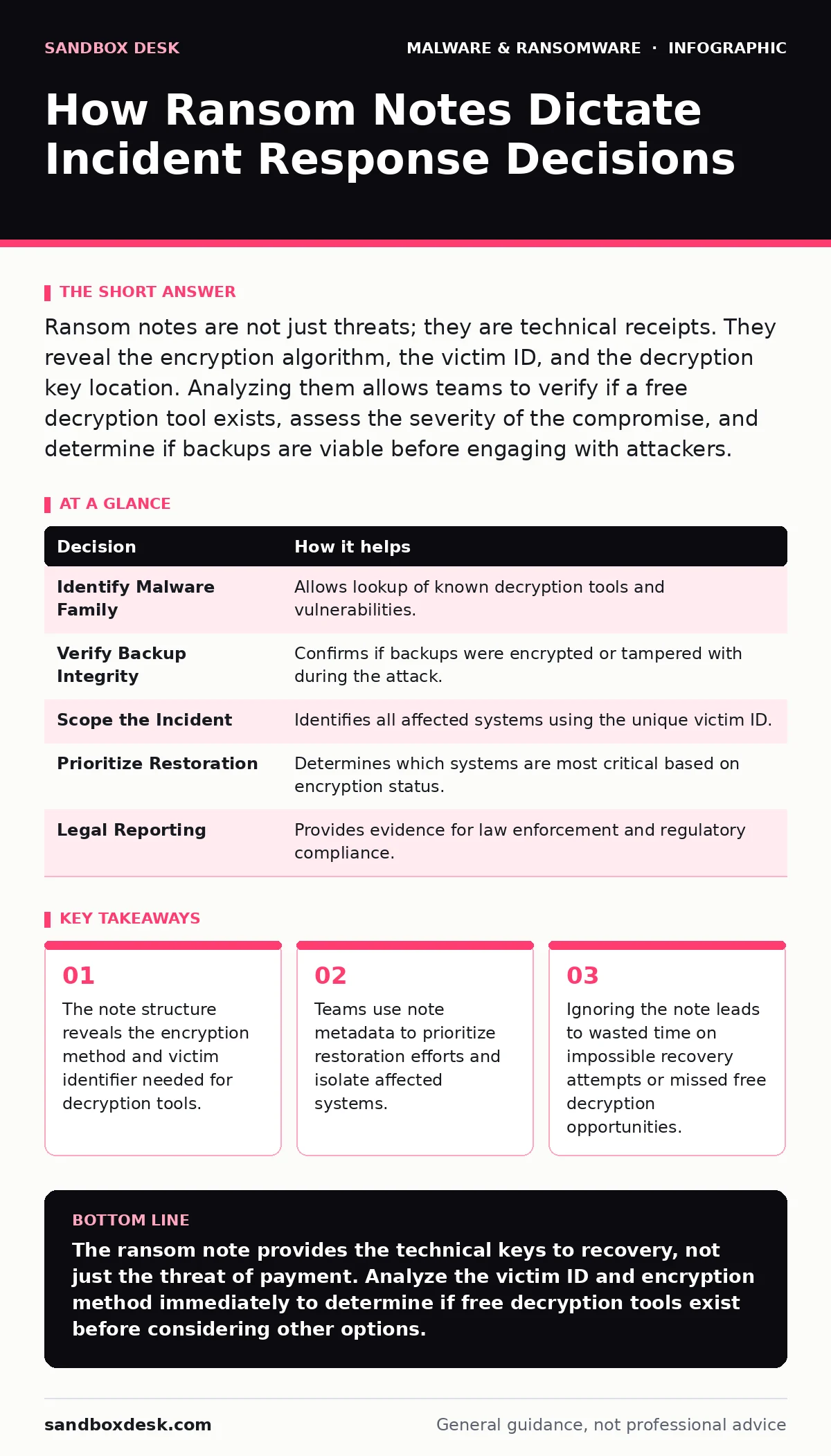
Ransom notes are not just threats; they are technical receipts. They reveal the encryption algorithm, the victim ID, and the decryption key location. Analyzing them allows teams to verify if a free decryption tool exists, assess the severity of the compromise, and determine if backups are viable before engaging with attackers.
The Technical Receipt
A ransom note is a text file placed on compromised systems after encryption occurs. It serves as the primary communication channel between the attacker and the victim. While the content is often threatening, the technical details within the file are more valuable to a security team than the ransom demand itself. These details dictate the immediate response strategy.
The note usually contains a unique victim ID, contact information, and instructions for payment. More importantly, it often hints at the encryption algorithm used. Some variants include a public key or a reference to a specific decryption method. This information allows analysts to categorize the malware family. Categorization is the first step toward determining if a known vulnerability or free decryption tool exists.
Without this file, you are operating in the dark. You cannot confirm if the encryption is reversible outside of the attacker’s control. You cannot verify if your backups are sufficient or if the attacker has encrypted them as well. The absence of a note often indicates a more sophisticated or destructive attack variant.
Decoding the Victim Identifier
The victim ID is a unique string assigned to your organization by the ransomware. It links your specific encryption to the attacker’s backend server. This identifier is critical for two reasons. First, it allows you to search public databases for decryption tools. Security researchers often publish tools for specific ransomware families when they obtain the master keys or find flaws in the implementation.
Second, the victim ID helps correlate events across different systems. If multiple servers have the same ID, you know they were infected in the same campaign. This helps in scoping the incident. It tells you which systems are part of the same encryption job. This scoping is necessary for prioritizing restoration efforts.
Imagine a team that ignores the victim ID. They might attempt to restore backups on a system that is not actually encrypted. They might waste hours verifying integrity on unaffected nodes. Conversely, a team that extracts the ID can quickly filter their incident response tickets. They focus only on the systems that match the cryptographic signature.
Algorithm and Key Analysis
The ransom note may explicitly state the encryption algorithm, such as RSA or AES. Even if it does not, the structure of the encrypted files can reveal it. Analysts use file hashes in malware detection to compare the ransomware binary against known samples. This comparison often reveals the algorithm used. Knowing the algorithm determines the feasibility of recovery.
If the ransomware uses weak or flawed encryption, decryption may be possible without the attacker’s key. Some early variants used the same key for every victim. Later variants use asymmetric encryption, where the public key encrypts data and the private key decrypts it. If the private key is never transmitted to the attacker’s server, or if the implementation is flawed, recovery is possible.
The note sometimes contains a sample decryption offer. This is a test to prove the attacker has the key. It also reveals how the key exchange works. Understanding this mechanism helps in blocking communication with the attacker’s command and control servers. It prevents the attacker from finalizing the encryption process on remaining systems.
Integration with Detection Systems
Modern detection systems rely on behavioral analysis rather than just signature-based detection. Ransomware exhibits specific behaviors, such as rapid file renaming or registry changes. These behaviors trigger alerts in next-generation antivirus solutions. However, the ransom note is often the final artifact created. It confirms the malicious intent.
Browser isolation can prevent initial access, but it does not stop ransomware that enters through other vectors. Point-of-sale malware operates differently, targeting transaction data rather than encrypting files. Ransomware targets availability. The note is the proof of that target. Integrating note detection into your security information and event management system allows for automated containment.
When a ransom note appears, automated playbooks can trigger. These playbooks might isolate the host, disable user accounts, and snapshot the disk. This automation reduces the time to contain the threat. It limits the spread of the encryption to other systems. The note acts as the tripwire for these automated responses.
The Decision Matrix
The information in the ransom note informs several critical decisions. Teams must decide whether to pay, restore from backups, or attempt decryption. Each option has trade-offs. Paying does not guarantee recovery and funds further criminal activity. Restoring from backups takes time and requires verified clean copies. Attempting decryption requires specific tools and may fail.
| Decision | How it helps |
|---|---|
| Identify Malware Family | Allows lookup of known decryption tools and vulnerabilities. |
| Verify Backup Integrity | Confirms if backups were encrypted or tampered with during the attack. |
| Scope the Incident | Identifies all affected systems using the unique victim ID. |
| Prioritize Restoration | Determines which systems are most critical based on encryption status. |
| Legal Reporting | Provides evidence for law enforcement and regulatory compliance. |
See also: Microsoft Defender Misunderstandings: Fix 6 Common Setup Errors
Handling Missing Notes
Sometimes, ransomware deletes the note or hides it in obscure locations. This is a tactic to increase confusion and panic. It forces the victim to contact the attacker directly for instructions. This communication channel is dangerous. It provides the attacker with more intelligence about your systems.
If the note is missing, you must rely on other indicators. Check for common file names in standard directories. Look for renamed file extensions. Analyze the encryption patterns of the files. These patterns can reveal the ransomware family even without the note. This requires deeper forensic analysis.
Immutable backups protect against this scenario. Since the backups cannot be modified or deleted, they remain clean. You can restore from these backups without needing the ransom note. However, you still need to identify the malware to ensure it is not present in the restored environment. This is where sandbox evasion techniques come into play. Running the ransomware sample in a sandbox can reveal its behavior and note placement strategy.
Operationalizing the Analysis
Teams should have a process for analyzing ransom notes. This process includes extracting the victim ID, checking public databases, and verifying backup status. It also includes documenting the findings for legal and insurance purposes. This documentation is vital for post-incident review.
Training staff to recognize ransom notes is part of incident response preparation. Not everyone is a security expert. Help desk staff may be the first to see the note. They need to know not to delete it. Deleting the note destroys evidence. It may also trigger additional encryption or data deletion by the malware.
The goal is to minimize downtime and data loss. The ransom note is a tool, not just a threat. By treating it as a source of technical intelligence, you gain the upper hand. You move from reactive panic to structured response. This shift in perspective changes the outcome of the incident.
Key takeaways
- The note structure reveals the encryption method and victim identifier needed for decryption tools.
- Teams use note metadata to prioritize restoration efforts and isolate affected systems.
- Ignoring the note leads to wasted time on impossible recovery attempts or missed free decryption opportunities.
The ransom note provides the technical keys to recovery, not just the threat of payment. Analyze the victim ID and encryption method immediately to determine if free decryption tools exist before considering other options.
Frequently asked questions
Can I delete the ransom note to stop the malware?
No, deleting the note does not stop the malware. The encryption is already complete. Deleting the note may destroy evidence needed for decryption or legal reporting.
What if the ransom note is in a foreign language?
Translate the text to extract the victim ID and contact details. The technical structure, such as file names and extensions, remains the same regardless of language.
Do all ransomware attacks leave a ransom note?
Most do, but some sophisticated variants may hide it or delete it to cause confusion. In these cases, forensic analysis of file changes is required to identify the malware.
How do I know if a decryption tool is safe?
Only use decryption tools from reputable security researchers or law enforcement agencies. Running unknown tools can cause further data corruption or introduce new malware.
How this guide was produced: written by the Sandbox Desk editorial team with AI assistance, checked against the public references listed below, and reviewed when the facts change. See our editorial policy or report an error.