Behavior-Based Detection: 6 Common Misunderstandings and Fixes
Behavior-based detection monitors runtime actions rather than static signatures, allowing it to catch polymorphic malware that changes its code structure between infections.

Behavior-based detection identifies threats by observing how software interacts with the system during execution. It does not rely on known hashes or file signatures. This approach catches zero-day attacks and modified malware but generates more false positives than signature scanning. You must tune the monitoring rules to match your specific environment.
Misreading: Behavior Detection Is Signature Scanning
Correct reading: Signature scanning compares a file’s cryptographic hash or byte pattern against a database of known threats. Behavior-based detection ignores the file’s static identity. It observes the process tree, registry modifications, and network connections made while the code runs. A file can have a clean signature yet execute malicious behavior. Conversely, a known good file can be coerced into bad behavior through living-off-the-land techniques. These two methods address different layers of the attack surface.
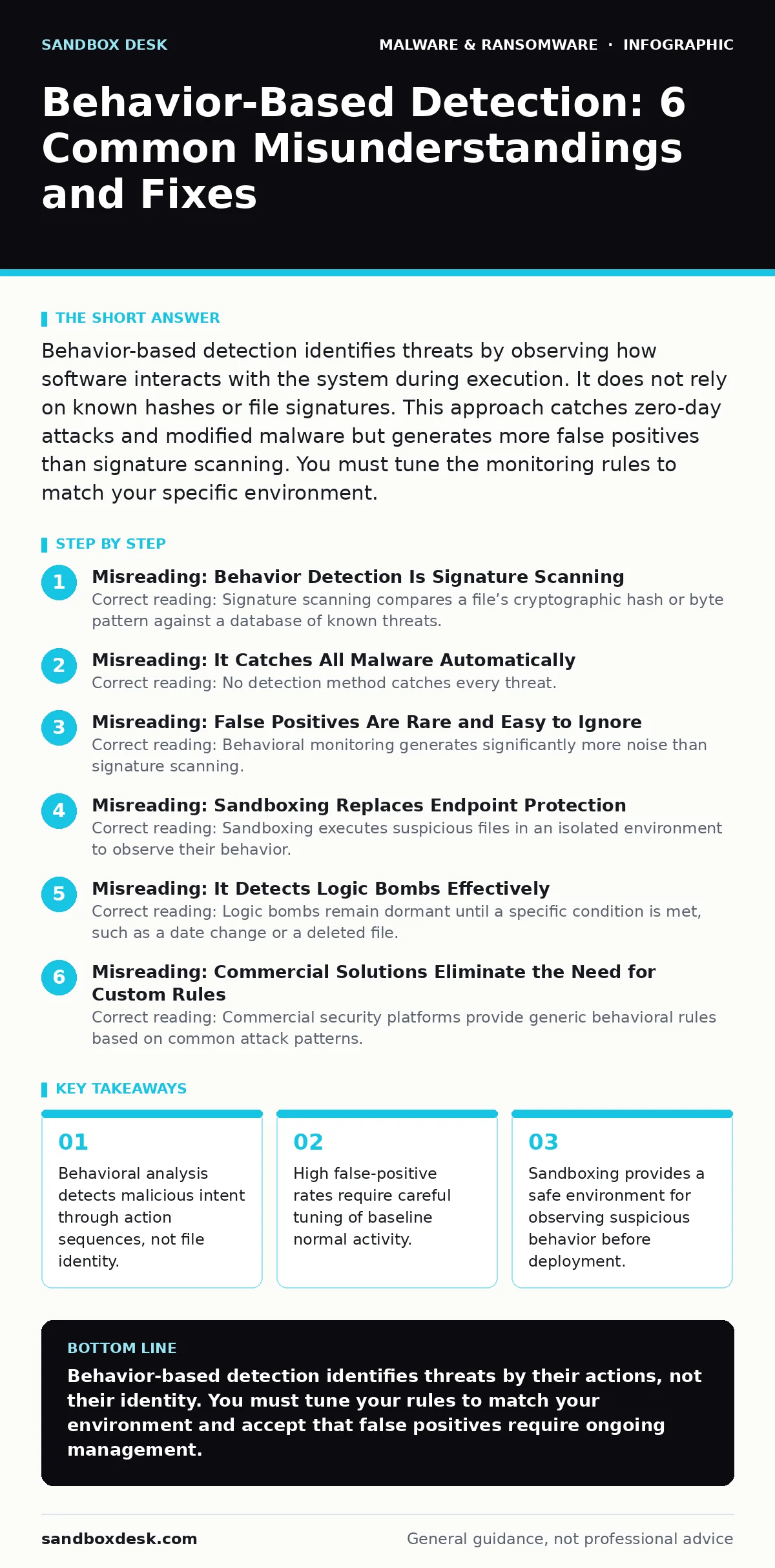
Misreading: It Catches All Malware Automatically
Correct reading: No detection method catches every threat. Behavior-based detection relies on predefined rules or machine learning models that define what constitutes suspicious activity. If a threat actor uses slow-and-low techniques that mimic normal administrative tasks, the system may not flag it. The detection engine must distinguish between a legitimate administrator installing software and a malware dropper and loader spreading payloads. You must define the boundaries of normal behavior explicitly.
Misreading: False Positives Are Rare and Easy to Ignore
Correct reading: Behavioral monitoring generates significantly more noise than signature scanning. Legitimate applications often perform actions that resemble malware, such as injecting code into other processes or modifying system settings. Ignoring alerts creates blind spots. Tuning the system requires analyzing the context of each alert. You must verify whether a process is acting within its expected scope. This tuning is an ongoing operational cost, not a one-time setup task.
Misreading: Sandboxing Replaces Endpoint Protection
Correct reading: Sandboxing executes suspicious files in an isolated environment to observe their behavior. It does not protect the host system from threats that bypass the sandbox. Some malware detects virtualization or sandbox environments and alters its behavior to appear benign. This evasion technique defeats static analysis and basic behavioral monitoring. Endpoint protection must run on the actual host to catch threats that evade the sandbox or originate from memory-only attacks.
Misreading: It Detects Logic Bombs Effectively
Correct reading: Logic bombs remain dormant until a specific condition is met, such as a date change or a deleted file. During the dormant period, they exhibit no malicious behavior. Behavioral detection cannot identify a threat that is not acting. The detection window opens only when the trigger fires. This delay allows the attacker to cause damage before the system responds. You must combine behavioral monitoring with integrity checking to detect unexpected changes to critical files.
See also: How Next-Generation Antivirus Works: The Mechanics of Behavioral Analysis · Antivirus Software: How Detection Engines Actually Work
Misreading: Commercial Solutions Eliminate the Need for Custom Rules
Correct reading: Commercial security platforms provide generic behavioral rules based on common attack patterns. They do not know your specific business logic or application workflows. A custom application might behave like a clipboard hijacker to a generic detector. You must create custom allow-lists for legitimate internal tools. You must also adjust sensitivity thresholds for different user groups. Relying solely on vendor defaults leaves gaps in your defense.
Misreading: It Protects Against SEO Poisoning
Correct reading: SEO poisoning manipulates search results to direct users to malicious sites. This is a social engineering vector, not a local execution threat. Behavior-based detection on the endpoint cannot prevent a user from clicking a link in a search result. The threat occurs before the malware executes. You must address this at the network level with filtering and at the user level with training. Endpoint detection responds only after the malicious content has been downloaded and executed.
Misreading: Memory-Only Threats Are Invisible
Correct reading: Malware that resides only in RAM avoids disk-based signature scanning. However, it must interact with the operating system to function. These interactions create behavioral artifacts. The malware must resolve API calls, allocate memory, and potentially communicate with command-and-control servers. Behavioral detection monitors these runtime activities. It can flag suspicious process creation or unusual memory access patterns even without a file on disk. This makes it effective against fileless attacks.
Misreading: Next-Generation Antivirus Is a Silver Bullet
Correct reading: Next-generation antivirus combines signature scanning with behavioral analysis and cloud intelligence. It is not immune to evasion or false positives. Attackers constantly adapt their techniques to bypass detection. You must maintain a layered defense strategy. This includes regular patching, least privilege access, and network segmentation. No single tool provides complete protection. You must validate your defenses against emerging threats regularly.
Misreading: It Replaces Disaster Recovery Plans
Correct reading: Behavior-based detection aims to stop threats before they cause damage. It does not guarantee success. Threats may slip through undetected for hours or days. You must assume that detection will fail. A disaster recovery plan ensures you can restore systems and data after a breach. Behavioral detection buys time; it does not eliminate the need for backups. You must test your recovery procedures regularly to ensure they work under pressure.
Misreading: Computer Viruses Are the Primary Threat
Correct reading: Traditional computer viruses replicate by attaching to other files. Modern threats often use more sophisticated techniques like fileless malware or supply chain compromises. These threats do not behave like traditional viruses. They may not replicate or modify files in obvious ways. Behavioral detection must be tuned to recognize these new patterns. Focusing only on virus-like behavior leaves you vulnerable to advanced persistent threats.
Key takeaways
- Behavioral analysis detects malicious intent through action sequences, not file identity.
- High false-positive rates require careful tuning of baseline normal activity.
- Sandboxing provides a safe environment for observing suspicious behavior before deployment.
- Memory-only threats bypass disk-based scanning but leave behavioral traces.
Behavior-based detection identifies threats by their actions, not their identity. You must tune your rules to match your environment and accept that false positives require ongoing management.
Frequently asked questions
Does behavior-based detection slow down my system?
It adds some overhead due to continuous monitoring, but modern implementations are optimized to minimize performance impact.
Can I use behavior detection with my existing antivirus?
Yes, most next-generation antivirus solutions include behavioral analysis. You can also layer specialized EDR tools on top of your existing security stack.
How do I reduce false positives?
Analyze alert logs to identify legitimate activities that trigger alerts. Create allow-lists for trusted applications and adjust sensitivity settings for different user groups.
Is behavior detection effective against ransomware?
Yes, it can detect the rapid file encryption and system changes typical of ransomware. However, it must be tuned to distinguish between ransomware and legitimate backup or indexing activities.
How this guide was produced: written by the Sandbox Desk editorial team with AI assistance, checked against the public references listed below, and reviewed when the facts change. See our editorial policy or report an error.