What Does Email Encryption Mean: How It Protects Data in Transit
Encryption transforms readable text into unreadable code, ensuring that only the intended recipient can reverse the process using a unique cryptographic key.
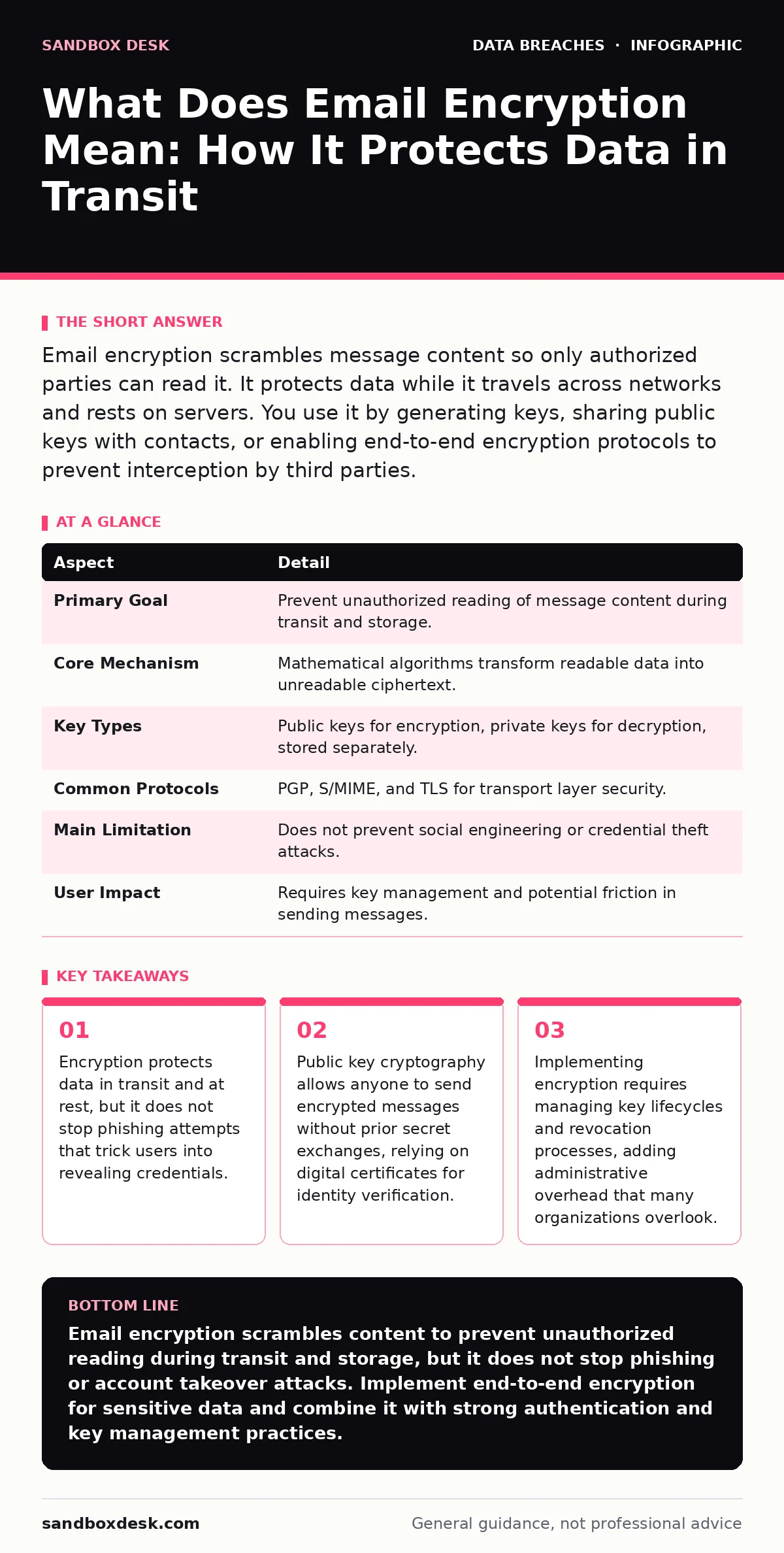
Email encryption scrambles message content so only authorized parties can read it. It protects data while it travels across networks and rests on servers. You use it by generating keys, sharing public keys with contacts, or enabling end-to-end encryption protocols to prevent interception by third parties.
The Postal Service Analogy
Imagine sending a letter containing sensitive financial details. Standard email operates like a postcard. Anyone handling the mail, from the sorting facility to the carrier, can read the contents written on the surface. Email encryption operates like a sealed metal box. You place the letter inside, lock it with a unique mechanism, and send it. The courier sees only the box. Only the recipient possesses the specific key required to open the lid and read the contents inside.
This distinction matters because standard email protocols transmit data in plain text. Plain text is human-readable format that lacks protection. If an attacker intercepts the data packet during transmission, they can read every word, attachment, and metadata field. Encryption converts that plain text into ciphertext. Ciphertext is a scrambled sequence of characters that appears random to anyone without the decryption key.
At a Glance
| Aspect | Detail |
|---|---|
| Primary Goal | Prevent unauthorized reading of message content during transit and storage. |
| Core Mechanism | Mathematical algorithms transform readable data into unreadable ciphertext. |
| Key Types | Public keys for encryption, private keys for decryption, stored separately. |
| Common Protocols | PGP, S/MIME, and TLS for transport layer security. |
| Main Limitation | Does not prevent social engineering or credential theft attacks. |
| User Impact | Requires key management and potential friction in sending messages. |
What Does Email Encryption Mean
What does email encryption mean in practical terms? It means applying cryptographic algorithms to email content before it leaves your device. The system converts your message into a format that is computationally infeasible to decode without the correct cryptographic key. This process happens automatically in many modern enterprise solutions, or manually in open-source tools.
The definition extends beyond just the message body. True encryption covers attachments, headers, and metadata. If only the body is encrypted, an attacker can still see who you are talking to, when you are talking, and the size of the files you are sharing. This metadata leakage can reveal sensitive patterns about your business operations or personal life.
How The Technology Works
Most email encryption relies on asymmetric cryptography. Asymmetric cryptography uses a pair of mathematically linked keys: a public key and a private key. The public key is shared openly. Anyone with this key can encrypt a message intended for you. The private key is kept secret. Only you can use it to decrypt the message.
When you send an encrypted email, your client software retrieves the recipient's public key. It uses this key to scramble the message. The scrambled data travels across the internet. When the recipient receives it, their software uses their private key to unscramble it. If an attacker intercepts the data, they possess the ciphertext but lack the private key. Without that key, the data remains useless noise.
Transport Layer Security (TLS) provides a different layer of protection. TLS encrypts the connection between email servers. It ensures that the data is safe while moving from your server to the recipient's server. However, once the email lands on the recipient's server, TLS encryption ends. The email may sit in plain text on that server. This is why end-to-end encryption, which uses PGP or S/MIME, is preferred for high-sensitivity data.
Who It Affects
Email encryption affects anyone who handles sensitive information. Developers exchanging source code, lawyers sharing case details, and healthcare workers transmitting patient records all face regulatory and ethical obligations to protect data. If you send unencrypted emails containing personal identifiable information, you may violate data subject rights laws. These laws require you to protect the privacy of individuals whose data you process.
Organizations also face risks from shadow IT data exposure. Employees often bypass official channels to send files via personal email accounts. These accounts rarely have enterprise-grade encryption. When data leaves the corporate environment through these unofficial channels, the organization loses visibility and control. Encryption tools must therefore be easy to use to prevent users from seeking easier, less secure alternatives.
See also: Log Retention Strategy: Benefits, Limits, and When to Stop · Prevent Misdirected Emails: 7 Configuration Mistakes To Fix Now
Common Misconceptions
People often believe that encryption makes their email invulnerable. This is incorrect. Encryption protects the content of the message, not the integrity of the sender's identity. An attacker can still spoof your email address. Spoofing involves forging the sender header to make an email appear as if it came from you. The recipient sees your name, but the message content is not encrypted by your private key.
Another misconception is that encryption prevents email account compromise. If an attacker gains access to your password, they can read your encrypted emails as you would. They can also use your account to send new encrypted messages. Encryption does not stop credential theft. You must combine encryption with multi-factor authentication to protect against account takeover.
What To Do About It
Start by assessing your data sensitivity. Not every email needs heavy encryption. Routine internal communications may only require TLS. Sensitive data requires end-to-end encryption. Choose a protocol that fits your workflow. PGP is widely supported and free, but key management can be complex. S/MIME integrates with corporate directories, making it easier for enterprise users but requiring a certificate authority.
Implement key management procedures. Keys expire and must be rotated. If an employee leaves the company, their private key must be revoked immediately. Failure to manage keys creates a long-term liability. Old keys can still decrypt old messages if they are compromised. Establish a clear policy for key generation, storage, and destruction.
Integration With Security Practices
Encryption is one component of a broader security strategy. It does not replace the need for log retention policies. You must still record who accessed what data and when. If a breach occurs, logs help you determine the scope. Encryption ensures that the stolen data is unreadable, but logs help you understand how the attacker got in.
Consider the risk of data exfiltration. Insiders may use encrypted channels to steal data legitimately. Encryption makes it harder to detect malicious transfers because the content is hidden. You must monitor for anomalous behavior, such as large volumes of encrypted emails sent at unusual times. Behavioral analytics can flag these activities even when content inspection is impossible.
Final Considerations
Implementing email encryption requires a balance between security and usability. If the process is too difficult, users will find workarounds. They may send sensitive data through unencrypted channels, creating a false sense of security. Training is necessary to explain why encryption matters and how to use the tools correctly.
Remember that encryption protects the data, not the decision to send it. You must still verify the identity of the recipient. Sending an encrypted message to the wrong person is just as dangerous as sending an unencrypted one. The recipient will receive a scrambled message, but they will know who sent it and that it contained sensitive information.
Key takeaways
- Encryption protects data in transit and at rest, but it does not stop phishing attempts that trick users into revealing credentials.
- Public key cryptography allows anyone to send encrypted messages without prior secret exchanges, relying on digital certificates for identity verification.
- Implementing encryption requires managing key lifecycles and revocation processes, adding administrative overhead that many organizations overlook.
Email encryption scrambles content to prevent unauthorized reading during transit and storage, but it does not stop phishing or account takeover attacks. Implement end-to-end encryption for sensitive data and combine it with strong authentication and key management practices.
Frequently asked questions
Is encrypted email completely private?
No, encryption protects the message content, but metadata like sender, recipient, and timestamp remains visible. Attackers can still analyze communication patterns.
Can I decrypt an email if I lose my private key?
No, without the private key, encrypted data cannot be recovered. This is by design to ensure security, but it means key backup is critical.
Does Gmail or Outlook encrypt emails by default?
Most providers use TLS for transport security, but end-to-end encryption usually requires manual setup or
How this guide was produced: written by the Sandbox Desk editorial team with AI assistance, checked against the public references listed below, and reviewed when the facts change. See our editorial policy or report an error.