Data Subject Rights: The Operational Cost of Privacy Compliance
Data subject rights transform legal obligations into engineering constraints that require deterministic data lineage and automated access controls across distributed systems.

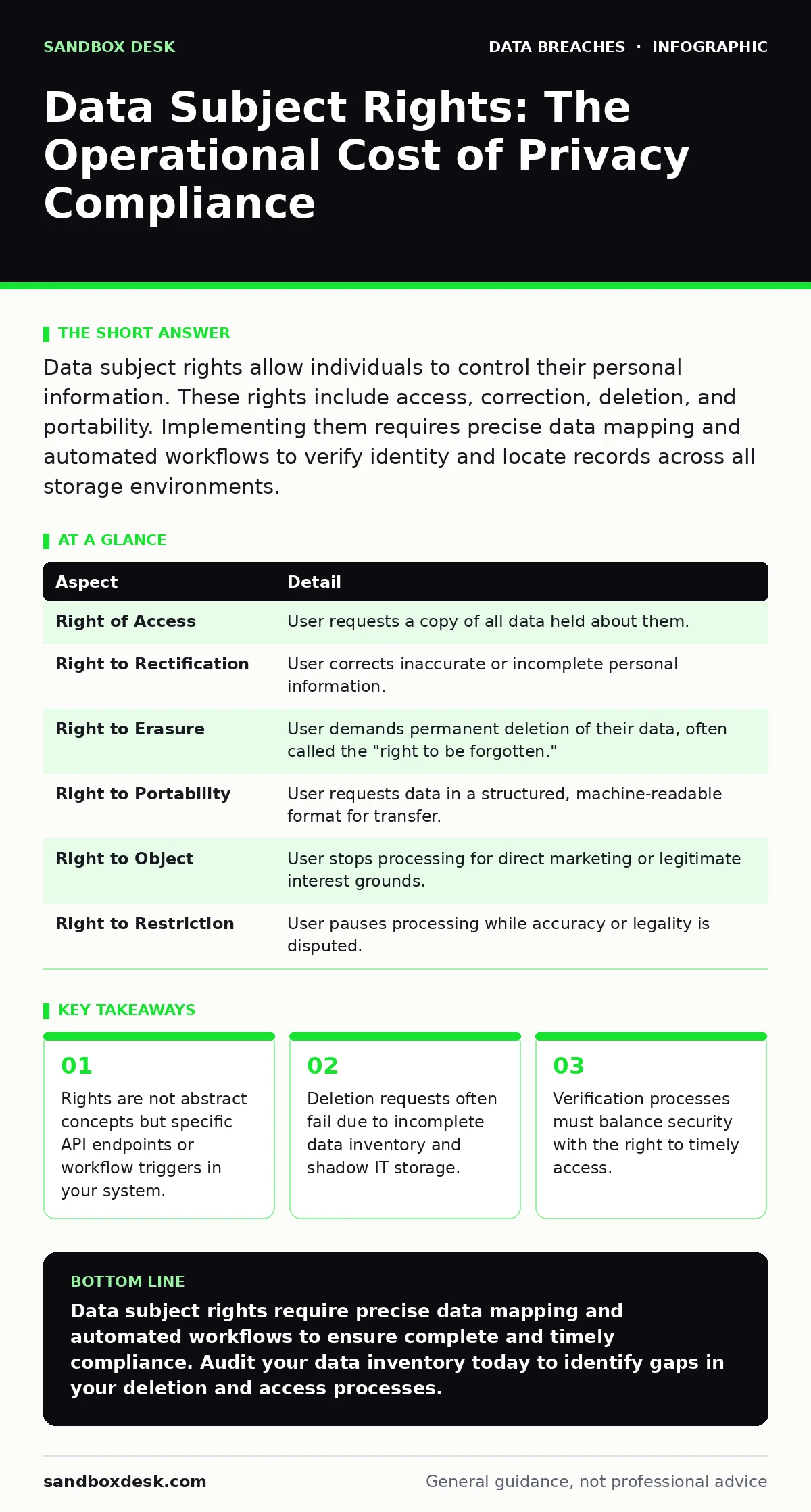
Data subject rights allow individuals to control their personal information. These rights include access, correction, deletion, and portability. Implementing them requires precise data mapping and automated workflows to verify identity and locate records across all storage environments.
The Library Analogy for Personal Data
Imagine a library where every book contains your personal history. You have the right to read any book, correct a typo in the biography, demand the book be burned, or take a copy home. The library staff cannot simply say "we do not know where that book is" or "it is too much work to find it." They must have a catalog that tracks every copy, every draft, and every backup.
In software systems, you are the library. The user is the patron. The books are records in your database. The "catalog" is your data inventory. Without a precise map of where data lives, you cannot fulfill the patron's request. This is not a customer service issue. It is a data architecture problem.
Defining Data Subject Rights
Data subject rights refer to the legal entitlements individuals hold over their personal data. These rights exist in frameworks like the General Data Protection Regulation in Europe and the California Consumer Privacy Act in the US. The core concept is that personal data belongs to the individual, not the organization that collected it.
You do not own the data. You hold it in trust. The rights typically include the right to access, the right to rectification, the right to erasure, the right to restrict processing, and the right to data portability. Each right triggers a specific technical action. Access requires a query. Rectification requires an update. Erasure requires a delete operation that propagates through backups.
Practical Origins and Legal Basis
The term "data subject" comes from privacy law. It designates any living individual who is identifiable, directly or indirectly. The "rights" are the mechanisms by which that individual exercises control. In practice, these rights emerged because centralized data collection outpaced individual consent.
Organizations began aggregating behavior, location, and identity into profiles. The law responded by giving individuals a way to interrupt this aggregation. For developers, this means the system must always know who owns which record. If your database does not link a row to a specific user identity, you cannot fulfill the right. This forces a shift from anonymous analytics to identity-aware storage.
| Aspect | Detail |
|---|---|
| Right of Access | User requests a copy of all data held about them. |
| Right to Rectification | User corrects inaccurate or incomplete personal information. |
| Right to Erasure | User demands permanent deletion of their data, often called the "right to be forgotten." |
| Right to Portability | User requests data in a structured, machine-readable format for transfer. |
| Right to Object | User stops processing for direct marketing or legitimate interest grounds. |
| Right to Restriction | User pauses processing while accuracy or legality is disputed. |
Day-to-Day Implementation Mechanics
Fulfilling these rights is a daily operational task. When a user submits a request, your system must identify the account. This requires robust identity verification. You cannot send a user’s medical records to an email address that might have been compromised in an email account compromise.
Once identity is verified, the system must locate the data. This is where data inventory and mapping becomes critical. You must know which tables, which logs, and which third-party processors hold the data. If you do not have this map, you will miss data. Missed data is a compliance failure.
For deletion, you must distinguish between permanent deletion and anonymization. Some data must be kept for legal reasons, such as tax records. In those cases, you restrict access rather than delete. For portability, you must export the data in a common format like JSON or CSV. This requires your data models to be structured and clean.
Common Misconceptions and Pitfalls
Many teams believe that deleting the user account is enough. This is incorrect. Deletion must be comprehensive. It must include logs, backups, caches, and third-party integrations. If you store data in a message queue, it must be purged. If you send data to a cloud analytics provider, you must instruct them to delete it.
Another mistake is assuming that anonymized data is safe to keep. If the anonymization is reversible, it is not anonymized. It is pseudonymized. Pseudonymized data is still personal data. It is subject to the same rights. You must ensure that re-identification is mathematically impossible before you exempt data from deletion.
Teams also struggle with the right to access. They often provide too much information, including internal notes or security logs. The user is entitled to their data, not your internal metadata. You must filter the response to include only what the user submitted or what was directly derived from their submission.
See also: How to Interpret CISA KEV Due Dates Without Breaking Production · Log Retention Strategy: Benefits, Limits, and When to Stop
The Hidden Costs of Compliance
The biggest cost is not the software. It is the complexity. Every new feature you build must consider data lineage. If you add a new field to the user profile, you must update your deletion scripts. If you move data to a new storage provider, you must update your portability exports.
This creates a technical debt. Systems that were not designed for privacy become brittle. Adding rights support to a legacy monolith is like retrofitting a bridge. It is possible, but it requires careful engineering. You must decouple data storage from business logic to allow for easy extraction and deletion.
Consider the impact on backup data exposure. Backups are often excluded from deletion requests because they are immutable. However, regulations may require you to delete from backups when they are restored. You must have a process to sanitize restored backups. This adds overhead to your disaster recovery plan.
Integration with Security Practices
Privacy and security are linked but distinct. Security protects data from unauthorized access. Privacy ensures authorized access is controlled by the owner. A breach can violate both. If you suffer healthcare data breaches, you face regulatory fines for both security failures and privacy violations.
You must also consider doxxing. If an attacker uses your access request process to harvest data about other users, you have a vulnerability. Your verification process must be strong. It must not leak information about whether a user exists in your system.
Finally, consider combo lists. If you sell or share data, you must ensure those partners honor deletion requests. If they do not, you remain liable. You must contractually require them to delete data when the user requests it. This extends your compliance burden to your supply chain.
Building a Resilient System
To handle these rights effectively, you must build automation. Manual requests do not scale. You need a workflow engine that triggers deletion scripts, updates indexes, and notifies partners. You need a data map that is always up to date.
Start by auditing your data flows. Identify every place personal data touches. Build APIs that support access, correction, and deletion. Test these endpoints regularly. Ensure they work across all environments, including staging and production.
Remember that identity theft protection is a user expectation, not just a marketing feature. When users trust you with their data, they expect you to protect it and respect their control over it. Building this trust requires engineering discipline. It requires treating privacy as a system requirement, not a legal afterthought.
Consider tax identity theft as a scenario where data retention conflicts with deletion. You must keep financial records for years. Your system must handle this exception gracefully. It must delete the user’s profile but retain the transaction logs in a restricted, access-controlled manner.
Key takeaways
- Rights are not abstract concepts but specific API endpoints or workflow triggers in your system.
- Deletion requests often fail due to incomplete data inventory and shadow IT storage.
- Verification processes must balance security with the right to timely access.
Data subject rights require precise data mapping and automated workflows to ensure complete and timely compliance. Audit your data inventory today to identify gaps in your deletion and access processes.
Frequently asked questions
How do I verify a user's identity for a data request?
Use the same authentication method you use for login, such as multi-factor authentication. If the user is not logged in, require additional verification steps like a code sent to their registered email or phone.
Do I have to delete data from backups?
You must delete data from active systems. For backups, you must ensure that when the backup is restored, the data is not reintroduced. You may need to sanitize backups or retain them securely until they expire.
What format should I use for data portability?
Use a structured, machine-readable format like JSON or CSV. The format should be common and supported by standard software. Avoid proprietary formats that the user cannot easily read or transfer.
How long do I have to respond to a request?
Most regulations require a response within one month. Complex requests may allow for an extension. You should aim to respond as quickly as possible to build trust and reduce liability.
How this guide was produced: written by the Sandbox Desk editorial team with AI assistance, checked against the public references listed below, and reviewed when the facts change. See our editorial policy or report an error.