Data Inventory and Mapping: What It Is and Why You Need It
Most organizations lose control of sensitive assets because they cannot distinguish between critical data and routine logs until a breach occurs.

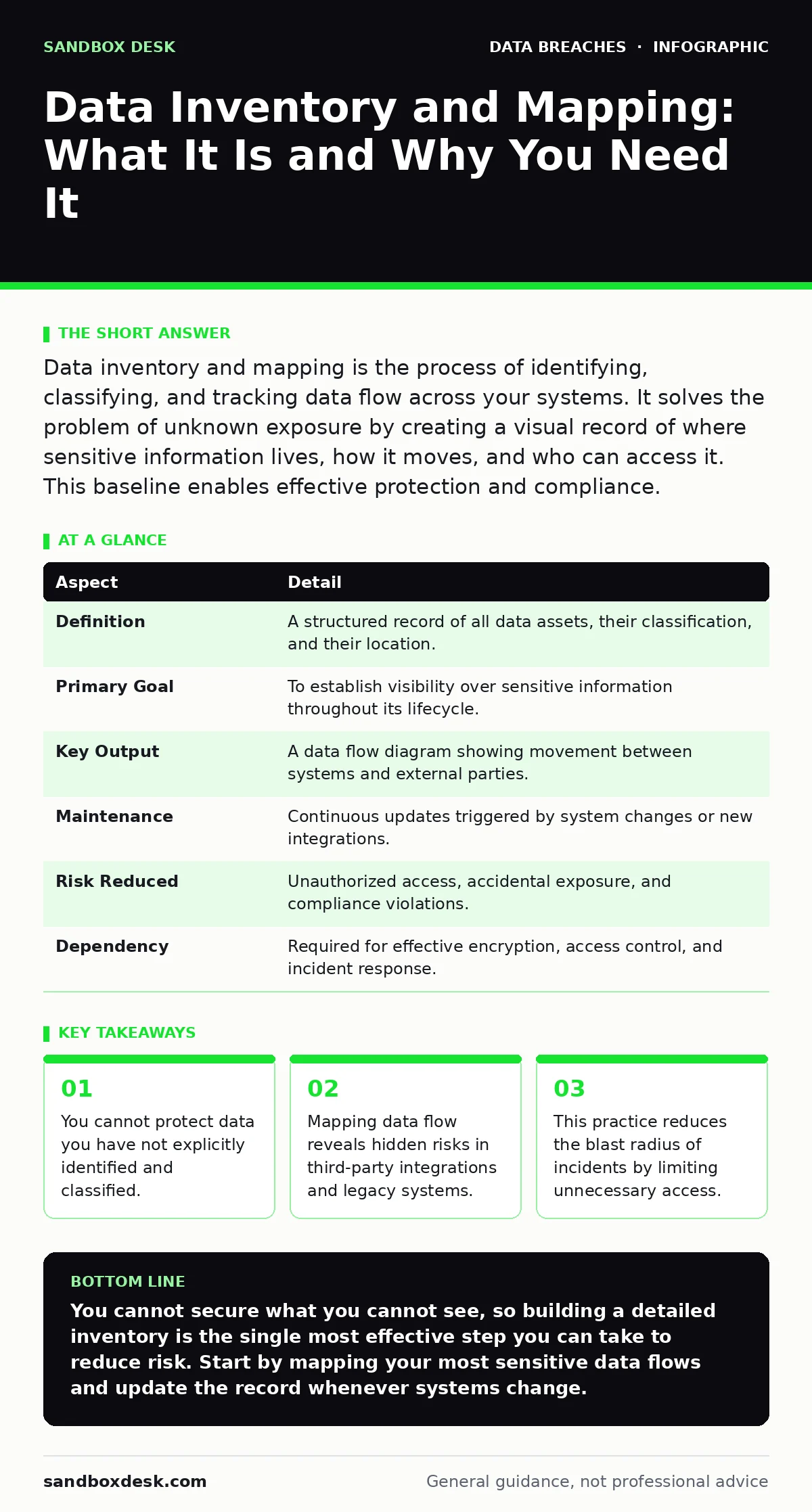
Data inventory and mapping is the process of identifying, classifying, and tracking data flow across your systems. It solves the problem of unknown exposure by creating a visual record of where sensitive information lives, how it moves, and who can access it. This baseline enables effective protection and compliance.
The Library Without a Catalog
Imagine a library where every book is dumped into a single, massive room. There are no shelves, no labels, and no librarian. If a fire starts, you cannot save the rare manuscripts because you do not know where they are. You also cannot tell if a visitor is stealing a first edition or borrowing a paperback. This is the state of most digital environments without a data inventory.
You likely assume you know what data your systems hold. You probably have a list of databases and a few file servers. But modern applications generate logs, temporary files, and cached copies that live in unexpected places. Without a systematic record, you are defending a perimeter rather than protecting specific assets.
| Aspect | Detail |
|---|---|
| Definition | A structured record of all data assets, their classification, and their location. |
| Primary Goal | To establish visibility over sensitive information throughout its lifecycle. |
| Key Output | A data flow diagram showing movement between systems and external parties. |
| Maintenance | Continuous updates triggered by system changes or new integrations. |
| Risk Reduced | Unauthorized access, accidental exposure, and compliance violations. |
| Dependency | Required for effective encryption, access control, and incident response. |
Why Visibility Is the First Line of Defense
The core problem data inventory solves is ignorance. You cannot enforce access controls if you do not know which files contain sensitive information. You cannot detect anomalies if you do not know the normal flow of data. When a breach occurs, responders waste time guessing where the attacker went. With a clear map, they know exactly which assets were at risk.
This visibility also addresses the issue of shadow IT data exposure. Employees often use unauthorized tools to share files, creating copies of data that IT does not monitor. An inventory process forces you to account for these off-road assets. It turns hidden liabilities into known quantities that can be secured or removed.
The Three Layers of Data Classification
A data inventory is not just a list of files. It requires classification. You must assign a sensitivity level to each data type. Common levels include public, internal, confidential, and restricted. Public data can be shared freely. Restricted data requires strict access controls and encryption.
Classification drives your security posture. Not all data needs the same level of protection. Encrypting every log file is expensive and slows down systems. By classifying data, you apply strong controls only where they matter. This efficiency reduces performance overhead while maintaining security for critical assets.
Mapping the Flow of Information
Knowing where data sits is only half the battle. You must also map how it moves. Data flows through APIs, message queues, and manual transfers. Each hop introduces a potential point of failure. A mapping exercise traces data from creation to deletion.
This mapping reveals dependencies you may have missed. Suppose a marketing application sends customer emails to a third-party analytics service. If that service is compromised, your data is exposed. The map shows this connection. It highlights where you need to enforce encryption in transit and where you need to verify the vendor’s security practices.
Where Inventory Fits in Your Defense Stack
Data inventory is not a standalone solution. It is the foundation for other controls. Without it, your firewall rules are blind. Your intrusion detection system generates noise because it cannot distinguish between normal data access and malicious activity. Your backup data exposure risk is high because you do not know what is being backed up.
Think of inventory as the blueprint. Encryption is the lock on the door. Access control is the key. Incident response is the fire extinguisher. None of these work effectively without the blueprint. When you integrate inventory with your security tools, you gain context. Alerts become actionable. Policies become enforceable.
See also: Data Scraping Meaning: How Automated Extraction Works and What It Costs · Log Retention Strategy: Benefits, Limits, and When to Stop
Common Mistakes in Data Tracking
Many organizations start an inventory and then abandon it. They treat it as a one-time project. Data changes constantly. New applications are deployed. Old systems are decommissioned. An outdated inventory is worse than no inventory because it gives a false sense of security.
Another common error is focusing only on structured data. You might catalog your SQL databases but ignore unstructured files in cloud storage buckets. Attackers often target these overlooked areas. Your inventory must include logs, documents, and media files. It must also account for data held by partners and vendors.
The Hidden Cost of Inaction
The cost of building an inventory is labor and time. The cost of not having one is catastrophic. When you face identity theft protection claims or doxxing incidents, the root cause is often poor data governance. You cannot defend against email account compromise if you do not know which accounts hold sensitive data.
Consider the scenario of healthcare data breaches. Hospitals often lose track of patient records stored in various departments. When a breach occurs, the scope is unclear. This uncertainty leads to massive fines and loss of trust. An accurate inventory limits the scope. It tells you exactly who was affected. This precision saves time and money during incident response.
Integrating with Compliance Frameworks
Regulators require you to know what data you hold. Whether you are dealing with tax identity theft risks or general privacy laws, the requirement is the same. You must demonstrate control over personal information. An audit without an inventory is a failed audit.
The inventory provides the evidence. It shows that you have identified sensitive data. It proves that you have applied appropriate controls. It documents the flow of data to third parties. This documentation is your best defense in legal proceedings. It shows due diligence. It proves you did not ignore the risk.
Maintaining the Living Record
A data inventory is a living document. It requires regular updates. You should integrate inventory checks into your change management process. Every new application deployment must include a data assessment. Every new vendor contract must include a data flow review.
Automation helps, but it is not a replacement for governance. You need a team responsible for maintaining the map. They should review changes quarterly. They should verify that classifications are still accurate. They should ensure that decommissioned data is truly deleted. This discipline keeps your defense stack aligned with your actual environment.
Key takeaways
- You cannot protect data you have not explicitly identified and classified.
- Mapping data flow reveals hidden risks in third-party integrations and legacy systems.
- This practice reduces the blast radius of incidents by limiting unnecessary access.
- It serves as the foundation for all other security controls and compliance efforts.
You cannot secure what you cannot see, so building a detailed inventory is the single most effective step you can take to reduce risk. Start by mapping your most sensitive data flows and update the record whenever systems change.
Frequently asked questions
How often should I update my data inventory?
Update it whenever systems change, such as new deployments or vendor additions, and perform a full review at least quarterly to ensure accuracy.
Do I need to map every single file?
Focus on sensitive and regulated data first. Mapping every log file is inefficient. Prioritize data that poses a high risk if exposed.
What is the difference between inventory and mapping?
Inventory identifies what data exists and where it is stored. Mapping shows how that data moves between systems and external parties over time.
Can automated tools replace manual review?
Tools can scan for data types, but they often lack context. Manual review is necessary to correctly classify data and validate the accuracy of automated findings.
How this guide was produced: written by the Sandbox Desk editorial team with AI assistance, checked against the public references listed below, and reviewed when the facts change. See our editorial policy or report an error.