Fine-Tuning LLMs: Answers to Eight Technical Questions
Fine-tuning adjusts model weights for specific tasks but rarely improves general reasoning, creating a hidden cost in maintenance and evaluation overhead that many teams overlook.

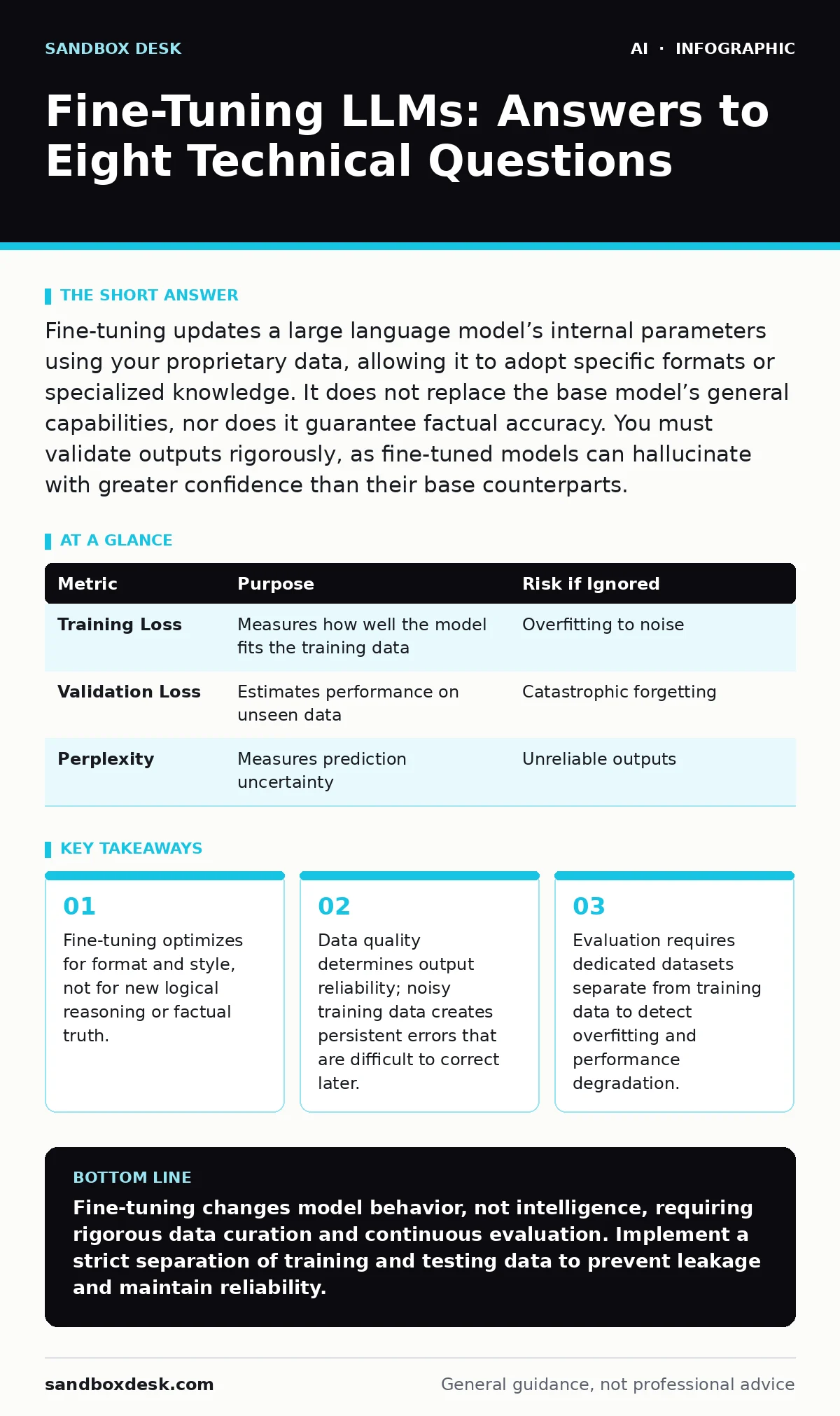
Fine-tuning updates a large language model’s internal parameters using your proprietary data, allowing it to adopt specific formats or specialized knowledge. It does not replace the base model’s general capabilities, nor does it guarantee factual accuracy. You must validate outputs rigorously, as fine-tuned models can hallucinate with greater confidence than their base counterparts.
Does fine-tuning make the model smarter?
No, fine-tuning adjusts the model’s statistical associations to match your specific data distribution, but it does not increase its general intelligence or reasoning capacity. The model learns to mimic the patterns, tone, and structure present in your training examples. If your data contains logical errors, the model will learn to reproduce those errors efficiently. You are teaching it how to behave, not how to think better.
What is the difference between fine-tuning and RAG?
Retrieval-Augmented Generation (RAG) attaches external documents to the model at inference time, while fine-tuning bakes information directly into the model’s weights. RAG allows you to update facts without retraining, making it ideal for dynamic knowledge bases. Fine-tuning is better for changing the model’s behavior, such as adopting a specific coding style or output format. Using both simultaneously combines up-to-date facts with specialized behavioral consistency.
How much data do I need to fine-tune?
There is no fixed minimum, but too little data causes the model to memorize examples rather than learn generalizable patterns. A small dataset of high-quality, diverse examples often outperforms a large dataset with noisy or redundant entries. You must balance quantity with variety to ensure the model adapts to the task without losing its general capabilities. Start with a few hundred carefully curated examples before scaling up.
Will fine-tuning cause catastrophic forgetting?
Catastrophic forgetting occurs when a model loses its general abilities after learning a narrow task, making it less useful for broader queries. This happens because the weight updates for the new task overwrite the pathways used for general reasoning. Regularization techniques and retaining a portion of general data during training can mitigate this effect. You must monitor performance on general benchmarks to detect this drift early.
How do I prevent data leakage during training?
Data leakage happens when information from your test set accidentally enters the training process, giving you a false sense of model accuracy. You must strictly separate your data into training, validation, and test sets before any processing begins. The model should never see the test data during any phase of weight adjustment. Use cryptographic hashing to verify that no records overlap between sets.
| Metric | Purpose | Risk if Ignored |
|---|---|---|
| Training Loss | Measures how well the model fits the training data | Overfitting to noise |
| Validation Loss | Estimates performance on unseen data | Catastrophic forgetting |
| Perplexity | Measures prediction uncertainty | Unreliable outputs |
See also: How Large Language Models Work: Mechanics, Limits, and Reality · How Machine Learning Changes Cybersecurity Decision Making
Can fine-tuning fix hallucinations?
Fine-tuning cannot eliminate hallucinations, which are inherent to the generative nature of large language models. It can reduce hallucinations in specific domains by providing the model with correct examples to mimic. However, the model may still invent plausible-sounding but incorrect information when faced with novel inputs. You must implement post-processing checks or use RAG to verify factual claims.
What are the security risks of fine-tuning?
Fine-tuning can introduce vulnerabilities if the training data contains malicious payloads or if the model is susceptible to prompt injection. An attacker might craft inputs that exploit the fine-tuned patterns to bypass safety filters. You must sanitize all training data and test the model against adversarial prompts. Review the OWASP Top 10 for LLM applications to understand common attack vectors specific to your architecture.
How do I maintain a fine-tuned model over time?
Models degrade as the underlying data distribution shifts, a phenomenon known as data drift. You must establish a continuous feedback loop to collect new examples and retrain the model periodically. Monitor output quality and flag anomalies for human review. Refer to guidelines on AI model monitoring to set up automated alerts for performance drops.
Is fine-tuning compliant with the EU AI Act?
The EU AI Act imposes strict requirements on high-risk AI systems, including transparency and data governance. Fine-tuning does not automatically make a system compliant, but it creates a clear lineage between your data and the model’s behavior. You must document your training data sources, preprocessing steps, and evaluation results. Align your practices with established AI risk management frameworks to demonstrate due diligence.
Key takeaways
- Fine-tuning optimizes for format and style, not for new logical reasoning or factual truth.
- Data quality determines output reliability; noisy training data creates persistent errors that are difficult to correct later.
- Evaluation requires dedicated datasets separate from training data to detect overfitting and performance degradation.
Fine-tuning changes model behavior, not intelligence, requiring rigorous data curation and continuous evaluation. Implement a strict separation of training and testing data to prevent leakage and maintain reliability.
Frequently asked questions
Can I fine-tune a model on my private company data?
Yes, but you must ensure the data is clean, representative, and free of sensitive personal information that violates privacy laws.
How do I know if my model is overfitting?
Check if the training loss decreases while the validation loss increases, indicating the model is memorizing noise instead of learning patterns.
Should I use supervised fine-tuning or reinforcement learning?
Start with supervised fine-tuning for format and style control, then consider reinforcement learning if you need to optimize for complex reward signals.
Does fine-tuning require expensive hardware?
It depends on the model size and dataset, but cloud-based services often provide accessible options for smaller models or parameter-efficient tuning methods.
How this guide was produced: written by the Sandbox Desk editorial team with AI assistance, checked against the public references listed below, and reviewed when the facts change. See our editorial policy or report an error.