EU AI Act Explained: Risk Levels and Compliance Basics
The law ties legal liability to the technical architecture of your system, meaning you can face penalties for data errors in models you did not train yourself.

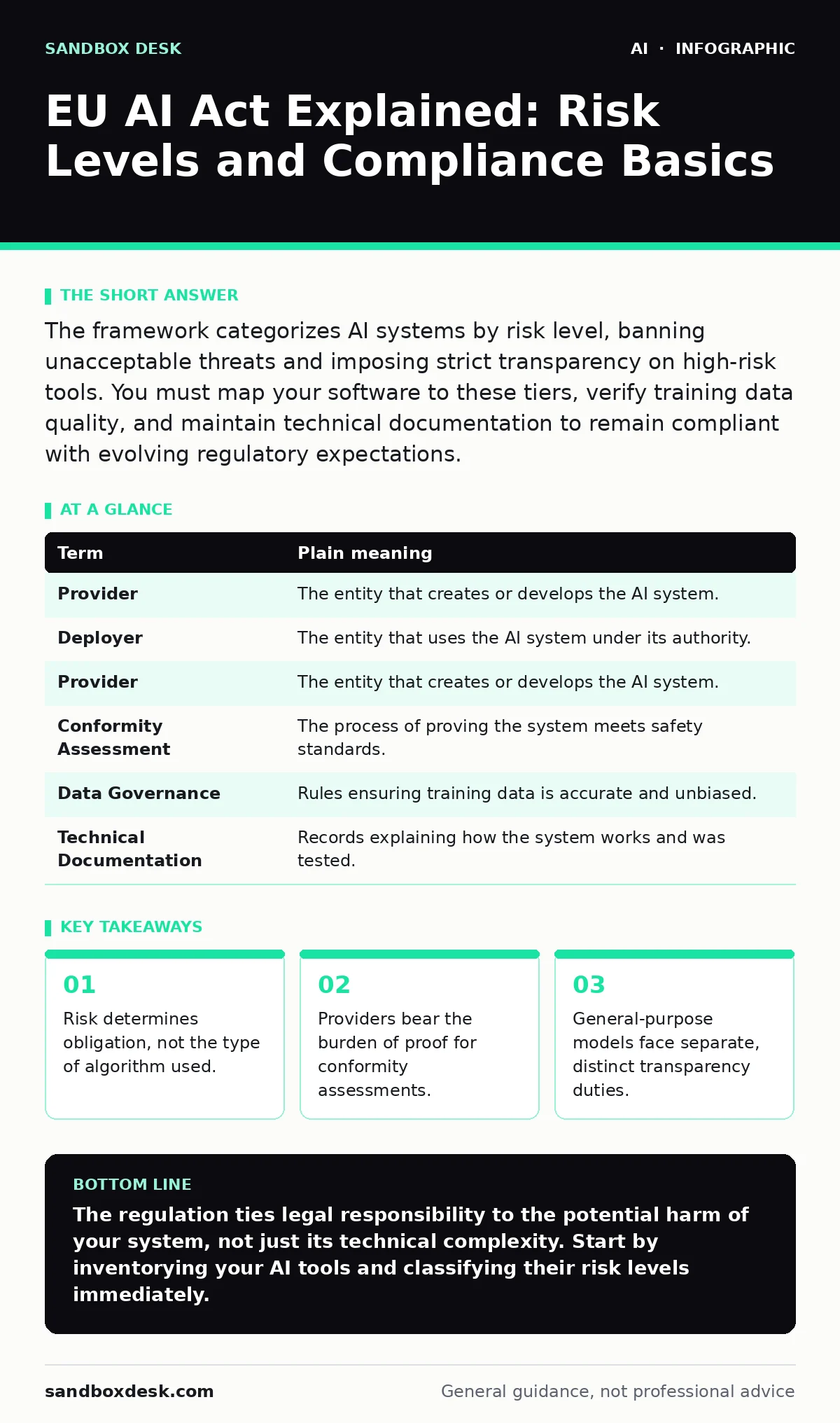
The framework categorizes AI systems by risk level, banning unacceptable threats and imposing strict transparency on high-risk tools. You must map your software to these tiers, verify training data quality, and maintain technical documentation to remain compliant with evolving regulatory expectations.
The Kitchen Safety Analogy
Imagine you are running a commercial kitchen. Some activities are so dangerous they are outright banned. You cannot serve food that contains known poisons. This is the baseline rule. Other tasks are standard. Making a sandwich carries low risk, so you just follow basic hygiene. You do not need a government inspector to watch you chop lettuce.
The EU AI Act works similarly. It does not ban AI. It bans specific, harmful uses. For most tools, it demands that you prove they are safe before you sell them. The level of proof required depends on how much harm the tool could cause if it fails. This structure shifts the focus from the technology itself to the potential impact of its failure.
Defining the Risk Tiers
The regulation sorts AI systems into four categories. Understanding this hierarchy is the first step toward compliance. You cannot know what to fix if you do not know what you are building.
Unacceptable risk systems are prohibited. These include social scoring by governments and real-time remote biometric identification in public spaces by law enforcement, with narrow exceptions. If your product fits here, you must stop development.
High-risk systems face heavy scrutiny. These are tools used in critical infrastructure, education, employment, or law enforcement. You must conduct conformity assessments, ensure data governance, and maintain technical documentation. Think of this as needing a health inspector’s seal before opening your restaurant.
Limited risk systems require transparency. Chatbots and deepfakes must disclose that they are AI-generated. This allows users to make informed choices. You must label your output clearly so people are not deceived about the nature of the interaction.
Minimal risk systems are free to operate. Most consumer apps fall here. You face no specific legal duties under this framework, but you should still follow voluntary codes of conduct.
Key Terms You Must Know
The language in the text can be dense. These definitions clarify the boundaries of your responsibility.
| Term | Plain meaning |
|---|---|
| Provider | The entity that creates or develops the AI system. |
| Deployer | The entity that uses the AI system under its authority. |
| Provider | The entity that creates or develops the AI system. |
| Conformity Assessment | The process of proving the system meets safety standards. |
| Data Governance | Rules ensuring training data is accurate and unbiased. |
| Technical Documentation | Records explaining how the system works and was tested. |
Common Points of Confusion
Many teams struggle with the distinction between the model and the application. The law treats them differently. A general-purpose model is the engine. The application is the car. You might buy an engine that is fine on its own, but if you put it in a race car, the safety rules change.
Another confusion involves open-source models. The framework applies to providers, regardless of whether they charge money. However, the rules for general-purpose models are nuanced. If you release a model with high capabilities, you must provide documentation on its training data. This prevents training data leakage of copyrighted or private information. You must ensure your dataset is clean.
The Supply Chain Reality
You often build on top of others' work. This creates AI supply chain risks. If you integrate a third-party model into your product, you become the provider of the final system. You are responsible for the whole. You cannot blame the original creator if the combined system fails safety checks.
This is similar to jailbreaking AI chatbots. If users can bypass safety filters, the system is not compliant. You must ensure that your deployment environment maintains the intended safety boundaries. This requires robust testing and monitoring, similar to AI model monitoring practices. You must detect drift and degradation in performance.
See also: Fine-Tuning LLMs: Answers to Eight Technical Questions · Difference Between Fine Tuning and Transfer Learning for Models
Try This Now
You do not need to rewrite your code today. But you should start mapping your assets.
- Inventory your AI usage. List every system that uses machine learning. Identify which one makes the final decision.
- Classify the risk. For each item, ask: Can this harm physical health, safety, or fundamental rights? If yes, it is likely high-risk.
- Audit your data sources. Review how your training data was collected. Ensure you have the right to use it and that it is free from obvious bias.
The Path Forward
Compliance is not a one-time check. It is a continuous process. As you update your models, you must re-evaluate their risk. This is where explainable AI becomes relevant. Regulators may ask how a decision was made. If your model is a black box, you cannot answer.
Consider machine learning for fraud detection or machine learning in cybersecurity. These are often high-risk areas. You must ensure your systems are reliable and do not discriminate. The law pushes you toward greater transparency and accountability.
The goal is not to stifle innovation. It is to build trust. By following these steps, you create systems that are not only legal but also safer for your users. This protects your business from liability and reputational damage.
Key takeaways
- Risk determines obligation, not the type of algorithm used.
- Providers bear the burden of proof for conformity assessments.
- General-purpose models face separate, distinct transparency duties.
The regulation ties legal responsibility to the potential harm of your system, not just its technical complexity. Start by inventorying your AI tools and classifying their risk levels immediately.
Frequently asked questions
Does this law apply to my startup?
Yes, if you place an AI system on the market or put it into service in the EU. Size does not exempt you.
What if I only use AI internally?
You are still a deployer. High-risk internal systems must meet safety and transparency requirements.
Can I use open-source models?
Yes, but you must assess the risk of the final application. You are responsible for the output.
When does this go into effect?
Prohibitions are already active. Other rules phase in over time. Check the latest official updates.
How this guide was produced: written by the Sandbox Desk editorial team with AI assistance, checked against the public references listed below, and reviewed when the facts change. See our editorial policy or report an error.