What Makes Generative AI Unique: The Architecture of Synthetic Output
Generative AI constructs novel artifacts from probabilistic patterns rather than retrieving stored data, creating a distinct risk surface for data leakage.

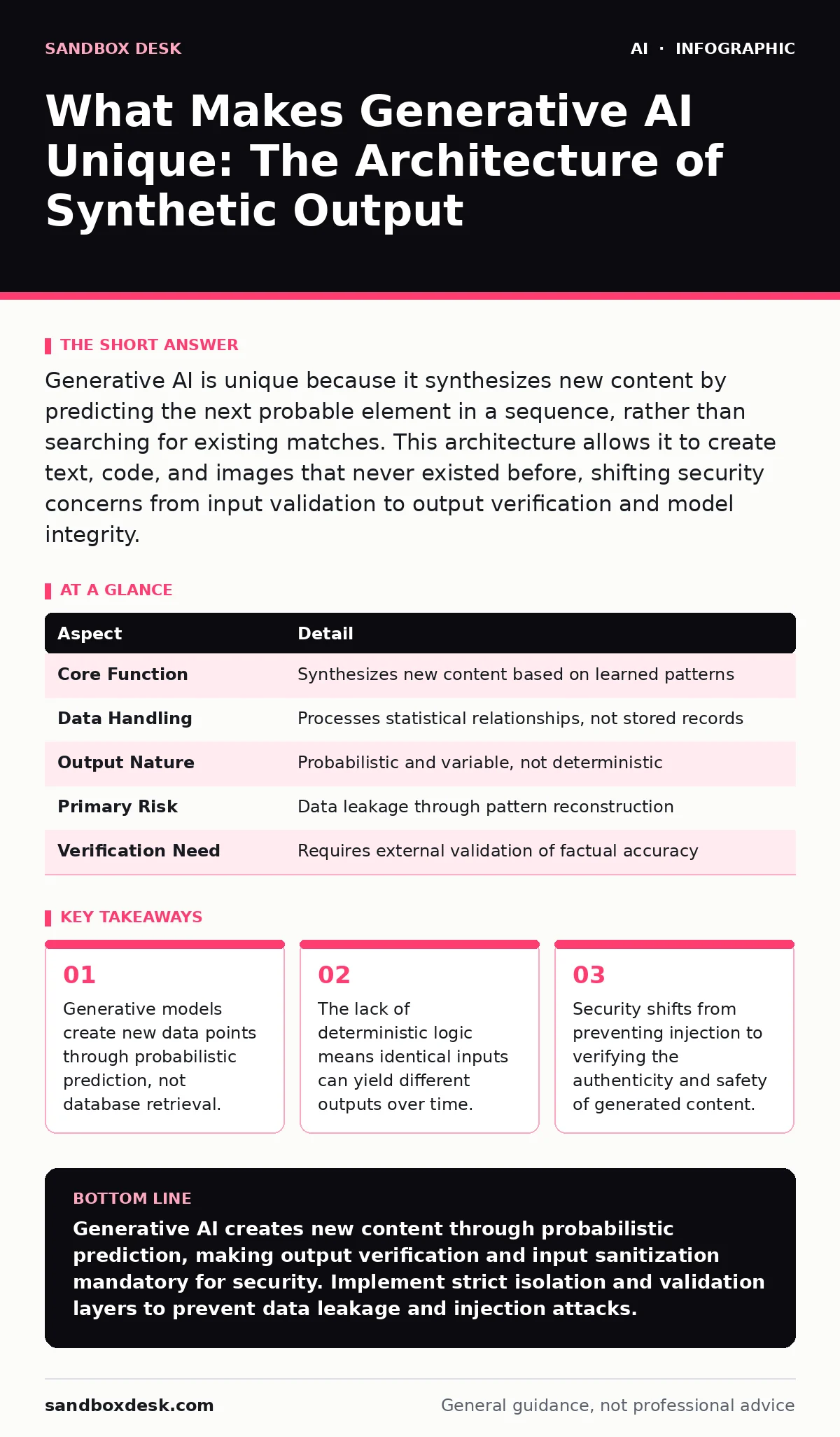
Generative AI is unique because it synthesizes new content by predicting the next probable element in a sequence, rather than searching for existing matches. This architecture allows it to create text, code, and images that never existed before, shifting security concerns from input validation to output verification and model integrity.
The Mechanism Behind Synthetic Creation
Imagine a librarian who has read every book in history but cannot remember exact quotes. When asked for a recipe, the librarian constructs one by predicting which ingredient words usually follow others. This prediction engine is the core of generative AI. Unlike traditional software that executes deterministic instructions, generative AI operates on probability distributions learned from vast datasets. It does not store facts; it stores statistical relationships between tokens, which are small units of text or data.
The uniqueness of this technology lies in its ability to generalize. Traditional search engines return links to existing documents. Generative AI constructs a new document that satisfies the structural and semantic constraints of the request. This distinction matters for security because the output is not a mirror of the training data. It is a reconstruction. This reconstruction process introduces variability. Two identical prompts may yield different responses because the model samples from a probability curve rather than retrieving a fixed answer.
| Aspect | Detail |
|---|---|
| Core Function | Synthesizes new content based on learned patterns |
| Data Handling | Processes statistical relationships, not stored records |
| Output Nature | Probabilistic and variable, not deterministic |
| Primary Risk | Data leakage through pattern reconstruction |
| Verification Need | Requires external validation of factual accuracy |
This probabilistic nature creates a hidden cost for developers. You cannot rely on consistent behavior for compliance checks. If a model refuses to answer a sensitive question today, it might answer it tomorrow if the internal sampling state changes. This non-determinism complicates audit trails. You must treat the model as a black box that can change its mind, rather than a function that returns a constant value for a given input.
How Generative AI Differs From Traditional Logic
Traditional software follows explicit rules. If input A occurs, output B happens. Generative AI follows implicit patterns. It learns that certain concepts co-occur in its training data and uses those associations to generate plausible continuations. This difference creates a fundamental shift in how you approach system design. You are no longer controlling the logic flow; you are guiding a statistical engine.
The model does not "know" truth. It knows likelihood. When you ask for a legal contract, the model generates text that looks like a contract because it has seen millions of contracts. It does not understand legal liability. This gap between appearance and understanding is where most failures occur. The system produces high-fidelity outputs that lack semantic grounding. This is why AI hallucinations remain a persistent threat. The model fills gaps in its knowledge with plausible-sounding fiction because its goal is coherence, not accuracy.
Suppose a developer uses a generative model to write database queries. The model produces syntactically correct SQL code. However, the logic contains a subtle flaw that deletes records instead of updating them. The model did not "lie." It predicted a plausible sequence of characters based on training data that included similar patterns. The developer assumed the output was safe because it looked correct. This assumption fails because the model has no concept of safety, only pattern matching.
Who Is Affected By This Shift
Every organization that processes unstructured data is affected. Generative AI touches content creation, customer support, code development, and data analysis. The impact is not limited to large enterprises. Small teams use these tools to accelerate workflows, which increases the attack surface. The risk is no longer confined to the IT department. It extends to legal, human resources, and executive functions.
Developers face a specific challenge. They must integrate unpredictable components into deterministic systems. This integration requires new validation layers. You cannot assume the AI output is clean. You must treat it as untrusted input, similar to data from a user. This mindset shift is difficult because the output often appears authoritative and professional. The illusion of competence masks the underlying fragility.
Security teams must adapt their monitoring strategies. Traditional perimeter defenses do not stop data exfiltration via prompt injection. An attacker can trick the model into revealing training data or internal prompts. This vector bypasses traditional access controls because the model processes the request as legitimate context. The threat moves from breaking into the system to manipulating the system’s behavior from within.
What People Usually Get Wrong
Most people assume that generative AI is a search engine with a better interface. This misunderstanding leads to inadequate controls. They believe the model retrieves information, so they apply traditional data access policies. In reality, the model reconstructs information. This reconstruction can leak sensitive data that was never explicitly stored in a queryable format. The model memorizes patterns from its training data, including proprietary code or private information, and can reproduce them when prompted correctly.
Another common error is assuming that privacy guarantees in training data apply to inference. Even if training data is anonymized, the model can re-identify individuals by combining disparate facts. This is known as membership inference. An attacker can determine whether a specific record was part of the training set by analyzing the model’s confidence scores. This risk persists even when the raw data is deleted, because the weights of the model retain the statistical imprint of the data.
Addressing The Security Surface
You must implement AI risk management practices that account for probabilistic outputs. Start by isolating the generative component. Do not allow the model direct access to sensitive databases. Use an intermediary layer that validates both the input prompt and the output response. This layer should check for injection attempts and verify that the output does not contain restricted information.
Input validation is critical. You must sanitize prompts to prevent prompt injection attacks. These attacks occur when an attacker embeds instructions in the input data that override the system’s original instructions. For example, a user might paste a text file containing a command to ignore previous rules. The model executes this command because it treats all text as context. You must treat all user input as potentially malicious code.
Output verification is equally important. You cannot trust the model to be honest. Implement automated checks that compare the output against known facts or policy constraints. For code generation, run static analysis tools to detect vulnerabilities. For text generation, use classification models to detect hallucinations or biased content. This adds latency and cost, but it is necessary for trust.
See also: Malware Targeting AI Infrastructure: Threats and Defense · Treat AI Models as Untrusted Insiders: 8 Security Practices
Practical Steps For Implementation
- Define clear boundaries for what the model can and cannot access. Use API keys and network segmentation to limit exposure.
- Implement rigorous logging. Record every prompt and response. This audit trail is essential for investigating incidents and improving model behavior.
- Train staff on the limitations of the technology. Users must understand that the model can fabricate information and that their judgment is the final control.
- Integrate AI model monitoring tools to detect drift and anomalies. The model’s behavior can change over time as it is used more frequently or as new data is introduced.
- Review the OWASP Top 10 for LLM applications to identify common vulnerabilities specific to large language models. This framework provides a structured approach to securing AI applications.
The Long-Term Implications
Generative AI changes the nature of trust in digital systems. You can no longer assume that text or code is human-created. This ambiguity requires new verification mechanisms. Digital signatures and provenance tracking will become standard for content authentication. The cost of verification will increase as attackers develop more sophisticated methods to mimic legitimate outputs.
The technology will continue to evolve, making detection harder. Models will become more efficient at generating realistic content. This arms race requires continuous adaptation. You must stay informed about emerging threats, such as jailbreaking AI chatbots, which allow users to bypass safety filters. Understanding these tactics helps you design more resilient systems.
The unique aspect of generative AI is its ability to create novelty from noise. This capability is both its power and its vulnerability. You must build systems that embrace the creativity while constraining the chaos. The goal is not to eliminate risk but to manage it within acceptable boundaries.
Key takeaways
- Generative models create new data points through probabilistic prediction, not database retrieval.
- The lack of deterministic logic means identical inputs can yield different outputs over time.
- Security shifts from preventing injection to verifying the authenticity and safety of generated content.
Generative AI creates new content through probabilistic prediction, making output verification and input sanitization mandatory for security. Implement strict isolation and validation layers to prevent data leakage and injection attacks.
Frequently asked questions
How do I prevent my AI model from leaking private data?
Isolate the model from sensitive databases, sanitize all inputs to remove hidden instructions, and validate outputs against policy constraints before displaying them to users.
Can generative AI be used for malicious purposes?
Yes, attackers can use it to generate phishing emails, malware code, or deepfake media, making it essential to monitor for unusual generation patterns and verify content authenticity.
What is the difference between AI-assisted threat detection and generative AI?
AI-assisted threat detection analyzes existing data to find anomalies, while generative AI creates new data; the former is analytical, the latter is synthetic.
Does using open-source models reduce security risks?
Open-source models allow for greater transparency and customization, but you are responsible for securing the deployment and monitoring for vulnerabilities without vendor support.
How this guide was produced: written by the Sandbox Desk editorial team with AI assistance, checked against the public references listed below, and reviewed when the facts change. See our editorial policy or report an error.