Why Generative AI Changes Security Decision Speed
Generative AI shifts security from reactive auditing to continuous validation, catching logic errors before they reach production.

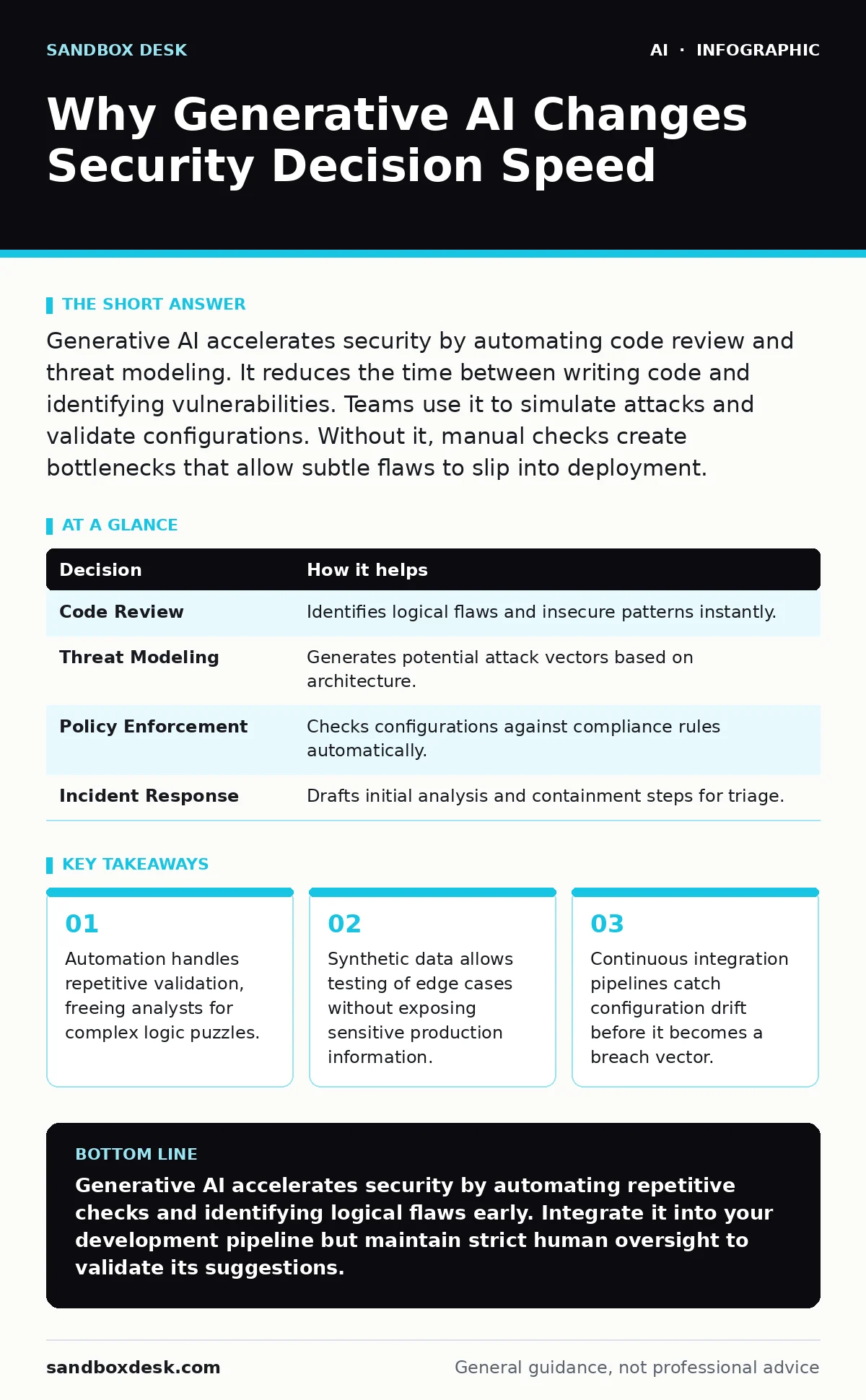
Generative AI accelerates security by automating code review and threat modeling. It reduces the time between writing code and identifying vulnerabilities. Teams use it to simulate attacks and validate configurations. Without it, manual checks create bottlenecks that allow subtle flaws to slip into deployment.
The Shift from Audit to Synthesis
Traditional security relies on periodic audits. You write code, then you wait for a review. This delay creates a gap where vulnerabilities linger. Generative AI changes this dynamic by enabling continuous synthesis. It analyzes code as it is written, not after it is finished.
This shift requires a change in mindset. You move from checking for known signatures to evaluating intent and structure. The model looks for patterns that indicate logical flaws, not just syntax errors. It flags potential injection points or misconfigured permissions in real time.
Decisions Informed by AI
Security teams make dozens of decisions daily. Many are repetitive, such as validating input sanitization or checking dependency versions. Generative AI informs these choices by providing immediate feedback. It suggests corrections based on established best practices.
| Decision | How it helps |
|---|---|
| Code Review | Identifies logical flaws and insecure patterns instantly. |
| Threat Modeling | Generates potential attack vectors based on architecture. |
| Policy Enforcement | Checks configurations against compliance rules automatically. |
| Incident Response | Drafts initial analysis and containment steps for triage. |
What Goes Wrong Without It
Without generative AI, security becomes a bottleneck. Manual reviews are slow and prone to fatigue. Analysts miss subtle issues when they are tired or overwhelmed. This leads to a false sense of security. You believe the code is safe because a human reviewed it, but humans make mistakes.
The cost is not just time. It is the accumulation of technical debt. Small, unaddressed issues compound over time. They create complex vulnerabilities that are harder to fix later. You spend more resources patching old code than building new features.
How Teams Use It
Teams integrate generative AI into their development pipelines. They use it to generate test cases that cover edge cases. These tests might include unusual input formats or unexpected user behaviors. The AI creates scenarios that a human tester might not consider.
You also use it for documentation and compliance. The AI scans code to ensure it meets regulatory requirements. It generates reports that prove compliance. This reduces the administrative burden on security teams. They can focus on strategic risks rather than paperwork.
The Hidden Costs of Adoption
Adopting generative AI is not free. The cost is not just licensing or compute resources. It is the risk of over-reliance. If you trust the AI blindly, you miss its limitations. The model can hallucinate solutions that look correct but are flawed.
You must validate the AI's output. This requires skilled personnel who understand both security and AI behavior. You cannot simply outsource security to a model. You need to maintain human oversight. This adds complexity to your workflow. You must train your team to question the AI, not just accept it.
See also: How Large Language Models Change Security Decision Making
Edge Cases and Failure Modes
Generative AI struggles with context it has not seen. If your application uses a novel architecture, the model may not understand the risks. It relies on patterns from its training data. If your code breaks those patterns, the AI may miss critical vulnerabilities.
Imagine a system that uses a unique cryptographic method. The AI might flag it as non-standard and suggest a common alternative. However, the common alternative might not fit your performance requirements. You must evaluate the suggestion against your specific constraints. Blindly following the AI's advice can introduce new risks.
Integrating with Existing Frameworks
Generative AI works best when integrated with existing security frameworks. It does not replace your policies. It enforces them. You define the rules, and the AI checks for compliance. This ensures consistency across your organization.
Refer to AI risk management for strategies on evaluating model outputs. You need a process for reviewing AI-generated code. This process should include human verification. You also need to monitor for training data leakage. Ensure that sensitive data is not exposed to the model during inference.
The Role of Human Judgment
The AI is a tool, not a decision-maker. It provides recommendations, but you make the final call. Your judgment is required to interpret the context. The AI may flag a benign pattern as risky, or miss a subtle threat. You must be able to distinguish between the two.
This requires a deep understanding of your system. You know the business logic and the constraints. The AI does not. It sees code, not intent. You must bridge that gap. Use the AI to augment your skills, not replace them.
Future Proofing Your Security
The landscape of threats evolves constantly. Generative AI helps you stay ahead by adapting quickly. It can analyze new threats and suggest mitigations. However, you must keep your models updated. Old models may not recognize new attack vectors.
Regularly update your security policies and AI configurations. Ensure that your team is trained on the latest threats. This continuous improvement cycle keeps your security posture strong. You cannot set it and forget it. Security is an ongoing process.
Refer to large language models for technical details on how these systems process information. Understanding the underlying technology helps you use it more effectively. You can better interpret its outputs and identify potential errors.
Key takeaways
- Automation handles repetitive validation, freeing analysts for complex logic puzzles.
- Synthetic data allows testing of edge cases without exposing sensitive production information.
- Continuous integration pipelines catch configuration drift before it becomes a breach vector.
Generative AI accelerates security by automating repetitive checks and identifying logical flaws early. Integrate it into your development pipeline but maintain strict human oversight to validate its suggestions.
Frequently asked questions
Does generative AI replace security analysts?
No, it augments their work by handling repetitive tasks. Analysts focus on complex logic and strategic decisions that require human judgment and context.
How do I prevent sensitive data leakage?
Use on-premise models or secure cloud environments. Implement strict data filtering to ensure no sensitive information is sent to the model for processing.
Can generative AI introduce new vulnerabilities?
Yes, if not validated. The model may suggest code that looks correct but contains subtle flaws. Always review and test AI-generated code thoroughly.
What is the best way to start using AI in security?
Start with non-critical tasks like documentation or test case generation. Gradually move to code review and threat modeling as you build trust and expertise.
How this guide was produced: written by the Sandbox Desk editorial team with AI assistance, checked against the public references listed below, and reviewed when the facts change. See our editorial policy or report an error.